
You’d think English would pick a lane. Add an “s” for plural, call it a day, everyone goes home happy. Nope. Instead, we get woman vs women, the spelling switcheroo that waits quietly in your sentence like a banana peel on a polished floor. One moment you sound brilliant. The next, autocorrect betrays you and your confidence files a resignation letter. If you’ve ever paused mid-typing and whispered, “Wait… which one is this again?” you’re in excellent company. The good news? This puzzle has a pattern. Once you see it, you can’t unsee it, and mistakes start dodging you like bad advice.
Quick Answer to Woman or Women
If you need clarity right now, here it is.
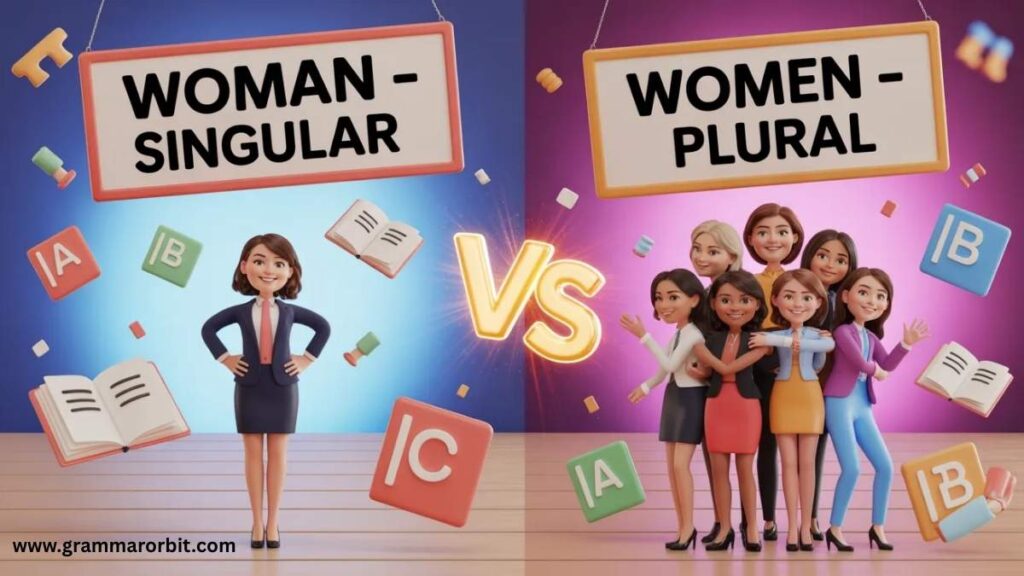
- Woman = one person → singular
- Women = more than one → plural
Example
- The woman is ready.
- The women are ready.
That’s the foundation. Everything else in this guide supports this core idea.
Why Writers Constantly Mix Them Up
If the rule is simple, why do mistakes appear everywhere?
Several reasons collide at once.
First, the spelling barely changes. Your eyes skim right past it. Second, the sound changes more dramatically than the letters suggest. Third, English plurals aren’t always predictable. You expect an “s,” yet English swaps vowels instead.
Add speed, stress, or autocorrect. Boom. Error.
Even skilled professionals hesitate when deciding when to use woman or women.
Take Affect vs Take Effect A Clear and Practical Guide
Woman vs Women Meaning Without the Jargon
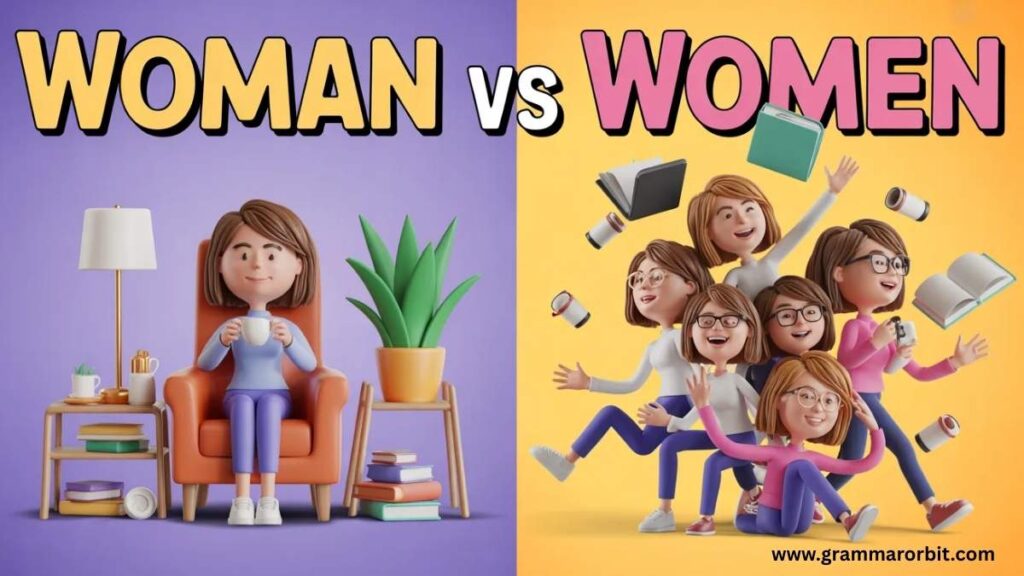
Forget complicated grammar language for a moment. Think in pictures.
| Word | Image in your head |
|---|---|
| woman | one person |
| women | a group |
If the mental movie shows one individual, choose woman. If more than one walks into the frame, choose women.
This visual trick works surprisingly well under pressure.
Understanding Woman as a Singular Noun
Let’s zoom in.
Woman is a woman singular noun. It identifies one adult female human.
Because it’s singular, the surrounding grammar must match. That means singular verbs, singular pronouns, singular determiners.
Examples
- The woman speaks clearly.
- A woman called earlier.
- This woman has experience.
- That woman runs the company.
Every verb lines up with one person.
Anyone asking, “is woman singular or plural?” can relax. It’s always singular.
Understanding Women as a Plural Noun
Now expand the group.
Women is the women plural noun. It refers to two or more adult females.
Plural noun. Plural partners.
Examples
- The women speak clearly.
- Several women called earlier.
- These women have experience.
- Those women run the company.
Notice how the verbs change from speaks to speak, from has to have.
That shift is crucial for noun number agreement.
Woman vs Women Pronunciation Helps More Than You Think
Your ears can save you.
- woman → wuh-muhn
- women → wih-min
Say them out loud. Hear how different they are?
Many editors quietly whisper sentences during proofreading. If it sounds plural, they write women. If it sounds singular, they write woman.
When someone searches “why is women pronounced differently,” the historical explanation goes deep into Old English. For everyday writers, the practical takeaway is easier: pronunciation gives you a clue about number.
Singular and Plural of Woman in Motion
Let’s watch the grammar react.
Subject position
- The woman is here.
- The women are here.
Object position
- I thanked the woman.
- I thanked the women.
Possessive
- The woman’s car.
- The women’s car.
One apostrophe hop can change meaning fast. Pay attention.
Woman vs Women Grammar Rules That Never Fail
Here’s where structure brings comfort.
Determiners
- a / this / that → woman
- many / these / those → women
Pronouns
- woman → she, her
- women → they, them
Verbs
- woman → is, does, has
- women → are, do, have
If you’re unsure about the noun, inspect its neighbors. They rarely lie.
What Is the Difference Between Woman and Women in English
Some readers want the formal definition.
The difference between woman and women in English comes down to grammatical number. Woman signals singular reference. Women signals plural reference. This change affects verbs, pronouns, possessives, and modifiers throughout the sentence.
In other words, the ripple spreads.
Afterward vs Afterword Know the Difference
Woman vs Women in Compound Nouns
This area causes sneaky errors.
Consider:
- woman athlete
- women athletes
Why doesn’t the first become women athlete?
Because English often keeps the modifying noun singular when it describes type rather than quantity. Think about car engine or apple tree. Same pattern.
Compare meanings
- She is a woman athlete → one athlete who is female.
- They are women athletes → multiple athletes.
Context rules the decision.
Common Grammar Mistakes You’ll Notice Instantly Now
Once you understand the pattern, errors jump off the page.
Examples of wrong usage
- A group of woman
- This women is talented
- Many woman attended
Correct versions
- A group of women
- This woman is talented
- Many women attended
Mistakes usually happen because writers focus on the idea, not the grammar frame.
How to Use Woman in a Sentence Correctly
When building a sentence with woman, run through a quick checklist.
- Are you talking about one person?
- Is the verb singular?
- Would you replace it with she?
If yes, you’re on solid ground.
Reliable starters
- The woman who
- A woman with
- That woman is
Plug in your detail and continue.
How to Use Women Correctly Without Hesitation
Switch to the plural checklist.
- More than one person?
- Verb plural?
- Replaceable with they?
Then choose women.
Strong sentence openings
- Women who
- Many women
- These women are
Memory Systems That Stick
Forget memorizing paragraphs. Use quick triggers.
Man to men bridge
man → men
woman → women
Your brain loves parallels.
Number swap
Try inserting one or many. Whichever sounds right gives you the answer.
Verb detector
If the verb ends with s, singular often fits.
Woman vs Women with Examples from Daily Life
Grammar becomes clearer in familiar situations.
Healthcare
- The woman met the doctor.
- The women met the doctor.
Education
- A woman teaches physics.
- Women teach physics.
Business
- The woman leads marketing.
- The women lead marketing.
Every context follows the same architecture.
A Practical Editing Scenario
Imagine writing:
“This award honors every women who contributed.”
Something feels off. Why?
Because every demands singular agreement. Swap in woman and the sentence stabilizes.
“This award honors every woman who contributed.”
Clean. Precise. Professional.
Formal vs Informal English
Good news. The rule does not change with tone.
Academic paper? Same structure.
Text message? Same structure.
Corporate report? Still the same.
Consistency across environments makes learning easier.
Woman vs Women for ESL Learners
If you learned English later in life, irregular plurals may feel unfair. That’s normal.
Group them together:
- tooth → teeth
- foot → feet
- man → men
- woman → women
Practice in chunks rather than isolation. Repetition builds reflex.
Mini Practice Drill
Fill the blanks.
- The __ is our supervisor.
- Several __ applied.
- That __ knows the answer.
- These __ are prepared.
Answers
woman, women, woman, women.
Quick training. Strong payoff.
Quick Reference Table for Fast Proofreading
| Question to Ask | If Yes | Use |
|---|---|---|
| Only one person? | Yes | woman |
| More than one? | Yes | women |
| Verb is “is” or “has”? | Yes | woman |
| Verb is “are” or “have”? | Yes | women |
| Can you say “they”? | Yes | women |
Keep this nearby when editing.
Why Mastering This Pair Improves Your Entire Grammar System
Learning the correct usage of woman and women strengthens your instincts about:
- singular vs plural nouns
- pronoun consistency
- verb agreement
- clarity in professional writing
One rule teaches many.
Woman vs Women Examples for Templates and Speed
Use these frameworks.
Singular
- The woman responsible for
- A woman who wants to
- This woman has
Plural
- Women interested in
- Many women believe
- These women have
Writers love templates because they reduce friction.
How to Remember Woman vs Women When the Clock Is Ticking
Deadlines shrink attention spans. Here’s a rapid method.
Look at the verb.
Listen to the sound.
Swap one or many.
Decision made.
Reference Cambridge Dictionary Definitions
Here’s a trusted source for clear word meanings:
FAQs
When to use woman or women?
Use woman when you mean one adult female. Use women when you mean more than one. The surrounding grammar will usually point you in the right direction.
For example:
- The woman is speaking.
- The women are speaking.
If the verb is plural, the noun should be plural too. When you’re unsure when to use woman or women, try swapping in one or many. The sentence will instantly sound right or wrong.
Why is “woman” not spelled “wombman”?
It looks like it should be, right? Historically, the word comes from Old English wifmann, which meant female person. Over centuries, pronunciation shifted, spellings simplified, and the middle sounds changed. English kept the modern form woman, even though the earlier root had nothing to do with the word womb.
Languages evolve the way cities do. Streets get renamed, buildings change, yet traces of history remain if you look closely.
When to use ladies vs women?
Great question, because grammar meets tone here.
Women is neutral and standard. It works in formal writing, academic contexts, journalism, and professional communication.
Ladies can sound polite, social, or old-fashioned depending on context. It may feel warm in hospitality or event settings, yet it can sound overly familiar or even patronizing in serious discussions.
Quick guide
- Research paper → women
- Workplace memo → women
- Friendly greeting → ladies might fit
- Mixed or unknown preference → women is safer
When in doubt, choose clarity and neutrality.
Why is woman pronounced wimmin?
The pronunciation difference between woman and women developed gradually in spoken English. Vowel sounds shifted over time, yet the spelling remained similar. That’s why the plural sounds like wih-min even though it looks close to the singular.
While the history runs deep, the practical benefit today is simple: the sound helps signal whether you’re talking about one person or a group.
If it sounds plural, it probably is.
Conclusion
One letter. That’s all the drama ever was. Woman vs women comes down to singular or plural, yet it has probably hijacked more sentences than any other pair in English. Now you’ve got the tools. Listen for the sound. Check the verb. Swap in one or many. Done.
What once caused a full mental traffic jam should now feel like a green light. Your writing moves faster,edits get sharper. Your confidence stops wobbling.
Next time the choice appears, you won’t guess or hope for mercy from autocorrect.
You’ll nail it. Every single time.

JHON AJS is an experienced blogger and the creative voice behind the website grammarorbit.com, namely Grammar Orbit. With a keen eye for language and a passion for wordplay, he creates engaging grammar insights, word meanings, and clever content that make learning English enjoyable and interesting for readers.