
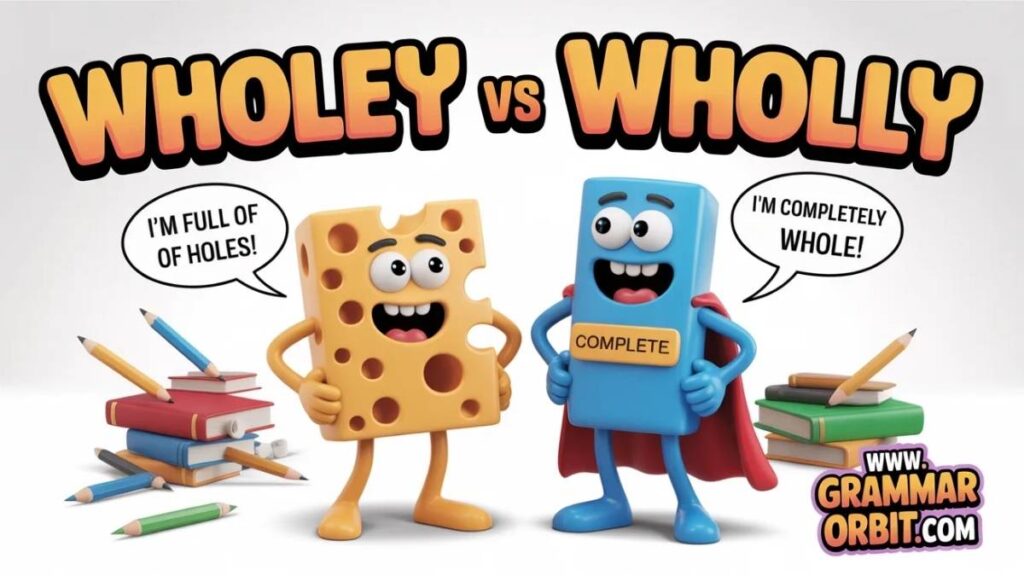
Have you ever paused mid-sentence while typing and wondered, “Wait… is it wholey vs wholly?” You’re not alone. English has a funny way of turning simple words into tiny spelling traps. One minute you’re confidently writing an email, and the next you’re staring at the screen like it just asked you to solve a math equation. The confusion between Wholey vs Wholly happens to students, professionals, and even seasoned writers. After all, both spellings sound identical. So which one is correct, and which one belongs in the grammar hall of shame? Don’t worry. In this guide, you’ll uncover the real wholly meaning, clear examples, and easy tricks to remember the spelling forever.
Understanding the Word Wholly
Wholly Definition and Meaning
The wholly definition is straightforward. The word means completely, entirely, fully, or totally. It expresses the idea that something happens without exception or without partial involvement.
In grammar terms, wholly functions as an adverb. Adverbs modify verbs, adjectives, or other adverbs by describing the degree or extent of an action.
For example:
- I wholly agree with your suggestion.
- The decision was wholly unexpected.
- She is wholly responsible for the outcome.
In each sentence, the word intensifies the statement and shows that the situation is complete or absolute.
Wholly Grammar Meaning
The wholly grammar meaning becomes clearer when you compare it with the base word whole.
| Word | Part of Speech | Example |
|---|---|---|
| whole | adjective | The whole project failed |
| wholly | adverb | The project was wholly unnecessary |
The adjective describes a noun. The adverb explains the degree of something.
Understanding this difference helps avoid many grammar mistakes with wholly.
Where the Word Wholly Comes From

Language history explains why the spelling looks unusual.
The word developed from the adjective whole, which comes from Old English roots meaning complete or healthy. When English speakers needed an adverb form, they added the common adverb ending -ly.
So the transformation looks like this:
whole → wholly
However, English spelling rules remove the silent e before adding -ly. The letter l also doubles to keep the pronunciation smooth.
This process produces the spelling wholly, which has remained standard in modern English.
Because pronunciation sounds similar to the word hole, many writers mistakenly create the spelling wholey.
What Is Wholey?
Wholey Meaning
Many people search for the wholey meaning, assuming it is a real word. In standard English dictionaries, the word does not appear.
The spelling wholey is considered a misspelling of wholly. It does not carry its own meaning or grammatical function.
That leads to one of the most common questions about this topic.
Is Wholey a Word?
No. Wholey is not a recognized English word.
You may see it occasionally in informal writing, social media posts, or unedited text. In those situations it usually appears because of typing errors or confusion about spelling patterns.
Professional editors treat it as one of the many spelling errors in English writing.
Unenroll vs Disenroll Which One is Correct
Wholey vs Wholly The Real Difference
The difference between wholey and wholly is actually very simple.
| Feature | Wholey | Wholly |
|---|---|---|
| Correct spelling | No | Yes |
| Dictionary entry | No | Yes |
| Part of speech | None | Adverb |
| Meaning | None | Completely or entirely |
| Used in professional writing | Never | Frequently |
If you want your writing to look accurate and polished, always choose wholly.
Why People Spell Wholly as Wholey
Even though the rule seems simple, the mistake still appears frequently. Several factors contribute to this confusion.
Pronunciation
The wholly pronunciation sounds like “hole-ee.” Because of that sound, writers often assume the spelling should match the word hole.
This mismatch between sound and spelling creates a classic case of English spelling confusion.
Familiar spelling patterns
Many English words add the letter y to create a new word.
Examples include:
- cloud → cloudy
- dust → dusty
- wind → windy
These patterns make people believe the same rule applies to whole, producing wholey.
Autocorrect and typing habits
Sometimes spelling mistakes slip through because writers type quickly or rely on spellcheck tools that fail to catch the error immediately.
These small habits contribute to the common spelling mistakes in English seen across blogs, emails, and online discussions.
Stellar vs Steller The Real Difference Most People Miss
Using Wholly in Real Sentences

The easiest way to understand a word is to see it used naturally.
Here are several wholly examples in sentences.
Everyday conversation
- I wholly support your decision.
- She was wholly surprised by the news.
- The explanation was wholly convincing.
Professional communication
- The company is a wholly owned subsidiary of the parent corporation.
- The manager is wholly responsible for the department’s performance.
Academic writing
- The conclusion is wholly supported by the research data.
- The theory presents a wholly different interpretation of the results.
These examples show how the word strengthens statements by expressing complete certainty.
When to Use Wholly
You should use wholly when you want to emphasize that something is complete or absolute.
Writers commonly use it when describing:
- full agreement
- total responsibility
- complete ownership
- strong commitment
Typical phrases include:
- wholly committed
- wholly responsible
- wholly owned
- wholly incorrect
- wholly unnecessary
These expressions appear frequently in business writing and legal documents because they clearly describe the extent of responsibility or involvement.
Words Similar to Wholly
English offers several words similar to wholly that carry the same idea of completeness.
Common wholly synonyms include:
- completely
- entirely
- fully
- totally
- utterly
- absolutely
Each of these words communicates a strong sense of totality.
For example:
| Sentence with Wholly | Sentence with Synonym |
|---|---|
| I wholly agree with the plan. | I completely agree with the plan. |
| She is wholly committed to the project. | She is fully committed to the project. |
Choosing between these words often depends on tone and context.
Wholly vs Holy vs Holey
Another spelling challenge appears when writers confuse wholly vs holy vs holey.
Although they sound similar, their meanings differ greatly.
| Word | Meaning | Example |
|---|---|---|
| wholly | completely | I wholly support the decision |
| holy | sacred or religious | The temple is a holy place |
| holey | full of holes | The socks are holey |
One small letter changes the meaning entirely. This explains why careful spelling matters when writing clearly.
A Real Writing Scenario
Imagine a company sending an official announcement.
Incorrect version:
The company is wholey responsible for product safety.
Correct version:
The company is wholly responsible for product safety.
The second version communicates professionalism and accuracy. The first version creates doubt about the quality of the writing.
Small corrections like this strengthen credibility and improve correct English spelling.
Eying or Eyeing the Correct Spelling and Usage
Tips to Remember How to Spell Wholly
Learning a few simple memory tricks can prevent future mistakes.
Remember the base word
The word comes from whole. When you convert it into an adverb, add -ly and remove the silent e.
whole + ly → wholly
Notice the double L
Many words with double L keep both letters when forming adverbs.
Examples include:
- full → fully
- dull → dully
- whole → wholly
This pattern makes the spelling easier to remember.
Replace it with completely
If the word completely fits in the sentence, wholly usually works as well.
Example:
I completely agree with the statement.
I wholly agree with the statement.
These simple strategies answer the common question about how to remember spelling of wholly.
Why English Spelling Creates Confusion
English spelling evolved from multiple languages over centuries. Influences include:
- Old English
- Latin
- French
- Greek
Because of these mixed origins, spelling patterns do not always follow simple phonetic rules. Words may look strange even though they are historically correct.
This complexity explains why spelling confusion happens so often.
The mix-up between wholey vs wholly is just one example of the broader challenges within English vocabulary.
Key Takeaways
A quick recap makes the rule easy to remember.
| Point | Explanation |
|---|---|
| Correct spelling | wholly |
| Incorrect spelling | wholey |
| Meaning | completely or entirely |
| Part of speech | adverb |
| Common usage | wholly responsible, wholly committed |
Whenever you want to express something as complete or absolute, wholly is the correct choice.
Naive vs Nieve Avoid Common Mistakes
Reference Cambridge Dictionary Definitions
Here’s a trusted source for clear word meanings:
FAQs
What does wholey mean?
The short answer: wholey does not have a real meaning in standard English.
The spelling usually appears because people confuse it with wholly, which means completely, entirely, or fully. When someone writes “wholey,” they almost always intend to write wholly.
For example:
Incorrect:
- I wholey agree with your decision.
Correct:
- I wholly agree with your decision.
So if you are searching for the wholey meaning, remember that it is simply a misspelling of wholly rather than a separate word with its own definition.
Is it Holey or wholey?
These two spellings often cause confusion, but they mean very different things.
| Word | Meaning | Example |
|---|---|---|
| holey | full of holes | The old socks are holey |
| wholey | incorrect spelling | Not recognized in dictionaries |
The correct word for “completely” is wholly, not wholey.
So if you want to describe something that is complete or total, always choose wholly.
Example:
- She was wholly committed to the project.
How do you spell wholely?
The spelling wholely sometimes appears in writing, but it is not the standard form either. The correct spelling is wholly.
English spelling drops the silent e from the base word whole before adding -ly.
So the correct transformation looks like this:
whole → wholly
Examples:
- The explanation was wholly correct.
- The company is wholly owned by its parent organization.
When to use wholly?
Use wholly when you want to emphasize that something is complete, total, or absolute. The word strengthens statements and clarifies that something happens without exceptions.
Common situations include:
Expressing complete agreement
- I wholly agree with your idea.
Showing full responsibility
- The manager is wholly responsible for the results.
Describing total ownership
- The brand is a wholly owned subsidiary.
Emphasizing strong commitment
- She is wholly committed to improving the system.
Whenever the words completely, entirely, or fully fit the sentence, wholly usually works as well.
What is an antonym for wholly?
Since wholly means completely or entirely, its antonyms describe something partial or incomplete.
Common antonyms include:
- partly
- partially
- incompletely
- somewhat
- moderately
Examples:
- The task was wholly finished.
- The task was partially finished.
Using these opposite words helps clarify the degree of completion in a sentence.
What is wholly other?
The phrase wholly other is a formal expression used to describe something that is completely different in nature or character.
You may see it in philosophical, religious, or academic writing.
Example:
- The new approach represents a wholly other way of solving the problem.
In theology and philosophy, the phrase sometimes refers to something beyond ordinary human experience or understanding. In everyday language, however, it simply means entirely different.
Example:
- Her second proposal was wholly other than the first plan.
Conclusion
English spelling loves a good prank. The wholey vs wholly confusion is one of those little traps that sneaks into writing when you least expect it. The good news is that the rule is refreshingly simple once you see it clearly. Wholly is the correct spelling, and it means completely, entirely, or fully. The spelling wholey is just one of those classic slip-ups that appear because our ears hear the word differently than our eyes spell it.
Think of it this way: if something is the whole thing, then it is wholly true. The extra L is your clue. Remember that small detail, and your grammar will stay happily on track.
So the next time you pause and wonder Wholey vs Wholly, relax. Choose wholly, finish your sentence with confidence, and enjoy the quiet victory of getting English spelling exactly right.

JHON AJS is an experienced blogger and the creative voice behind the website grammarorbit.com, namely Grammar Orbit. With a keen eye for language and a passion for wordplay, he creates engaging grammar insights, word meanings, and clever content that make learning English enjoyable and interesting for readers.