
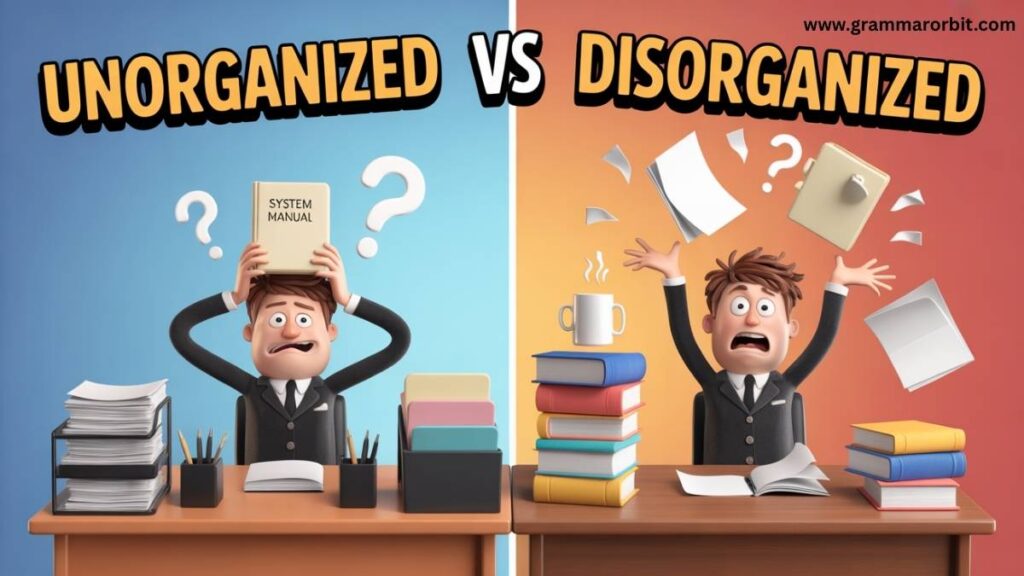
If you’ve ever stared at your desk and wondered whether it’s unorganized or disorganized, congratulations you’ve officially entered the grammar jungle where papers go to die and pens mysteriously vanish. The debate of Unorganized vs Disorganized isn’t just about messy drawers or chaotic workflows, it’s a full blown identity crisis for anyone who’s ever promised to “clean it tomorrow.” One word hints at potential, the other screams chaos waving a red flag. Understanding the Difference between unorganized and disorganized can save your sanity, sharpen your writing, and maybe even rescue your workspace from becoming a black hole of forgotten notes.
Breaking Down the Prefixes Un vs Dis
Prefixes change the meaning of words, and understanding them solves half the confusion before it even starts. English may look chaotic sometimes, but prefix logic usually follows consistent rules.
Meaning of the Prefix Un
The prefix un often signals the following ideas:
- not
- opposite of
- lacking something
- without
When you add un to a word, the result usually carries a neutral tone. Think of words like unlocked, unfinished, or unclear. None of these sound negative. They simply describe something that is missing a feature.
The same idea applies to unorganized. It doesn’t attack or judge anything. It just says there is no structure yet.
Meaning of the Prefix Dis
The prefix dis has a sharper edge. It often means:
- apart
- away
- reversal
- not functioning correctly
- lacking proper order
Words like disorder, disconnect, and disapprove show that dis tends to be more negative. When something is disorganized, the prefix signals that order once existed but has broken down.
This is where the heart of the difference between unorganized and disorganized begins.
Etymology and Historical Development
Understanding the historical roots behind both words makes the modern usage much easier to navigate.
Origins of Un
Un comes from Old English, where it was commonly used to show simple negation. The purpose was straightforward. If something lacked a feature, the prefix told the listener exactly what was missing. This prefix became a natural part of English vocabulary and remains extremely productive today.
Origins of Dis
Dis traces back to Latin. It carried meanings like apart, away, or in the opposite direction. As English developed through Middle English and absorbed Latin and French influences, dis evolved into a marker of error or malfunction. It often appears in contexts where things go wrong or where proper function breaks down.
Why This Historical Context Matters
These different histories show why un feels neutral and dis feels negative. These tones still affect how English speakers perceive the words today. Understanding that difference helps you choose the right term with confidence.
Unorganized Meaning
Now we can look at unorganized in-depth and understand what it truly means.
Unorganized Definition
Unorganized means something is not arranged, not structured, or not formed into a system yet. It shows the absence of order, not the destruction of order. There is no chaos here, just a blank slate waiting for structure.
Key Characteristics of Unorganized
An unorganized thing usually has:
- no established pattern
- no grouping or system
- no prior structure
- neutral tone
- potential for improvement
- nothing chaotic or messy by default
This is why unorganized meaning often shows up in early stages of a process.
Common Contexts Where Unorganized Fits Perfectly
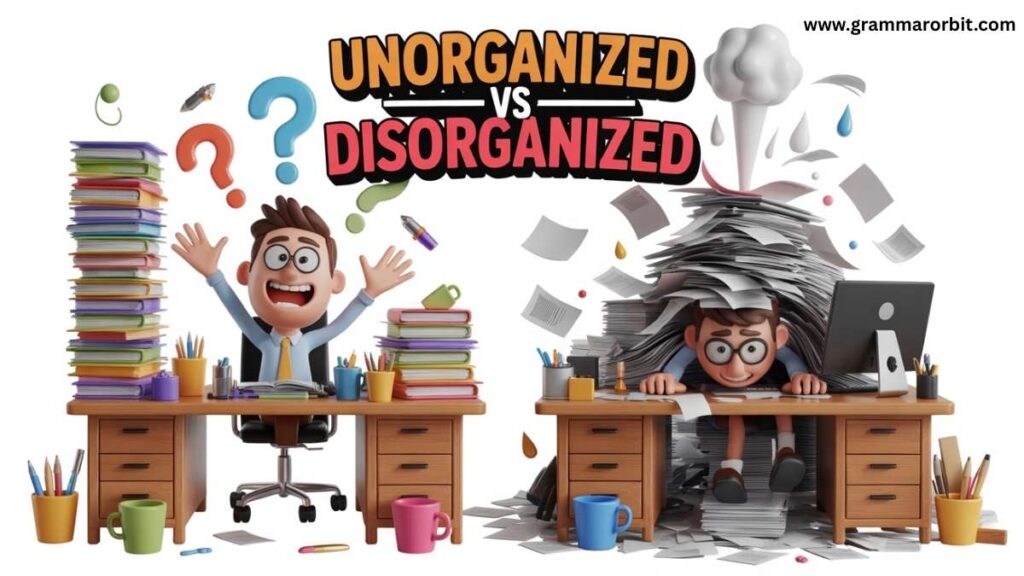
You may use unorganized in situations such as:
- a new folder with random files because no system exists yet
- a new team that hasn’t assigned roles
- unorganized notes at the beginning of a semester
- tasks that haven’t been scheduled or categorized
- a business that hasn’t created workflows yet
Nothing is wrong or broken. Structure just hasn’t been created.
Examples of Unorganized in Real Life
Here is a quick table that shows how unorganized vs messy differs:
| Scenario | Unorganized or Something Else | Explanation |
|---|---|---|
| A new binder with papers not sorted into sections | Unorganized | There is no system yet |
| A pile of tools in a garage that were never arranged | Unorganized | No method was set from the start |
| A cluttered desk with items everywhere | Usually disorganized | That signals breakdown, not absence |
| Notes written quickly on day one of class | Unorganized | Structure has not formed yet |
Unorganized often appears when something is new or untouched.
Disorganized Meaning
Now let’s switch gears and explore disorganized with full clarity.
Disorganized Definition
Disorganized describes something that once had order but has now fallen into confusion, clutter, or chaos. It suggests that structure existed but failed or collapsed. This word carries a negative tone because it implies something needs fixing.
Key Characteristics of Disorganized
A disorganized system often includes:
- scattered materials
- inconsistent patterns
- breakdown in workflow
- lost items
- messy or chaotic environments
- disordered processes
- behaviors that reduce productivity
This is why disorganized behavior is often discussed in workplaces or academic settings.
Common Contexts Where Disorganized Applies
Disorganized fits best in these situations:
- a messy office where work cannot be found easily
- a student who loses assignments repeatedly
- a team missing deadlines due to mixed priorities
- a disorganized workspace full of random stacks
- chaotic meetings with no clear direction
Disorganized suggests that something needs correction or restoration.
Examples of Disorganized Situations
Here is a quick comparison:
| Scenario | Does It Count as Disorganized? | Why? |
|---|---|---|
| A desk covered in random paperwork | Yes | Structure once existed but is now broken |
| A cluttered email inbox with unread messages | Yes | That indicates failure of maintenance |
| A perfectly clean desk with no system | No | That is unorganized, not disorganized |
| A team missing tasks repeatedly | Yes | Indicates disorder and lack of coordination |
Disorganized always hints at chaos or failure, not just absence.
STSU Meaning in Text 💬 | Full Guide to Meaning
Unorganized vs Disorganized Grammar Differences

Here is the simplest explanation you can remember forever:
Unorganized means something has no structure.
Disorganized means something had structure but lost it.
This affects tone, interpretation, and communication effectiveness.
Key Differences Summarized in a Table
| Feature | Unorganized | Disorganized |
|---|---|---|
| Tone | Neutral | Negative |
| State | Structure missing | Structure broken |
| Behavior or System | Structure | Behavior |
| Fault implied | No | Yes |
| Typical Context | New systems and early stages | Chaotic workflow or messy environment |
| Example | Unorganized tasks | Disorganized behavior |
These simple distinctions help you choose the right term every time.
Modern Usage and Common Mistakes
Even though the meanings are different, people often mix the two terms up. This usually happens because they look similar, sound similar, and both relate to order.
Most Common Mistakes People Make
Here are typical errors:
- Calling a new system disorganized even when no structure existed
- Using unorganized instead of disorganized when highlighting messiness
- Confusing structure with behavior
- Using the words as synonyms in professional communication
Why the Distinction Matters Today
Using the right word improves:
- clarity in writing
- professionalism in speech
- accuracy in workplace reports
- academic feedback
- communication effectiveness
Precision builds credibility and trust.
Practical Guidelines for Choosing the Right Word
Here are simple questions that help you decide.
Was the item or workflow ever organized before?
- If yes, use disorganized.
- If no, use unorganized.
Are you describing behavior or structure?
- Structure fits unorganized.
- Behavior fits disorganized.
Do you want a neutral or negative tone?
- Neutral tone: unorganized.
- Negative tone: disorganized.
Does fixing the issue require creating structure or restoring it?
- Creating structure: unorganized.
- Restoring structure: disorganized.
These quick checks make the decision easy.
Real-Life Examples in Context
Real-world situations often illustrate the difference better than definitions alone. Here are three settings where the difference between unorganized and disorganized becomes obvious.
TTY Meaning in Text 📱 | Origins Uses & How to Reply
Classroom Examples

Unorganized Situations
- A student’s notes are scattered because classes just started
- A teacher planning lessons but not arranging them yet
- A group project with no assigned roles on day one
Disorganized Situations
- Students losing assignments regularly
- Chaotic group work with no direction
- Projects missing major requirements
Classroom Case Study
A freshman enters school with a new binder and notebooks. Everything is unorganized simply because no structure has been established. By mid-semester, papers are stuffed everywhere and deadlines slip by. Now the student has moved from unorganized to disorganized.
Workplace Examples
Unorganized Situations
- New employees without clear workflows
- A startup building its first operating procedures
- A department beginning a fresh project with no framework yet
Disorganized Situations
- A desk full of random stacks and sticky notes
- Missed deadlines due to chaotic task management
- Meetings without direction causing confusion
Workplace Quote
“Unorganized teams are waiting for structure. Disorganized teams are losing it.”
MIA Meaning in Text 📲 What It Really Says About You
Student Life Examples
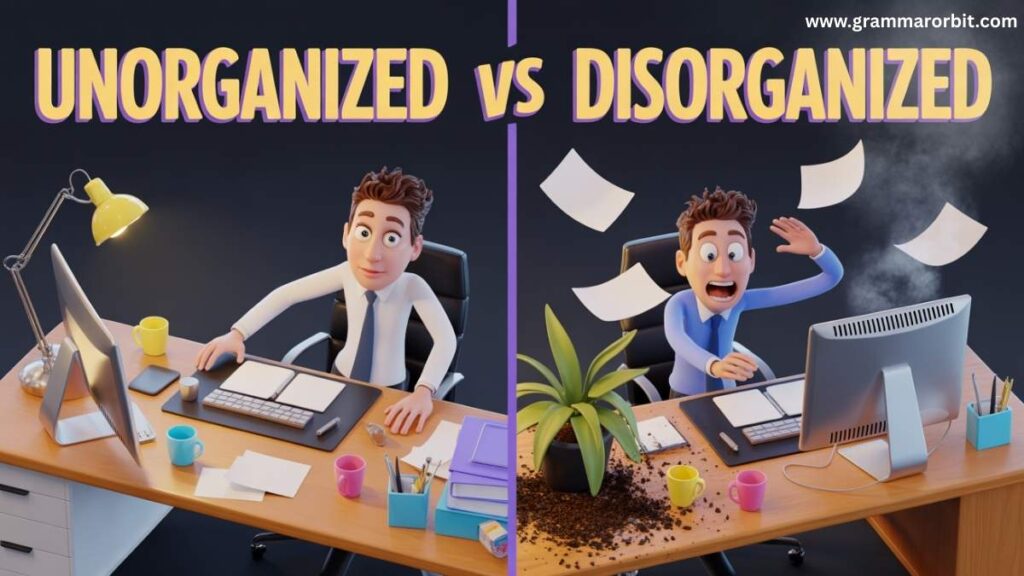
Unorganized Situations
- Notes waiting to be categorized
- Tasks that need scheduling
- A study system that has not yet been designed
Disorganized Situations
- A chaotic workflow with forgotten tasks
- Books scattered across the floor
- Missing materials and half-finished assignments
Student Case Study
Jake enters exam week with unorganized materials. As the pressure grows, papers disappear, priorities collide, and everything becomes disorganized. The stress amplifies the chaos, turning unorganized beginnings into full disarray.
Reference: Cambridge Dictionary Definitions
Here’s a trusted source for clear word meanings:
FAQs
Is it unorganized or disorganized according to the Oxford Dictionary?
The Oxford Dictionary lists both unorganized and disorganized as correct words, but they have distinct meanings. Unorganized refers to something that has not yet been arranged or structured. Disorganized describes something that was once organized but has fallen into disorder or chaos. Using the right term depends on whether you’re describing absence of order or a breakdown of order.
What is a disorganized personality?
A disorganized personality refers to someone whose behavior, routines, or thought processes lack consistent structure. Such a person may struggle with planning, completing tasks on time, or maintaining organized spaces. This is different from being occasionally unorganized—it usually points to a habitual pattern of chaos affecting productivity and decision-making.
What is the difference between organized and unorganized?
- Organized: Things are arranged methodically, follow a clear structure, and function efficiently.
- Unorganized: Things are not yet arranged or structured, often because planning hasn’t occurred.
In short, organized implies order, unorganized implies order hasn’t been created yet.
What is the meaning of an unorganized person?
An unorganized person is someone who has not developed a structured system for tasks, schedules, or belongings—but it’s neutral. Unlike disorganized people, unorganized people haven’t necessarily lost order; they simply haven’t established it yet. Think of someone who has a fresh notebook but hasn’t sorted their notes—potential for order exists.
Conclusion
When it comes to Unorganized vs Disorganized, the difference might seem like splitting hairs, but trust me — it’s the hair-splitting that saves your sanity. One shows potential, the other screams chaos. Mastering Unorganized vs Disorganized helps you avoid calling a brand-new binder “disorganized” and prevents calling a messy office “unorganized.” Whether it’s student notes, workplace tasks, or your kitchen drawers, knowing the Unorganized vs Disorganized usage ensures clarity and keeps everyone from rolling their eyes at your word choices. So next time you debate Unorganized vs Disorganized, remember: one is neutral, the other is a red-flag warning, and now you’ll never mix them up again.

JHON AJS is an experienced blogger and the creative voice behind the website grammarorbit.com, namely Grammar Orbit. With a keen eye for language and a passion for wordplay, he creates engaging grammar insights, word meanings, and clever content that make learning English enjoyable and interesting for readers.