
Ever signed up for a class, membership, or online course and later wondered whether you should unenroll vs disenroll? You’re not alone. The tiny debate of unenroll vs disenroll has confused students, professionals, and even grammar lovers for years. Both words sound like they came from the same language lab experiment, yet they show up in different places school portals, insurance forms, and program policies. One minute you’re trying to drop a class, the next minute you’re questioning your entire vocabulary. Don’t worry. The difference isn’t as mysterious as it seems. Once you understand how each word works in real life, choosing between them becomes surprisingly simple and even a little amusing.
What Does Unenroll Mean
The word unenroll describes the act of removing yourself from something you previously signed up for. It usually involves a voluntary decision. A person enrolls in a course, program, or service, and later chooses to cancel that enrollment.
In simple terms, unenroll means to stop being enrolled in something by choice.
You will often see this word in schools, universities, and online learning platforms. When students register for classes, they are added to an enrollment system. If they later decide the class is not right for them, they may unenroll before the deadline.
Common situations where the word appears include:
- Leaving a course after realizing it does not match your schedule
- Dropping a class during the first weeks of a semester
- Canceling participation in an online training program
- Removing yourself from a membership program
For example, imagine a student who registers for three classes but quickly realizes the workload is overwhelming. The student logs into the academic system and removes one course from the schedule. In that situation, the student unenrolls from the course.
Here are several natural examples:
- The student decided to unenroll from the course after switching majors.
- She unenrolled from the online program when she started a new job.
- If you no longer want to participate, you can unenroll from the class through the student portal.
- Many schools allow students to unenroll during the first week without penalties.
The important detail is that the person enrolled usually starts the process.
What Does Disenroll Mean
The word disenroll also means removing someone from an enrollment list. However, it often appears in more formal or administrative contexts. In many cases, the action is performed by an institution or authority rather than the individual participant.
In simple language, disenroll means to officially remove someone from a program, system, or membership.
This word frequently appears in government programs, insurance plans, and official administrative systems. Organizations use it when they process enrollment changes or terminate participation in a program.
Consider a healthcare example. A person might be enrolled in an insurance plan. If the individual switches providers or no longer qualifies for coverage, the organization may process a disenrollment. That means the person is officially removed from the insurance program.
Common contexts where the word appears include:
- Health insurance plans
- Government assistance programs
- Institutional academic decisions
- Membership databases
Examples of how the word appears in everyday language include:
- The agency decided to disenroll members who no longer met eligibility requirements.
- The insurance company will disenroll participants at the end of the coverage period.
- The school administration may disenroll students who violate academic policies.
- Participants must submit a request if they want to disenroll from the program.
In many of these situations, the removal is handled by an organization rather than the individual.
Figoro or Masingo The Complete Guide
The Key Difference Between Unenroll and Disenroll

Although both words describe the end of enrollment, the main difference usually involves who initiates the action and how formal the process is.
The easiest way to understand the difference is to compare them directly.
| Feature | Unenroll | Disenroll |
|---|---|---|
| Who starts the action | Usually the participant | Often an institution |
| Tone | Informal and everyday | More formal and administrative |
| Common setting | Education and online platforms | Insurance and government programs |
| Example | A student leaves a course | A system removes a member |
A helpful way to remember this distinction is to imagine two scenarios.
In the first scenario, a student signs up for a course but later decides it is not useful. The student logs in and removes the course from the schedule. That student unenrolls.
In the second scenario, a program administrator reviews enrollment records and discovers that a participant no longer meets the requirements. The administrator removes the person from the program. That participant is disenrolled.
Even though both actions remove someone from a list, the person responsible for the action is different.
How These Words Appear in Education
Education systems provide some of the clearest examples of how these words work.
When students register for classes, their names are added to the school’s enrollment system. If a student changes plans, the school often allows them to drop the course before a certain deadline.
That process is usually described with the word unenroll.
Students might unenroll from a class for several reasons:
- They selected the wrong course
- The schedule conflicts with another class
- The subject is more difficult than expected
- They decide to change their major
For example, a student might enroll in an advanced mathematics class but realize the course requires knowledge they do not yet have. Instead of struggling through the semester, the student chooses to unenroll and take a different course.
However, there are situations where the school itself removes a student from a program. In those cases, the institution may use the word disenroll.
Examples include:
- Academic misconduct
- Failure to meet attendance requirements
- Violation of school policies
- Expulsion from a program
In those cases, the removal is not voluntary.
How These Words Appear in Insurance and Government Programs
Outside of education, the word disenroll becomes more common.
Healthcare programs, insurance providers, and government agencies often use formal administrative language. These organizations manage large systems where millions of people enroll in benefits or services.
When someone leaves such a system, the official process is often described as disenrollment.
For example, insurance plans may disenroll members when:
- A participant switches to a different plan
- Eligibility requirements change
- The person moves to another region
- Coverage payments stop
In those situations, the organization processes the change through its administrative system. The participant may request the change, but the system records the action as a formal disenrollment.
Government programs also use the term frequently because it sounds more official and procedural.
Offered vs Offerred Understanding the Correct Usage
Examples of Unenroll vs Disenroll in Everyday Sentences
Using unenroll and disenroll in real-life sentences makes the difference clear. Below are practical examples showing when each word is appropriate.
Unenroll in Education
- I decided to unenroll from a class because it conflicted with my work schedule.
- She unenrolled from the online course after realizing it was too advanced.
- Students can unenroll from a course during the first week without penalty.
Disenroll in Administrative Contexts
- The school had to disenroll a student who failed to submit required documents.
- The insurance company may disenroll members if eligibility requirements are not met.
- Government programs can disenroll participants for not following rules.
Quick Reference Table
| Situation | Correct Word | Example Sentence |
|---|---|---|
| Student leaves a class voluntarily | Unenroll | She unenrolled from the math course due to schedule conflicts. |
| Institution removes a student | Disenroll | The university disenrolled the student for missing paperwork. |
| Insurance coverage ends by authority | Disenroll | The provider disenrolled inactive members from the health plan. |
| Online course voluntarily dropped | Unenroll | He unenrolled from the online training after starting a new job. |
This table helps you instantly see which word fits depending on who initiates the action and the context.
Common Mistakes People Make
Even though unenroll and disenroll seem straightforward, many people misuse them in writing and conversation. Understanding these mistakes can help you avoid awkward phrasing or miscommunication.
Using Unenroll and Disenroll Interchangeably
A common error is treating unenroll and disenroll as exact synonyms in every situation. While both involve leaving a course, program, or membership, the key difference lies in who initiates the action. Use unenroll when someone voluntarily leaves a class or program. Use disenroll when an institution or authority removes someone. Using the wrong term can make your writing sound confusing or overly formal.
Confusing Voluntary and Administrative Actions
Another frequent mistake is mixing up voluntary withdrawal with institutional removal. For example, saying a student was disenrolled from a class when they chose to leave can sound harsh or incorrect. Always consider whether the action is initiated by the person or by an authority.
Ignoring Context and System Terminology
Different schools, programs, and platforms standardize the terms they use. Some systems use unenroll for everything, while others reserve disenroll for administrative actions. Ignoring the official terminology of a system may lead to miscommunication. Always follow the enrollment management terms used by the institution or platform.
Overlooking Deadlines and Policies
People often unenroll or disenroll without checking deadlines or policies. Some schools allow students to unenroll from a course within the first week without penalties. Insurance plans may require formal disenrollment requests before the coverage renewal date. Failing to follow these procedures can cause unnecessary complications.
Spelling and Pronunciation Errors
Finally, some mistakes are simply about spelling or pronunciation. Unenroll and disenroll are easy to misspell, and mispronouncing them can lead to misunderstandings in verbal communication. Pronounce unenroll as uhn-en-rohl and disenroll as dis-en-rohl to sound confident and correct.
Why Context Matters So Much
English often relies on context rather than strict rules. The difference between these two words is a good example of that pattern.
In some systems, the two words function almost like synonyms. Software platforms sometimes use whichever word their designers prefer. A learning platform may use unenroll for every situation, even when administrators remove students.
Other systems adopt formal terminology. Government programs and insurance providers often rely on the word disenroll because it sounds more procedural and official.
Understanding the environment helps determine which word feels natural.
Shakey or Shaky the Complete Guide
Quick Way to Remember the Difference
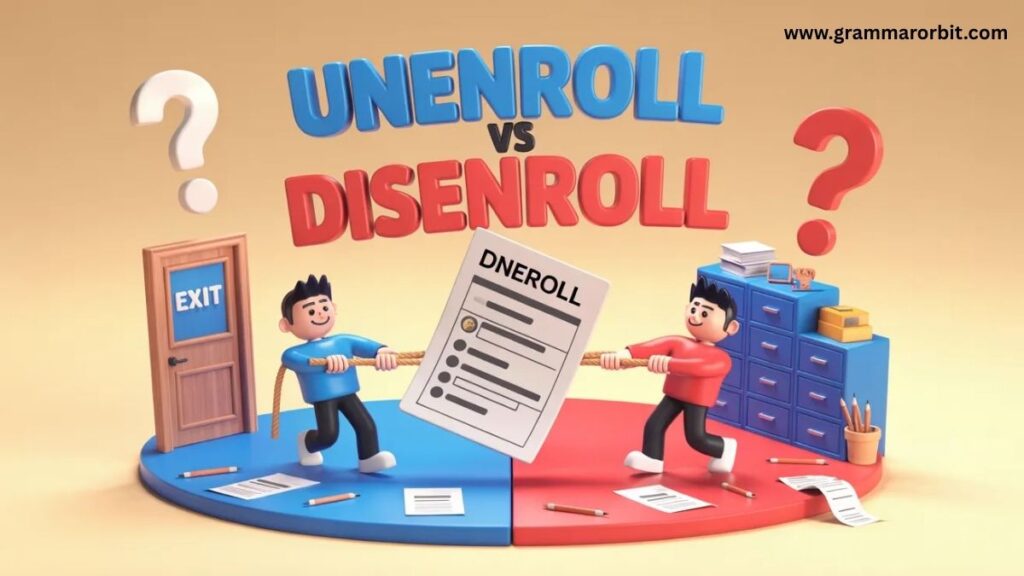
Understanding the difference between unenroll and disenroll becomes much easier with a simple mental trick. Both words involve removing someone from a course, program, or membership, but the key distinction is about who initiates the action and the level of formality.
Focus on Who Initiates the Action
The easiest way to remember is to ask yourself: Who is doing the removing?
- Unenroll: The action is usually started by you, the participant.
- Example: You decide to unenroll from a class because your schedule changed.
- Disenroll: The action is usually started by an authority or institution.
- Example: The school may disenroll a student for failing to meet requirements.
Think About Formality
Another helpful clue is tone:
- Unenroll has a casual, everyday feel, used in student portals or online platforms.
- Disenroll has a formal, official tone, commonly found in insurance, government programs, or institutional documents.
Use a Memory Trick
Here’s a simple trick to remember:
- The prefix “un” = undo, reverse, or voluntary action. Think of you un-enroll yourself.
- The prefix “dis” = remove, separate, or administrative action. Think of someone or some system dis-enrolls you.
Visualize the Scenario
Imagine a student portal versus an administrator’s office:
- In the portal, you click a button to unenroll from a course.
- In the office, the administrator processes a form to disenroll a student.
By keeping these points in mind, you can confidently choose between unenroll and disenroll in any situation, without second-guessing yourself.
El Belicon Meaning: What You Need to Know in 2026
Reference Cambridge Dictionary Definitions
Here’s a trusted source for clear word meanings:
FAQs
Which is correct, disenroll or unenroll?
Both disenroll and unenroll are correct words. The choice depends on context: unenroll is usually used when someone voluntarily leaves a course or program, while disenroll is more formal and often used when an institution or authority removes someone from enrollment.
Is unenroll a correct word?
Yes, unenroll is a correct word. It is commonly used in education, online courses, and membership systems to indicate voluntary withdrawal from a class, course, or program.
Is disenroll a proper word?
Yes, disenroll is a proper word. It is often used in formal, administrative, or institutional contexts to indicate the removal of someone from a program, system, or membership.
What does “unenroll” mean?
Unenroll means to voluntarily remove yourself from a course, class, program, or membership. It refers to taking action to stop being enrolled.
How do you say “unenroll”?
“Unenroll” is pronounced as uhn-en-rohl. The stress is on the second syllable, “en.”
What does outvote mean?
Outvote means to defeat someone in a vote by receiving more votes. For example, in a committee, if a motion is outvoted, it means the majority voted against it.
Conclusion
At the end of the day, the confusion around unenroll vs disenroll is mostly about context. Both words describe removing someone from enrollment, yet unenroll and disenroll are often used in slightly different situations. A student might choose to unenroll vs disenroll from a class voluntarily, while an institution may process paperwork to unenroll and disenroll someone from a program.
Once you understand how unenroll vs disenroll work in real situations, choosing the right word becomes much easier. Instead of guessing, you’ll know exactly when unenroll vs disenroll fit naturally in your writing or conversation.

JHON AJS is an experienced blogger and the creative voice behind the website grammarorbit.com, namely Grammar Orbit. With a keen eye for language and a passion for wordplay, he creates engaging grammar insights, word meanings, and clever content that make learning English enjoyable and interesting for readers.