
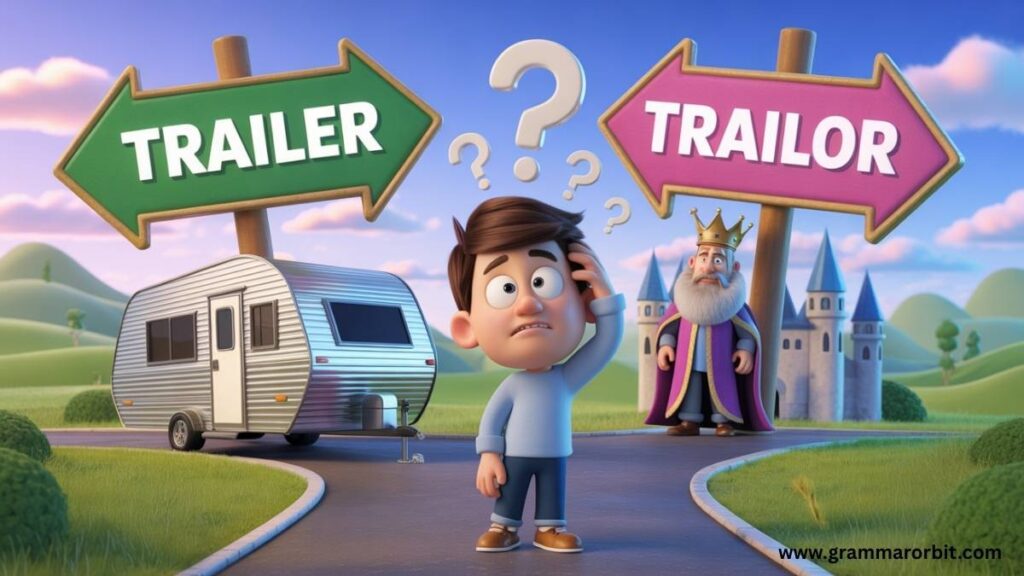
Have you ever stared at a word and felt like English was playing a practical joke on you? Welcome to the battle of trailer or trailor. One letter changes everything, yet somehow people keep typing the wrong version as if “trailor” has secretly been hiding in dictionaries, sipping tea, and judging your spelling. Maybe it’s the influence of words ending in -or, maybe it’s auto-correct chaos, or maybe your brain just loves a little chaos. Whatever the reason, trailer or trailor confuses writers everywhere. This article clears up the confusion once and for all, so you’ll never misspell it again.
Trailer or Trailor: Which Spelling Is Correct?
Let’s start with the bottom line. The correct spelling is trailer. Always.
Every dictionary, including Merriam-Webster and Oxford, recognizes trailer as the proper word. Trailor does not exist in standard English. It’s a common spelling mistake caused by sound confusion and the assumption that words ending in -or are somehow more correct or professional.
A simple way to remember it:
- A trailer trails. That’s why it ends with -er, not -or.
Why People Misspell Trailer as Trailor
Several factors contribute to the trailer versus trailor confusion. Here are the main reasons:
Pronunciation
When spoken quickly, trailer and trailor sound identical. The ear can easily hear the “-or” ending and assume it’s correct.
Influence from Words Ending in -or
English has many words that end in -or, such as:
- Actor
- Inspector
- Doctor
- Generator
Writers often copy this pattern subconsciously when unsure about spelling.
Typing Habits and Auto-correct
Many spelling errors arise from:
- Fast typing
- Predictive text mistakes
- Speech-to-text software mishearing
Once someone sees trailor a few times, it starts to “look right.”
Unfamiliarity with the Word
Unlike common words like color or doctor, trailer is not written or typed as often by many people. Less familiarity increases the likelihood of mistakes.
Trailer: Meaning and Definition
Understanding the trailer word meaning helps anchor the correct spelling in your mind. Surprisingly, the word has multiple meanings depending on context.
Trailer as a Noun
1. Vehicle or Container Towed by Another Vehicle
This is the most familiar usage. A trailer can be:
- A container attached to a vehicle
- Used for transporting goods, livestock, or personal items
- Seen in construction, farming, logistics, and everyday hauling
Common types include:
- Utility trailer
- Semi-trailer
- Flatbed trailer
- Travel trailer
- Boat trailer
2. Mobile Living Unit
Also called:
- Camper trailer
- RV trailer
- Mobile trailer
People use these for vacations, seasonal living, or full-time mobile lifestyles.
3. Short Promotional Video
Movie and TV trailers introduce content to audiences before the full release. These clips are designed to trail the main story, tease viewers, and build excitement.
Trailer as a Verb
Less common, trailer can also function as a verb in media contexts:
- To promote something using a short preview clip
Examples:
- “The studio trailered the new superhero movie before the premiere.”
- “They trailered the documentary to attract viewers on social media.”
Unregister vs Deregister Clear Differences and Uses
Real World Uses of Trailer
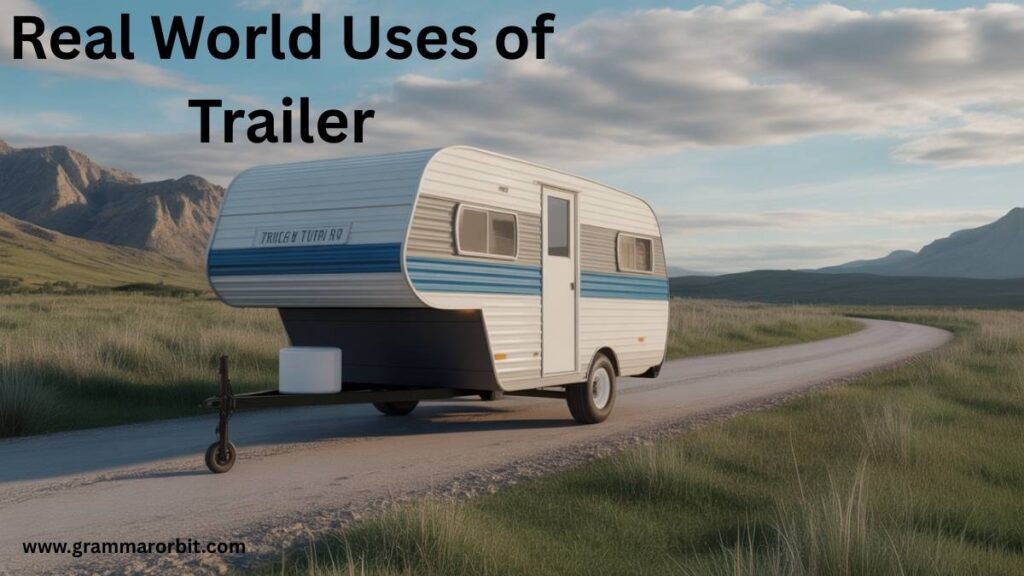
Transportation and Logistics
In logistics, trailers are indispensable:
- Semi-trailers: Detachable cargo units for long-haul trucks
- Refrigerated trailers: Transport perishable goods
- Flatbed trailers: Carry oversized or irregular cargo
- Enclosed cargo trailers: Protect items from weather
These examples also reinforce towed vehicle terminology and explain why trailers always trail.
Entertainment
Movie trailers and series previews give audiences a short taste of upcoming content. The word’s modern usage exploded with digital streaming and social media platforms.
Recreation and Lifestyle
Everyday uses include:
- Families towing boats to lakes
- Campers traveling in towable RVs
- Farmers hauling livestock or equipment
- DIY enthusiasts transporting building materials
Trailer Synonyms
Vehicle Related Synonyms
- Hauler
- Towable
- Wagon
- Semi trailer
- Flatbed
Media Related Synonyms
- Teaser
- Preview
- Promo
These synonyms help with understanding trailer grammar and avoiding the trailor mistake.
Using Trailer in Sentences
Seeing the word in context reinforces spelling and meaning.
Noun Examples
- “We loaded our furniture into a trailer and drove across the state.”
- “The movie trailer was so good that I watched it three times.”
- “She bought a new horse trailer with improved ventilation.”
- “They rented an enclosed trailer to protect the equipment from rain.”
Verb Examples
- “The company trailered a short preview before the conference.”
- “They will trailer the new documentary next week.”
These examples show correct usage while highlighting that trailor is never appropriate.
Etymology: Where Trailer Comes From
The word trailer originates from the verb trail, meaning:
- To follow behind
- To be pulled along
Adding the -er suffix, which forms nouns meaning “that which” or “one who,” gives us:
- Trailer = that which trails
This follows the same pattern as:
- Driver = one who drives
- Baker = one who bakes
- Loader = one who loads
English words ending in -or usually come from Latin, while er is the standard Germanic agentive ending. Because trail is an English verb, the correct ending is er.
WS Meaning in Text 📱 The Complete Guide
Common Misspellings and How to Avoid Them
Even simple words like trailer can trip people up, and it’s no surprise that trailor is one of the most common mistakes in English. Other variations sometimes appear too, often due to typing errors, mispronunciation, or assumptions based on similar-looking words. Understanding why these mistakes happen and how to avoid them will help you always write trailer correctly.
Common Misspellings
- Trailor – The most frequent error. People often assume the word ends with -or, like actor or doctor.
- Trailerr – Sometimes people double the “r” at the end unnecessarily.
- Trailar – Rarely, “a” replaces “e” due to phonetic mishearing.
- Traylor – A mistaken variant influenced by surnames or regional spelling habits.
- Traler – Dropping the “i” is another phonetic mistake.
All of these are incorrect in standard English. None appear in dictionaries, and they are generally marked as spelling errors in word processors.
Why These Mistakes Happen
- Pronunciation Confusion: The sound of trailer can be misheard, leading to wrong endings.
- Influence of Other Words: English has many words ending in -or (doctor, actor, inspector), so people assume trailer follows the same pattern.
- Auto-Correct and Predictive Text: Phones and software sometimes “correct” trailer into trailor or other wrong forms.
- Typing Speed: Quick typing without proofreading increases errors.
- Lack of Familiarity: Words used less frequently are more prone to mistakes.
Tips to Avoid Misspelling Trailer
- Think About the Root Word: Trailer comes from the verb trail. Anything that trails behind something else ends with -er.
- Use Memory Tricks: “A trailer trails, so it ends with -er.”
- Say It Slowly: Pronounce it clearly as “tray-ler” in your mind while writing.
- Practice in Sentences: Examples reinforce the correct spelling.
- “We loaded the furniture into a trailer.”
- “The movie trailer was exciting.”
- Proofread: Even small mistakes can sneak in; a quick check will catch common errors.
Quick Reference Table: Correct vs Incorrect
| Correct Spelling | Incorrect Variants | Reason |
|---|---|---|
| Trailer | Trailor | Wrong suffix, not a word |
| Trailer | Trailerr | Extra “r” is unnecessary |
| Trailer | Trailar | Phonetic mishearing |
| Trailer | Traylor | Influence of surnames or regional spelling |
| Trailer | Traler | Missing “i” from root word |
By understanding the trailor mistake and using these simple tricks, you’ll never confuse trailer spelling again.
Mine as Well or Might as Well? Which Is Correct, A Complete Guide
Trailer vs Trailor Table
| Feature | Trailer | Trailor |
|---|---|---|
| Correct spelling | Yes | No |
| Dictionary entry | Yes | No |
| Meaning | Towed vehicle, movie preview, mobile unit | None |
| Pronunciation | tray-ler | Same sound, wrong spelling |
| Grammar | Noun and verb | Not recognized |
| Reason incorrect | Matches trail + er | Incorrect suffix, not a word |
Case Study: Logistics Company
A Midwest logistics company operates 80 semi-trailers. They categorize them as:
- Refrigerated trailers
- Dry van trailers
- Flatbed trailers
The internal system flags trailor as a spelling mistake. Staff training uses the rule:
- “Every trailer trails the tractor. That’s why it’s spelled with -er.”
How to Spell Trailer Correctly
- Remember the root: If it trails, it is a trailer.
- Say it slowly: Tray-ler.
- Connect spelling to meaning: Movie trailers trail the story; utility trailers trail a vehicle.
- Apply the suffix rule: Trail → Trailer.
- Practice short sentences with trailer in different contexts.
Reference: Cambridge Dictionary Definitions
Here’s a trusted source for clear word meanings:
FAQs
What is trailer in British English?
In British English, a trailer usually refers to a vehicle or container that is towed by another vehicle. It can also mean a promotional clip for movies or TV shows. So whether you’re on a motorway or in a cinema, the meaning depends on context.
What’s the difference between a trailer and a trailer?
This might sound confusing, but context is key. One trailer refers to a towed vehicle, such as a caravan or cargo trailer. The other trailer refers to a short preview of a movie, show, or game. Same spelling, different usage—think transportation versus entertainment.
How do you spell trailer vehicle?
The correct spelling is always trailer. Avoid writing trailor, which is a common mistake. Whether it’s a horse trailer, utility trailer, or travel trailer, the -er ending is correct every time.
What is meant by trailer?
A trailer is anything that trails behind something else. It can be:
- A vehicle pulled by another vehicle
- A mobile living unit, like a camper or RV
- A promotional clip teasing a movie, show, or game
The key idea is that a trailer always follows or comes after something.
Conclusion
So, there you have it: the ultimate showdown between trailer and trailor. One trails behind reality, the other just trails behind common sense. Remember, a trailer literally trails whether it’s carrying furniture, horses, or movie spoilers so the -er ending makes perfect sense. Trailor, on the other hand, doesn’t exist outside of typo territory, autocorrect mishaps, and those cruel little spelling quizzes teachers love. Next time you type it, think of trailers hauling their cargo or teasing a blockbuster, and you’ll never make the trailor mistake again. English can be tricky, but at least now, you’re in the driver’s seat.

JHON AJS is an experienced blogger and the creative voice behind the website grammarorbit.com, namely Grammar Orbit. With a keen eye for language and a passion for wordplay, he creates engaging grammar insights, word meanings, and clever content that make learning English enjoyable and interesting for readers.