
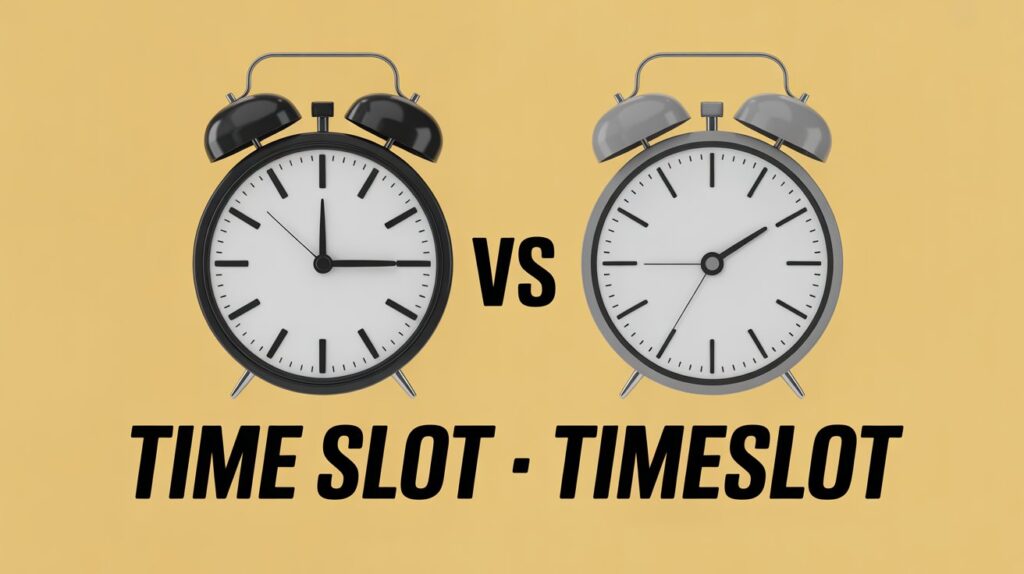
Are you one of those people who pause mid-email, staring at the screen, wondering whether to write time slot or timeslot? You’re not alone. The debate over Time Slot vs Timeslot has baffled students, office workers, and even UX designers who just want their booking systems to make sense. Is it one word? Two words? Should there be a hyphen? The truth is, knowing the correct spelling saves embarrassment, keeps your writing professional, and prevents awkward calendar misunderstandings. In this guide, we’ll settle the great Time Slot vs Timeslot debate once and for all, so your schedules and your grammar are flawless.
The Difference Between Time Slot and Timeslot
When people compare time slot vs timeslot they’re comparing two forms that look similar although only one is accepted in formal English.
Time Slot Is the Correct Form
The standard spelling is time slot.
It’s an open compound word, which means two separate words work together to form a single concept. You see this same structure in terms like full moon, living room, and coffee table.
Why Timeslot Exists at All
Timeslot appears because:
- Technology teams often shorten words for UI design
- Closed compounds sometimes evolve over decades
- Faster digital communication encourages shorter forms
But convenience doesn’t override grammar rules. Timeslot remains a nonstandard variant and shouldn’t appear in professional, academic, or business writing.
Dictionary Evidence for the Correct Spelling
Every major dictionary recognizes time slot as the proper form.
Here’s a breakdown.
Merriam-Webster
- Lists only time slot
- No entry for timeslot
Oxford English Dictionary
- Accepts time slot
- Treats it as the standard scheduling term
Cambridge Dictionary
- Defines time slot
- Ignores the fused form entirely
Collins English Dictionary
- Accepts time slot
- Notes timeslot only as an informal spelling
Dictionary Summary Table
| Dictionary | Accepted Spelling | Notes |
|---|---|---|
| Merriam-Webster | time slot | No alternative entry |
| Oxford | time slot | Standard usage |
| Cambridge | time slot | No timeslot listing |
| Collins | time slot | Timeslot labeled uncommon |
Dictionaries overwhelmingly support one conclusion: time slot is the correct form.
Compound Words in English: Why the Form Matters
To understand the time slot meaning, you need a quick overview of how compound nouns work. English builds compound terms in three main ways.
The Three Compound Structures
- Open compounds: two separate words (time slot, ice cream, teacher assistant)
- Hyphenated compounds: words joined with a hyphen (mother-in-law, award-winning)
- Closed compounds: words fused together (notebook, website, haircut)
Most compounds begin as open compounds then transition to closed ones over time. Strong exposure, wide usage, and dictionary adoption are what close a compound.
Where Time Slot Fits
Time slot is an open compound and it currently shows no signs of transitioning into a closed form. Scheduling expressions like appointment slot, meeting time, and lunch break almost always remain open because clarity is essential.
Time slot sits in the same category which explains why it stays open in modern English.
Damnit or Dammit? Learn How to Swear Correctly
Should You Ever Write Time-Slot? Understanding the Hyphen Rule

People often wonder when to hyphenate time-slot. Here’s the rule that makes it simple.
Do Not Hyphenate the Noun
As a noun, the correct spelling is time slot without a hyphen.
Hyphenate Only When It Acts as a Modifier
When time slot directly modifies another noun, it becomes a time-slot modifier and takes a hyphen.
Examples:
- time-slot system
- time-slot framework
- time-slot scheduling model
The hyphen makes the phrase clearer because it shows the two words function together as a single descriptor.
Correct vs Incorrect Examples
| Usage | Correct? | Example |
|---|---|---|
| Noun form | Yes | The time slot is still available. |
| Modifier before noun | Yes | They launched a new time-slot system. |
| Hyphenated noun | No | Select your time-slot. |
| Closed compound | No | Choose a timeslot. |
Simple Rule
Use time slot as a noun.
Use time-slot as a modifier before another noun.
Avoid timeslot in professional writing.
How Style Guides Treat Time Slot
Style guides are important when you’re writing for business, media, or academic environments. Each one treats the spelling slightly differently although they all agree on the same main point.
AP Stylebook
- Uses time slot
- Allows hyphen when modifying another noun
- Rejects timeslot
Chicago Manual of Style
- Uses time slot consistently
- Hyphen optional for clarity in compound modifiers
MLA Handbook
- Follows dictionary authority
- Requires time slot unless dictionaries close the compound in the future
APA Style
- Uses time slot
- Accepts hyphenated modifiers when needed
Style Guide Comparison Table
| Style Guide | Preferred Form | Hyphen Rule |
|---|---|---|
| AP | time slot | Hyphen for modifiers |
| Chicago | time slot | Hyphen optional for clarity |
| MLA | time slot | No hyphen in noun form |
| APA | time slot | Hyphen when describing a noun |
Every style guide aligns with the dictionary conclusion: time slot is the correct spelling.
Better Than or Better Then – Which Is Correct?
Better Than or Better Then – Which Is Correct?
Real-World Writing: Correct vs Incorrect Usage
Even with clear rules, real writing often shows inconsistent usage which confuses learners.
Correct Use in Formal Writing
You will find time slot in:
- business meeting confirmations
- academic scheduling systems
- government appointment portals
- healthcare registration forms
- legal documentation
Examples:
- Your time slot for the consultation is approved.
- Please select a time slot from the options listed below.
Incorrect Use in Informal or Digital Contexts
Timeslot pops up in:
- internal software dashboards
- app menus
- mobile booking systems
- online streaming schedules
Examples:
- Your selected timeslot is not available.
- Choose a timeslot for delivery.
These are design-driven choices, not grammar-driven ones. UI constraints often compress words to save space, yet that doesn’t validate the spelling in professional writing.
Why Clarity and Consistency Matter in Scheduling Terms
Small spelling choices make a big difference when readers rely on accuracy.
Clarity
Open compounds are easier to read which keeps your meaning sharp.
Professionalism
Your writing looks far more polished when you follow correct compound rules.
User Trust
Clear terminology reduces confusion in booking systems and scheduling tools.
Brand Voice
Consistent spelling strengthens communication in large organizations.
Grammar Consistency
Following established standards keeps your writing credible in business settings.
Consistency is one of the simplest ways to improve your writing instantly.
Common Mistakes and How to Avoid Them
Writers fall into predictable traps with this term. Here’s how to sidestep them.
Mistake 1: Using Timeslot in Serious Writing
Stick to time slot for anything formal.
Mistake 2: Adding a Hyphen When It Isn’t Needed
Remember the rule: nouns stay open, modifiers may be hyphenated.
Mistake 3: Switching Between Spellings
Pick one correct form and stay consistent throughout the document.
Mistake 4: Copying UI Labels Word for Word
UI labels are not grammar references. They’re design choices.
Will Timeslot Ever Become an Accepted Spelling?
English evolves constantly. Words like database, today, and anyone were once split. So can timeslot ever become standard?
It’s possible although not likely in the near future.
Why It Probably Won’t Change Soon
- Dictionaries show no movement toward the closed form
- Academic and business communities prefer clarity
- Scheduling vocabulary rarely closes into single words
- Time slot remains far more common in global usage
Google Trends Insight
Search patterns strongly favor time slot over timeslot, especially for formal contexts.
Case Study: University Scheduling System
A large university redesigned its online booking system. The design team tested both versions.
What They Chose:
Time slot received better usability feedback.
Outcome:
Students found time slot more intuitive and professional which improved the booking completion rate.
This shows that clarity wins even in digital products.
RLS Meaning in Text: The Complete Guide to Understanding
Best Practices for Using Time Slot Correctly
You can follow a few simple rules to avoid mistakes.
Use Time Slot When
- Writing emails
- Communicating with clients
- Preparing academic papers
- Drafting business documents
- Writing instructions
- Sending confirmations
Use Time-Slot Only As a Modifier
Examples:
- time-slot allocation system
- time-slot selection menu
Avoid Timeslot Except in UI Limited Spaces
Even then, clarity works better than compression.
Quick-Reference Table: Time Slot vs Timeslot
| Form | Use Case | Example |
|---|---|---|
| time slot | Noun | Select your time slot. |
| time-slot | Modifier | Install the new time-slot system. |
| timeslot | Avoid | Your timeslot is confirmed. |
Reference: Cambridge Dictionary Definitions
Here’s a trusted source for clear word meanings:
FAQs
Is it correct to say time slot?
Yes. Time slot is the correct spelling in standard English. All major dictionaries list it as two words. It’s the preferred form in professional writing, academic papers, business communication, and UX writing. Style guides like AP, Chicago, MLA, and APA all treat time slot as an open compound.
What is the meaning of time slot?
A time slot is a specific, scheduled period reserved for an activity, meeting, appointment, or event. Think of it as a dedicated window on a calendar during which something is supposed to happen. It’s a common term in scheduling terminology, booking systems, and digital calendars.
How do you use time slot in a sentence?
Here are examples that show natural usage:
- I booked the earliest time slot available for the meeting.
- Please choose a time slot between 2 PM and 4 PM.
- Each presenter gets a ten-minute time slot during the event.
These sentences show how the term fits into real scheduling and business writing grammar rules.
How long is a timeslot?
A timeslot (or more correctly, time slot) can be any length depending on the system using it. In most real-world contexts:
- Medical appointments: 10–30 minutes
- University classes: 50–90 minutes
- TV broadcasts: 30–60 minutes
- Gym or facility bookings: 45–90 minutes
There’s no universal length. A time slot simply refers to a defined window of time, whatever its duration.
Is timeslot 1 or 2 words?
Standard English uses two words: time slot.
Here’s the breakdown:
- Correct in formal writing: time slot
- Incorrect or informal: timeslot (closed compound)
- Less common and usually unnecessary: time-slot (hyphenated)
Writers use timeslot informally in tech, gaming, and casual digital communication, but it isn’t recognized as the preferred form in dictionaries or major style guides.
If you want the version that works everywhere from business emails to academic papers choose time slot.
Conclusion
After all this, the mystery of time slot vs timeslot is finally solved. Remember, the correct spelling in professional writing is time slot, not the sneaky timeslot that pops up in apps and casual chats. Use time slot for clarity, use time slot only when it’s a modifier, and avoid timeslot unless you want your grammar teacher to give you a side eye. Consistently sticking with time slot not only keeps your writing sharp but also makes scheduling, emails, and business documents look polished. So next time you type, don’t panic just pick time slot and write with confidence!

JHON AJS is an experienced blogger and the creative voice behind the website grammarorbit.com, namely Grammar Orbit. With a keen eye for language and a passion for wordplay, he creates engaging grammar insights, word meanings, and clever content that make learning English enjoyable and interesting for readers.