If you’ve ever typed tieing or tying, stared at the screen, and felt your confidence quietly unravel, welcome to the club. This tiny spelling debate has humbled students, bloggers, and professionals alike. One version looks reasonable. The other looks suspicious. English, of course, refuses to make it easy. The problem isn’t intelligence. It’s habit, sound, and a sneaky grammar rule hiding in plain sight. This guide pulls the knot tight on the confusion. You’ll learn the correct spelling, why the wrong one keeps showing up, and how to spot similar traps instantly. By the end, you’ll write it right without hesitation, or spellcheck anxiety.
Tieing or Tying: The Short Answer
Let’s clear this up right away.
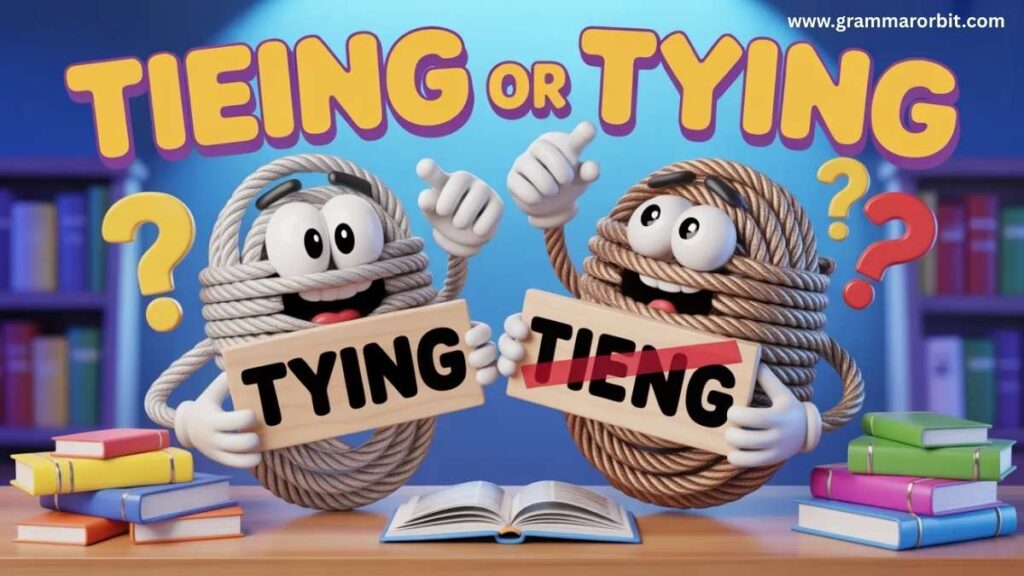
Tying is the correct spelling.
Tieing is incorrect. Always.
If you’re asking is it tieing or tying, the answer is tying in every form of modern English. There are no exceptions.
Tieing vs Tying: Why So Many People Get It Wrong
This mistake doesn’t happen because writers are careless. It happens because English trains us to expect patterns that don’t always apply.
Many verbs simply add -ing without changing form:
- see → seeing
- free → freeing
So it feels logical to write:
- tie → tieing
That logic makes sense. English just doesn’t follow it here. This is one of the most common common spelling mistakes in English, especially in digital writing.
The Correct Present Participle of Tie
The present participle of tie is tying.
That’s the only correct form when describing an action in progress. This applies in everyday writing, academic work, and professional communication.
Examples:
- She is tying her shoes.
- He was tying loose ends before the deadline.
- They kept tying the rope tighter.
In every case, tying is correct.
The Grammar Rule That Explains Everything
Here is the rule that matters most.
When a verb ends in a silent e, drop the e before adding ing.
This rule explains the tying grammar rule completely and applies across modern English spelling.
Verbs That Follow the Same Rule
| Base Verb | Present Participle |
|---|---|
| tie | tying |
| die | dying |
| lie | lying |
| make | making |
| write | writing |
| bake | baking |
This is why tieing violates English language rules. The silent e must be removed.
Scrapped or Scraped? Let’s Clarify the Confusion Once and for All
Why Tieing Is Incorrect, Not Just Uncommon
Some spellings fade over time. Others never belonged in the language to begin with.
Tieing is incorrect spelling, not an outdated version. It was never accepted as standard English. Dictionaries, editors, and style guides all reject it.
That makes tying the only dictionary accepted spelling.
Why Tieing Looks Right to the Eye
This error survives because it feels familiar. Three forces cause that illusion.
Sound-based spelling
You hear the long i sound, so your brain wants to keep the e.
Pattern confusion
Words like seeing and freeing create false expectations.
Visual repetition
People see tieing online often enough that it starts to look normal.
That combination creates persistent tie spelling confusion, even among experienced writers.
Tying Meaning Explained Simply
Understanding the tying meaning helps lock in the correct form.
Tying describes an action that connects, fastens, or links things together while it is happening.
Literal uses
- tying shoes
- tying a knot
- tying a package
Figurative uses
- tying ideas together
- tying actions to consequences
- tying emotions to memories
In every case, tying reflects continuous tense and ongoing action.
HBU Meaning: Understanding and Polite Alternatives
Tying vs Tied: A Quick Clarity Check
These two forms often get mixed up.
| Word | Meaning | Example |
|---|---|---|
| tying | action in progress | She is tying the ribbon |
| tied | completed action | She tied the ribbon |
Knowing the difference between tying vs tied improves grammatical correctness and sentence clarity.
How the Verb Tie Works in Real Sentences
The tie verb present participle always appears with helping verbs.
Correct usage examples:
- He is tying the final knot.
- They were tying up loose details.
- She kept tying the rope tighter.
Using tieing in these sentences breaks grammar accuracy immediately.
Did Tieing Ever Exist in English?
No.
Early English spelling was inconsistent, but tieing never gained acceptance. By the time spelling consistency formed, tying was already the standard.
This means tieing is neither historical nor regional. It’s simply an error that keeps repeating.
Why English Kept This Rule
Language changes constantly. Some rules disappear. Others stay because they help readers.
Dropping the silent e before adding ing improves readability and reduces confusion. That’s why this rule remains firm in modern English spelling.
Where This Mistake Commonly Appears
You’ll see tieing most often in places where writing moves fast.
- Emails and messages
- Blog posts
- Student assignments
- SEO content written quickly
Spellcheck doesn’t always flag it, which is why understanding English spelling rules matters.
The Cost of Misspelling in Professional Writing
Spelling errors carry weight, even small ones.
In academic and professional writing, mistakes like tieing can:
- Reduce credibility
- Distract readers
- Undermine authority
- Weaken writing clarity
Readers notice more than writers expect.
How to Spell Tying Correctly Every Time
Use this simple memory rule.
If the verb ends in a silent e, drop it before adding ing.
Think of dying. No one writes dieing. The same logic applies to tying.
Once you remember that, the hesitation disappears.
What Does Stay Tuned Mean? (With 21 Polite Alternatives)
Related Forms of the Verb Tie
Consistency matters in verb conjugation.
| Form | Correct Spelling |
|---|---|
| Base verb | tie |
| Past tense | tied |
| Present participle | tying |
| Third person singular | ties |
Using these forms correctly strengthens spelling consistency and professional writing.
Real-Life Usage Examples
You’ll find tying everywhere once you start paying attention.
- She’s tying together multiple ideas.
- The coach focused on tying effort to results.
- He finished tying the rope before leaving.
Professional writers never use tieing. That’s not an accident.
Why This Matters for Clear Writing and SEO
Search engines reward correct verb spelling.
Content with spelling errors often suffers from:
- Lower trust
- Reduced engagement
- Poorer rankings
Using the correct spelling of tying supports clarity, readability, and long-term performance.
Reference Cambridge Dictionary Definitions
Here’s a trusted source for clear word meanings:
FAQs
Is it tying or tieing the knot?
It is tying the knot. This phrase refers to getting married, and the verb follows standard English spelling rules. The silent e in tie is dropped before adding -ing, which makes tying the only correct form. Tieing the knot is grammatically incorrect and never accepted in modern English.
What is the meaning of tieing?
Tieing has no meaning in standard English. It is a spelling error, not a word with its own definition. The correct form is tying, which means fastening, connecting, or linking something while the action is happening.
Is it tying or tieing for first place?
The correct phrase is tying for first place. It describes two or more competitors sharing the same top score or position. Tieing for first place is incorrect and breaks English spelling rules.
Is it tieing in or tying in?
The correct form is tying in. This phrase means connecting ideas, coordinating plans, or linking details together. As with all present participle forms of tie, the spelling must be tying, not tieing.
What do you mean by tying?
Tying means fastening, joining, or connecting something together while the action is in progress. It can be literal, such as tying a rope, or figurative, such as tying ideas together. The word always uses the tying spelling in continuous tense.
Is it fly tying or tieing?
The correct term is fly tying, which refers to making artificial fishing flies. This term is widely used in fishing and outdoor communities, and tieing is never used in this context.
Conclusion
At this point, the mystery of tieing or tying should feel completely untangled. One spelling plays by the rules. The other just pretends it does. Drop the silent e, add ing, and move on with confidence. No more pausing mid-sentence. No more second-guessing your keyboard. Once you know the rule, you see it everywhere, and you stop falling for the same trap. English still has plenty of surprises waiting, but this one won’t trip you up again. Go ahead and write tying like a pro. Your future sentences will thank you.

JHON AJS is an experienced blogger and the creative voice behind the website grammarorbit.com, namely Grammar Orbit. With a keen eye for language and a passion for wordplay, he creates engaging grammar insights, word meanings, and clever content that make learning English enjoyable and interesting for readers.