Ever ended a conversation and blurted out “Talk to you then,” and wondered if you sounded like a polite human or a robot on autopilot? You’re not alone. The Talk to You Then Meaning phrase pops up everywhere from casual text messages to workplace emails yet many English learners (and even native speakers) pause mid-sentence, questioning, What does talk to you then mean exactly? Is it friendly formal or just a filler? This guide dives into the ins and outs of talk to you then in English showing you how to use it naturally confidently and maybe even charmingly without sounding like a walking phrasebook.
What Does “Talk to You Then” Mean?
At its most basic level, talk to you then means:
“I will talk to you at the time we already mentioned.”
The key word here is then. It refers to a specific future moment that both speakers understand. That time does not need to be repeated because the context already makes it clear.
Simple explanation
- You and the other person agree on a future time
- The conversation is ending
- You say talk to you then to confirm that future conversation
Think of it as a friendly verbal bookmark.
Everyday example
“Let’s continue this tomorrow.”
“Sounds good. Talk to you then.”
No confusion. No extra explanation. The meaning lands cleanly.
The Grammar Behind “Talk to You Then”
From a grammar point of view, talk to you then is not a full sentence. And that’s completely normal.
What’s missing?
The full version would be:
“I will talk to you then.”
In real-life English, native speakers drop:
- The subject (“I”)
- The auxiliary verb (“will”)
This happens constantly in spoken English expressions and casual writing.
Why it works
English allows this kind of shortening when:
- The speaker is obvious
- The time reference is clear
- The phrase appears at the end of a conversation
Other examples follow the same pattern:
- “See you later.”
- “Catch you soon.”
- “Speak soon.”
These are not grammar mistakes. They are signs of natural conversational flow.
Zeroes or Zeros Complete Guide
When Native Speakers Use “Talk to You Then”
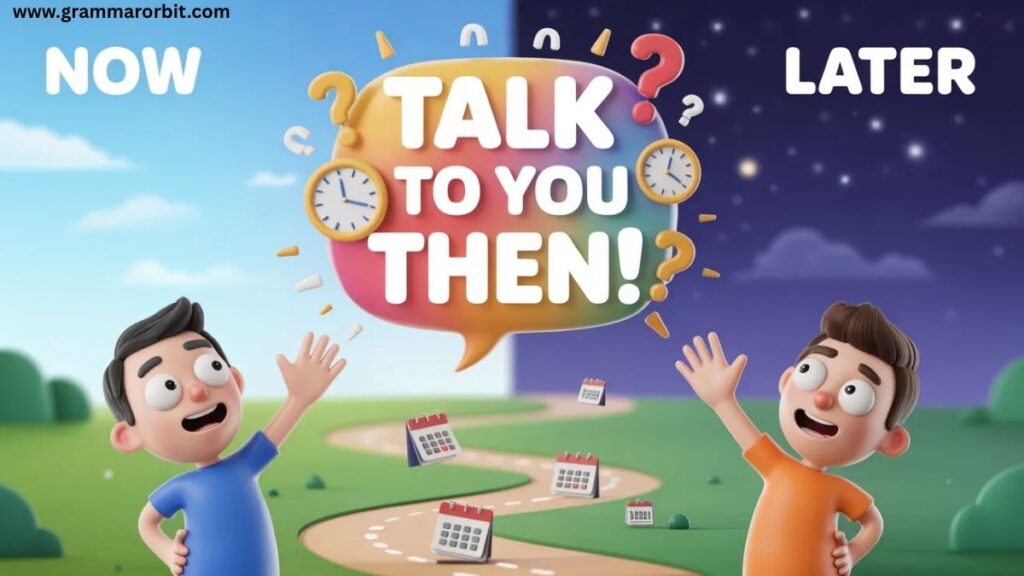
Native speakers use talk to you then in English in moments where future communication is already planned.
Common situations
- Ending a phone call
- Wrapping up a meeting
- Closing an email thread
- Finishing a text conversation
- Signing off from a video call
What the phrase signals
Using talk to you then tells the listener:
- The conversation is ending politely
- There is no urgency right now
- Another conversation will happen later
It’s a smooth, friendly sign-off. Not a brush-off.
Tone and Nuance of “Talk to You Then”
Tone is where many learners struggle. The words are simple, but the feeling matters.
Talk to you then sounds:
- Polite
- Calm
- Friendly
- Neutral
It doesn’t sound cold. It doesn’t sound overly casual either. That balance is why it works in both personal conversation and many professional settings.
Tone changes with delivery
| Version | How it sounds |
|---|---|
| Talk to you then. | Neutral and professional |
| Talk to you then! | Friendly and upbeat |
| Talk to you then 🙂 | Warm and casual |
| Talk to you then… | Uncertain or hesitant |
In most cases, a simple period is enough.
Is “Talk to You Then” Informal or Formal?
This is one of the most common questions.
Talk to you then is an informal phrase, but that does not mean it is unprofessional.
Informal use
It works perfectly in:
- Text messages
- Casual conversations
- Chats with friends and family
- Relaxed workplace environments
Example:
“I’ll send you the photos tonight. Talk to you then.”
Professional use
It is also acceptable in:
- Friendly work emails
- Ongoing conversations with colleagues
- Internal communication
Example:
“Let’s review the proposal after the meeting. Talk to you then.”
When to avoid it
Avoid using talk to you then in:
- Legal writing
- Very formal first-contact emails
- Official announcements
In those cases, choose a more formal English sign-off phrase.
Receipt vs Recipe Understanding the Historical Difference
How to Use “Talk to You Then” Correctly
Correct talk to you then usage depends on one main rule.
The golden rule
There must be a clear future time.
If the listener doesn’t know what “then” refers to, the phrase feels confusing.
Correct usage examples
- “Let’s meet at 4. Talk to you then.”
- “I’ll call you tomorrow morning. Talk to you then.”
- “We’ll discuss this next week. Talk to you then.”
Incorrect usage examples
- “Okay, bye. Talk to you then.”
(No future time mentioned.) - “I talked to you yesterday. Talk to you then.”
(Wrong tense.)
Timing and clarity make all the difference.
Talk to You Then Example in Real Contexts
Seeing the phrase in action helps it stick.
Casual conversation
- “I need to head out now. Let’s catch up later. Talk to you then.”
- “We’ll finish this after lunch. Talk to you then!”
Professional email
“I’ll prepare the draft by Friday.
Talk to you then.”
“Thanks for the update. Let’s revisit this once the data is ready.
Talk to you then.”
Text messages
- “I’ll message you once I arrive. Talk to you then.”
- “See you at 7. Talk to you then 🙂”
Phone and video calls
At the end of a call:
“Thanks for your time. Talk to you then.”
These examples show how flexible the phrase is across digital communication, phone calls, and emails.
Common Mistakes With “Talk to You Then”
Even advanced learners make small errors with this phrase.
Using it without context
The biggest mistake is using talk to you then without mentioning a future time first. The listener is left guessing.
Overusing it in formal writing
In serious professional communication, repeating this phrase too often can sound casual or lazy.
Mixing time references
Saying talk to you then while referring to the past creates confusion and breaks natural flow.
“Talk to You Then” vs Similar English Phrases
Many English conversation phrases sound similar but serve different purposes.
Comparison table
| Phrase | Best use | Tone |
|---|---|---|
| Talk to you then | Clear future time | Neutral |
| Talk later | Vague future | Casual |
| Talk soon | Polite but flexible | Friendly |
| See you then | In-person meetings | Neutral |
| Speak to you later | Slightly more formal | Polite |
Understanding these differences helps you choose the best phrase for the situation.
Better Alternatives to “Talk to You Then”
Sometimes another phrase fits better. Context always wins.
Casual alternatives
- Catch you later
- Talk later
- Chat later
- See you then
These work well in personal conversation and relaxed settings.
Neutral and polite alternatives
- Talk soon
- Speak to you later
- Until then
These balance friendliness and professionalism.
Professional alternatives
- I’ll be in touch
- I’ll follow up then
- We’ll discuss this then
These phrases sound more formal and work well in professional communication.
How Native Speakers Hear “Talk to You Then”
To native speakers, talk to you then sounds completely normal. It doesn’t stand out. That’s the goal.
It signals:
- Ongoing communication
- Mutual understanding
- Polite closure
In everyday English, sounding natural matters more than sounding impressive.
Meantime or Mean Time Complete Guide to Grammar
How to Practice Using “Talk to You Then”
Practice doesn’t need to be complicated.
Simple speaking practice
- Mention a future time
- End the conversation
- Use the phrase naturally
Example:
“Let’s finish this tomorrow.”
“Perfect. Talk to you then.”
Writing practice
Replace stiff endings like:
- “I will communicate with you at that time.”
With:
- Talk to you then.
The difference feels immediate.
Quick Checklist Before Using the Phrase
Before you say or write it, ask yourself:
- Is the future time clear?
- Is the tone right for this relationship?
- Is the situation casual, professional, or mixed?
If the answer feels right, the phrase will land naturally.
Reference Cambridge Dictionary Definitions
Here’s a trusted source for clear word meanings:
FAQs
What Does “Talk to You Then” Mean?
Talk to you then is a friendly phrase used to end a conversation while confirming a future time to talk again. The word “then” refers to a specific moment already mentioned or implied. For example:
“Let’s review the report tomorrow.”
“Sounds good. Talk to You Then Meaning.”
It’s commonly used in casual chats, emails, text messages, and calls to signal that the conversation is wrapping up but communication will continue.
Is “Talk to You Then” Correct English?
Yes, it is correct English. While the phrase drops the subject and auxiliary verb (like “I will”), this is perfectly acceptable in informal and semi-formal contexts. Native speakers use it every day in spoken and written English, and it fits naturally in digital communication, phone calls, and casual professional emails.
What Is Another Way to Say “Talk to You Then”?
There are many alternatives depending on tone and context:
Casual Alternatives:
- Talk later
- Catch you later
- Chat later
Polite/Neutral Alternatives:
- Talk soon
- Speak to you later
- See you then
Professional Alternatives:
- I’ll follow up then
- I’ll be in touch
- We’ll discuss this then
Choosing the right alternative ensures your English sounds natural and appropriate for the situation.
When Should You Say “Talk to You Then Meaning”?
Use this phrase when:
- You’ve agreed on a specific future time to communicate
- You’re ending a conversation politely
- You want to signal ongoing communication without sounding abrupt
Avoid using it if the future time is unclear, because “then” needs context to make sense.
Can I Use “Talk to You Then Meaning” at Work?
Yes! Talk to You Then Meaning works in professional settings, especially in friendly, ongoing email threads, meetings, or team chats. It’s a polite way to close a conversation while keeping the tone casual yet professional. Just avoid using it in very formal emails, official announcements, or legal communication.
Conclusion
So there you have it “Talk to You Then Meaning” isn’t some mysterious magic spell, it’s just English doing its polite, slightly casual thing. Use it after you’ve set a future time, drop it at the end of a conversation, and watch how smoothly your chats, calls, or emails glide to a close. Remember, it’s friendly, it’s flexible, and yes, it even works better than that awkward “I’ll talk to you at some undefined later time” nonsense. So go ahead—say it confidently, sprinkle in a smile if texting, and let Talk to You Then Meaning make you sound like a native, without needing a translator or a grammar PhD.

JHON AJS is an experienced blogger and the creative voice behind the website grammarorbit.com, namely Grammar Orbit. With a keen eye for language and a passion for wordplay, he creates engaging grammar insights, word meanings, and clever content that make learning English enjoyable and interesting for readers.