
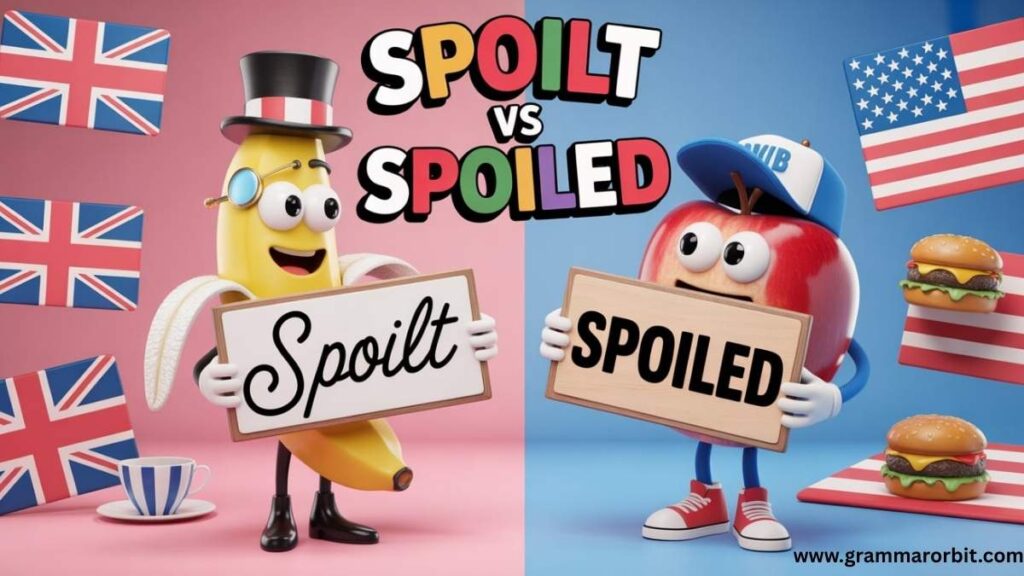
Ever found yourself staring at a sentence, wondering whether to type “Spoilt vs Spoiled” like it’s some life-or-death decision? Don’t worry you’re not alone. English loves to mess with our heads, especially when a single letter can spark a regional identity crisis. Is your child overindulged, a true spoilt child or a spoiled child depending on which side of the Atlantic you’re on? And what about that leftover cake did it spoil or spoil… wait, I mean spoilt? This guide will unravel the confusion, explore the cultural quirks, and teach you how to wield spoilt vs spoiled like a pro, all without breaking a sweat.
Why People Get Confused
Many learners and writers stumble over spoilt vs spoiled because English contains many dual-form verbs. Words like spoil have multiple accepted past tense and past participle forms. Over centuries, these forms evolved differently in different regions, leading to US vs UK English differences.
- Regional English variations mean that what’s normal in Britain can feel outdated in America.
- Grammar differences UK vs US contribute to the confusion: Americans favor regular verbs, while Britons often retain older spellings.
- English word evolution plays a role. Words like learnt/learned, burnt/burned, and dreamt/dreamed show that dual forms are common.
“Language changes slowly, but it always carries its history.” Understanding historical English spelling helps explain why we have spoilt or spoiled today.
The Origins of ‘Spoilt’ and ‘Spoiled’
The verb “to spoil” comes from Old French espoillier, which meant “to strip” or “take by force.” Over time, English adapted the word to mean to damage, ruin, or overindulge, creating the meanings we use now.
| Form | Region | How It Developed | Example Usage |
|---|---|---|---|
| Spoiled | US | Regularized American form | The milk spoiled in the sun. |
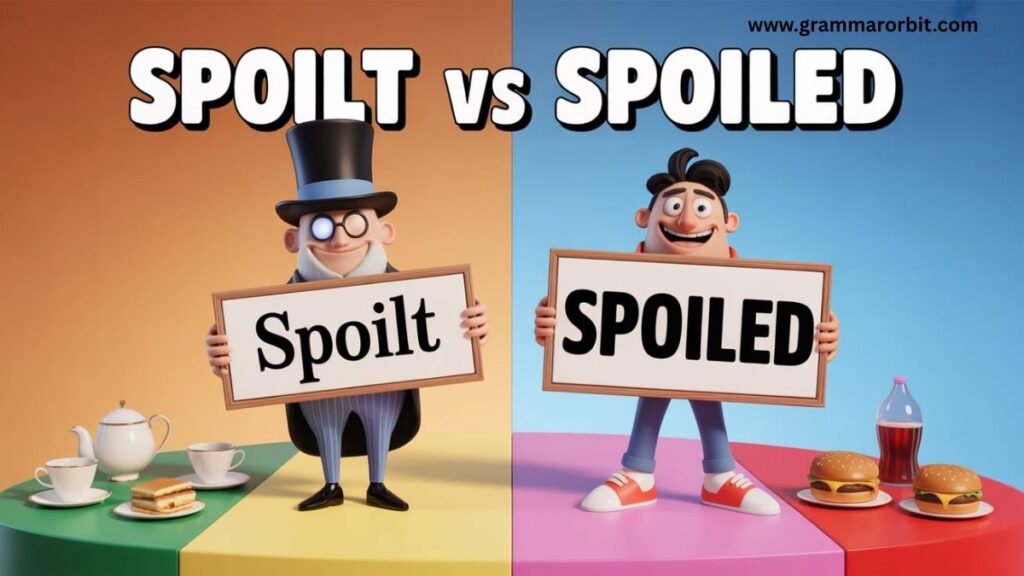
| Spoilt | UK, AU, NZ | Historical British ending (-t) | The milk spoilt because it was left out. |
British English verbs with -t endings were once standard in Middle English. Over time, Americans simplified the spelling, creating what we now know as American English regular verbs.
Why Americans Prefer Spoiled
In the United States, “spoiled” dominates for several reasons:
- Simplified grammar: Americans prefer regular verbs for ease of use.
- Cultural influence: The phrase “spoiled child” describes an overindulged child, someone who is pampered excessively.
- Everyday usage: Americans use spoiled both for children and for describing food or objects that have gone bad.
Examples in American English:
- He is such a spoiled child; he never gets told no.
- Don’t eat that sandwich it’s spoiled.
Here, spoiled functions as both the past tense of spoil and the past participle of spoil, making it a flexible choice.
How ‘Spoilt’ Persists in British English
In Britain, Australia, and New Zealand, spoilt is widely used, especially in speech and literature. It fits a pattern of British English verbs with -t endings, such as:
- Learnt instead of learned
- Burnt instead of burned
- Dreamt instead of dreamed
UK English examples:
- The milk is spoilt, so throw it away.
- She was a spoilt child, always getting her way.
Using spoilt conveys a slightly formal or traditional tone, even though spoiled would also be understood.
Grammar Insights: Past Tense vs Past Participle
Spoil is an irregular verb, but both spoiled and spoilt serve as:
- Past tense of spoil
- Past participle of spoil
| Form | Function | Regional Preference | Example Sentence |
|---|---|---|---|
| Spoiled | Past tense / participle | US | The food spoiled before dinner. |
| Spoilt | Past tense / participle | UK, AU, NZ | The chocolate spoilt after a few hours. |
Other dual-form verbs show similar patterns: learnt/learned, burnt/burned, dreamt/dreamed. When writing for a UK vs US audience, it’s important to choose the form that matches the region.
Contextual Examples of ‘Spoiled’ and ‘Spoilt’
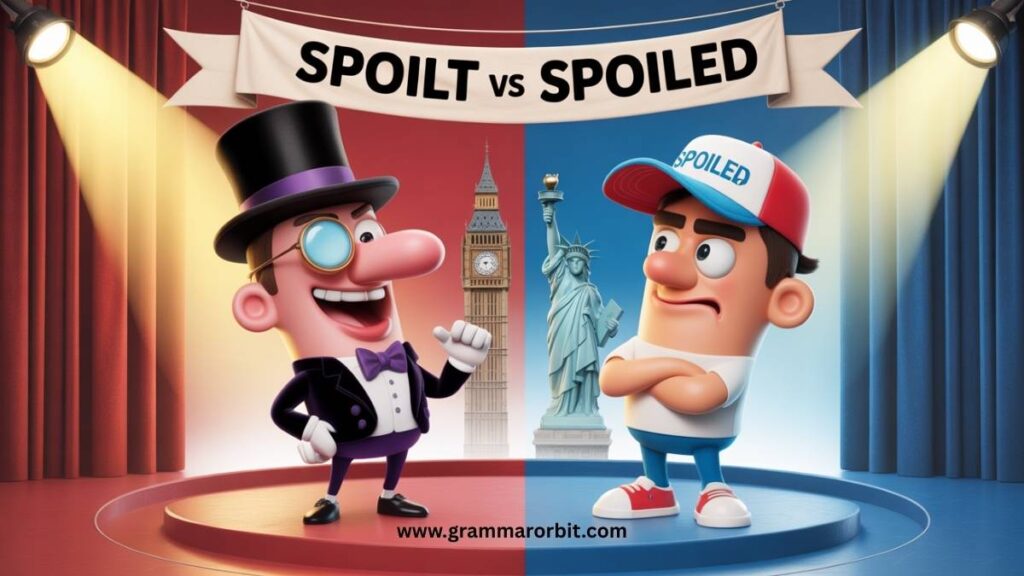
The best way to see the difference is in context:
Food terminology:
- US: The fruit spoiled on the counter.
- UK: The fruit spoilt on the counter.
Children and upbringing:
- US: He is a spoiled child, used to getting everything he wants.
- UK: He is a spoilt child, always pampered by his parents.
Idiomatic phrases:
- US: “Don’t let him get spoiled.”
- UK: “She’s completely spoilt.”
Practice exercise:
Fill in the blanks with the correct form:
- The bread in the warm kitchen.
- That boy became a child after his parents gave him too many toys.
How American Culture Shapes Usage
In American English, spoiled reflects cultural ideas about indulgence, food, and personality.
- Media and literature: Descriptions of children as spoiled convey personality traits or family dynamics.
- Food usage: Any perishable item that has gone bad is spoiled.
- Idioms: Expressions like “spoiled rotten” exaggerate the idea of indulgence humorously.
Example:
“If you keep giving him everything, he’ll grow up spoiled.”
Here, the word connects behavior, culture, and societal expectations.
What Does Paraphernalia Mean?Definition Origins
Practical Guide: When to Use ‘Spoiled’ vs ‘Spoilt’
Here’s a simple approach:
- Use ‘spoiled’ for American English or global audiences.
- Use ‘spoilt’ for British, Australian, and New Zealand English.
- Both forms work as past tense of spoil or past participle of spoil, depending on region.
- Default to spoiled when unsure; it’s universally understood.
Memory aid:
- US = spoiled (simple, regular form)
- UK = spoilt (historical, traditional ending)
Common Mistakes and How to Avoid Them
Even experienced writers sometimes mix up spoilt or spoiled. Common errors include:
- Using spoilt in American writing it may seem outdated.
- Confusing adjective and verb usage: “He is a spoiled child” vs “The milk is spoiled.”
- Overcomplicating spelling with forms like spoilted, which do not exist.
Quick checklist for writers:
- Identify your audience (US vs UK).
- Determine the function (past tense or past participle).
- Consider style and tone: formal, casual, literary, or conversational.
Mixing British and American spelling in the same sentence
Many writers switch between spoilt and spoiled without noticing. That move confuses readers and looks sloppy.
How to avoid it:
Pick one style and stay loyal.
- Writing for a US audience? Use spoiled everywhere.
- Writing for a UK audience? Stick with spoilt.
Consistency wins every time.
Using spoilt vs spoiled only for people
Some people think these words describe children or behavior only. That belief limits your writing.
You can also use them for:
- Food: “The milk spoiled overnight.”
- Devices: “My phone has spoilt.”
- Plans: “The rain spoiled our picnic.”
How to avoid it:
Remember: anything that goes bad, breaks, or loses value can spoil.
Any Problem or Any Problems Which Is Correct?
Saying “I am spoilt” when you mean “I feel happy”
“I’m spoilt today” sounds odd unless someone treated you generously.
How to avoid it:
Use spoilt when someone gives you extra care, gifts, or privileges.
Say happy, excited, or grateful for emotions.
Confusing past tense with past participle
Writers often mix forms like “has spoilt” and “had spoiled” without knowing why.
Correct forms:
- Present perfect: has spoilt / has spoiled
- Simple past: spoilt / spoiled
How to avoid it:
Use has / have before the verb when the action connects to now.
Using spoilt vs spoiled in formal writing without context
In formal or academic writing, these words can sound vague.
Example problem:
- “The decision spoiled the process.”
How to avoid it:
Clarify the damage.
- “The decision delayed the process.”
- “The decision reduced efficiency.”
Specific verbs sound stronger and clearer.
Assuming one spelling is wrong
Many learners think spoilt is incorrect. It isn’t.
How to avoid it:
Know the rule:
- Spoilt = British English
- Spoiled = American English
Both follow standard grammar.
Style Guide Notes
Here’s a simple reference for guidance:
| Source | Recommended Form | Notes |
|---|---|---|
| Oxford English Dictionary | Both | UK-focused; spoilt used historically |
| Cambridge Dictionary | Both | Emphasizes regional usage |
| Merriam-Webster | Spoiled | Standard American English |
| AP Style Guide | Spoiled | Used in journalism and formal writing |
| Chicago Manual of Style | Spoiled | Preferred in American English |
Using these guidelines ensures correct writing for UK vs US English audiences.
Reference Cambridge Dictionary Definitions
Here’s a trusted source for clear word meanings:
FAQs
Is “spoilt” wrong in American English?
No. Spoilt isn’t wrong in American English, but it sounds uncommon.
American writers strongly prefer spoiled in everyday and professional writing. Using spoilt may feel British to US readers, so it can distract them.
Do “spoilt” and “spoiled” mean the same thing?
Yes, but regional preference differs.
Can I use “spoilt” in formal writing?
Yes, if your audience is British. In American writing, use spoiled.
Why do these variations exist?
They come from historical English spelling, regional conventions, and the evolution of English.
How can I remember which one to use?
Think regionally: US = spoiled, UK = spoilt.
Conclusion
So, there you have it spoilt vs spoiled isn’t a spelling disaster, it’s a cultural adventure. Whether you’re in the US insisting your child is a spoiled brat or in the UK quietly muttering about a spoilt child, the choice is yours but context is king. Remember spoiled dominates in America, spoilt charms in Britain, and both make you look like someone who actually knows their past tense of spoil. Next time you encounter a dessert gone bad or a pampered kid, you’ll confidently pick the right word and maybe even chuckle at how one tiny letter can cause such international drama.

JHON AJS is an experienced blogger and the creative voice behind the website grammarorbit.com, namely Grammar Orbit. With a keen eye for language and a passion for wordplay, he creates engaging grammar insights, word meanings, and clever content that make learning English enjoyable and interesting for readers.