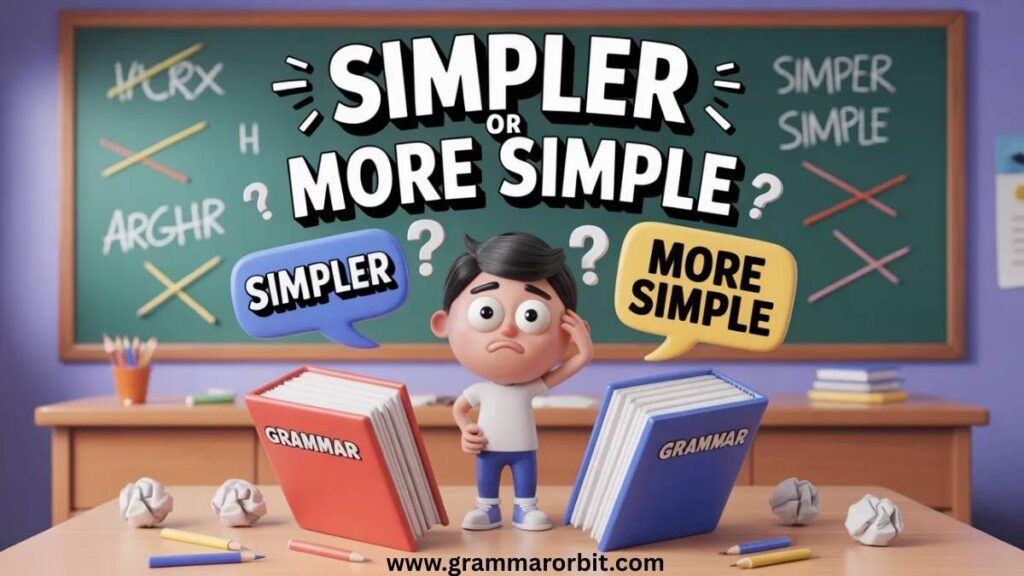
Grammar has a sneaky way of stopping you mid-sentence, coffee cooling beside you, as one tiny question takes over your brain: simpler or more simple? It sounds like a harmless choice, yet suddenly you’re doubting everything you know about English. Both options look right. Both feel possible. And somehow, both make you nervous. Welcome to one of the most common grammar speed bumps in everyday writing. The good news? This confusion isn’t a sign you’re bad at English. It’s a sign English likes to bend its own rules. Once you understand what’s really going on, choosing between simpler and more simple becomes, well… much simpler.
Why “Simpler or More Simple” Causes So Much Confusion
At first glance, this shouldn’t be hard. English has rules for comparing adjectives. Short adjectives add -er. Longer adjectives use more. Done.
Except English rarely plays that cleanly.
The confusion around simpler vs more simple grammar exists because simple sits in a gray area. It looks short, but it ends in “-ple.” Some speakers treat it like a longer adjective. Others don’t.
That uncertainty leads to questions like:
- Is simpler correct, or does it sound informal?
- Is more simple grammatically correct, or is it a mistake?
- Does tone or context matter?
- Why do grammar tools sometimes accept both?
To answer those questions, we need to break down how English comparison actually works.
What “Simple” Is in Grammar Terms
Before choosing simpler or more simple grammar, you need to know what simple is structurally.
Simple Is a One-Syllable Adjective (Functionally)
In English grammar, simple functions as a one-syllable adjective, despite how it looks on the page. The “-ple” ending behaves like a consonant sound, similar to words like:
- humble
- subtle
- gentle
Because of this structure, simple follows the same pattern as other simple comparative adjectives that take -er.
This matters more than spelling. Grammar works on sound and rhythm, not just letters.
The Core Rule: How Comparative Adjectives in English Work
Let’s zoom out.
Basic Grammar Rules for Adjectives
In English grammar comparison, adjectives change form to compare two things.
Standard rules look like this:
- One-syllable adjectives → add -er
- small → smaller
- fast → faster
- Two or more syllables → use more
- complex → more complex
- efficient → more efficient
These are known as adjective comparison rules and adjective syllable rules.
Now here’s the key detail.
Some adjectives especially two-syllable ones ending in -le, -er, or -ow can go either way. Simple is one of them.
That’s why both simpler vs more simple exist.
Is “Simpler” Correct? Yes and It’s the Standard Form
Let’s be direct.
Yes, simpler is correct.
It’s a real word.
It’s the correct comparative form of simple.
Simpler Meaning
Simpler means:
Easier to understand, do, explain, or deal with compared to something else.
Examples:
- This explanation is simpler than the original one.
- The updated design is simpler and cleaner.
- We need a simpler solution.
This form follows standard comparative adjectives in English rules. It’s concise, natural, preferred.
If you’re asking what is the comparative form of simple, the answer most editors, teachers, and style guides give is simpler.
Is “More Simple” Grammatically Correct? Technically, Yes
Here’s where nuance matters.
More simple is grammatically correct, but that doesn’t make it the best choice in most situations.
More Simple Meaning
Simple carries the same meaning as simpler. There is no difference in definition. The difference lies in style and frequency.
English allows both forms because of grammar exceptions in English, especially with flexible two-syllable adjectives.
However, correctness doesn’t always equal good writing.
Simpler vs More Simple: A Clear Side-by-Side Comparison
| Feature | Simpler | More Simple |
|---|---|---|
| Grammar status | Fully correct | Grammatically allowed |
| Length | Shorter | Longer |
| Natural sound | Very natural | Often stiff |
| Common usage | High | Low |
| Editor preference | Strong | Weak |
| Spoken English | Common | Rare |
| SEO & readability | Strong | Weaker |
This table alone answers which is grammatically correct simpler or more simple in practical terms.
Why “Simpler” Sounds More Natural to Native Speakers
Language isn’t just about rules. It’s about instinct.
Native speakers overwhelmingly choose simpler because:
- It’s shorter
- It flows better
- It feels conversational
- It avoids unnecessary complexity
Compare these sentences:
- This method is simpler to follow.
- This method is more simple to follow.
The second sentence isn’t wrong. It just sounds like someone stopped to think about grammar instead of focusing on clarity.
That’s why people ask why is simpler preferred over more simple. The answer is rhythm, not rules.
Anual or Annual Which One Is Correct? Complete Guide
Simpler or More Simple in Everyday Speech
In real conversations, the debate barely exists.
You’ll hear:
- “There has to be a simpler way.”
- “Let’s keep this simpler.”
- “Make it simpler for the client.”
You almost never hear:
- “Let’s make it more simple.”
That’s why simpler or more simple in everyday speech isn’t a close call. Simpler wins by default.
Simpler or More Simple in Formal Writing
Now let’s talk tone.
Formal vs Informal Grammar Usage
Many writers assume longer forms sound more formal. That’s not how modern English works.
In academic, business, and professional writing:
- Shorter comparatives improve clarity
- Familiar forms build trust
- Awkward phrasing distracts readers
Editors routinely replace more simple with simpler because it reads cleaner.
So when asking about simpler or more simple in formal writing, the answer stays the same: simpler is safer.
Why People Still Use “More Simple”
If simpler is preferred, why does more simple keep appearing?
Several reasons explain this common grammar mistake.
Why Writers Choose “More Simple”
- Influence from non-native English structures
- Overapplying grammar rules for long adjectives
- Trying to sound formal or precise
- Emphasizing contrast in a sentence
Example:
This system isn’t just simple. It’s more simple than the old one.
Even here, many editors would still revise it to simpler.
What Does Bombastic Side Eye Mean?
Simpler vs More Simply: A Common Mix-Up
This mistake deserves its own section.
Adjective vs Adverb
- Simpler → adjective
- More simply → adverb
Examples:
- This rule is simpler to understand.
- Explain it more simply, please.
Here’s the test:
If you’re describing a noun, use simpler.
If you’re describing a verb, use more simply.
Mixing these up leads to confusion fast.
Potatoes or Potatos Which Is the Correct Spelling?
Grammar Myths About Simpler vs More Simple
Let’s clear out some bad advice.
Myth: “More simple is always wrong”
False. It’s allowed.
Myth: “Simpler sounds informal or childish”
Also false. It’s standard English.
Myth: “Formal writing requires more + adjective”
Nope. Formal writing values clarity, not length.
English bends rules more than people expect.
Which Is More Popular Online and in Published Writing?
Usage data tells a clear story.
In blogs, articles, books, and edited publications, simpler appears far more often than more simple.
Why?
Because writers aim for:
- Readability
- Natural tone
- Correct word choice in English
Search engines reward content that sounds human. Readers stay longer when language flows.
Synonyms That Can Replace Both
Sometimes the smartest move is avoiding the debate entirely.
Strong alternatives include:
- Easier
- Clearer
- Less complicated
- More straightforward
- Cleaner
Using synonyms can improve clarity and style without touching comparative rules.
Examples from Literature and Professional Writing
Professional writers rarely hesitate here.
You’ll see lines like:
“The updated process offers a simpler approach.”
When more simple appears, it’s usually deliberate and rare.
This answers is simpler a real word with real-world proof.
Choosing the Right Option Every Time
Here’s a quick checklist.
Use “Simpler” When:
- Writing for general audiences
- Speaking casually or professionally
- Aiming for clarity and flow
- Unsure which option to choose
Use “More Simple” When:
- Emphasizing contrast very deliberately
- Matching a specific stylistic pattern
- Writing with a clear rhetorical reason
If you hesitate, choose simpler. You’ll almost never be wrong.
Final Verdict: Simpler or More Simple?
So, which is correct: simpler or more simple?
Both forms are grammatically correct.
Only one sounds natural most of the time.
Simpler is the standard comparative of simple. It’s shorter, clearer, and preferred in both speech and writing. More simple exists, but it’s rarely necessary.
If your goal is clean, confident English, choose simpler and keep moving.
Good grammar should make things easier not more complicated.
Reference Cambridge Dictionary Definitions
Here’s a trusted source for clear word meanings:
FAQs
Is it simpler or more simple according to the Oxford Dictionary?
Oxford dictionaries list simpler as the standard comparative form of simple. They also acknowledge more simple as grammatically acceptable, but it is less common. In real usage, Oxford style English strongly favors simpler because it follows normal comparative adjective patterns and sounds more natural.
Is it simplest or most simple?
The correct superlative form is simplest.
Simple forms its superlative by adding -est, not by using most.
Correct:
- This is the simplest explanation.
Awkward and rarely used:
- This is the most simple explanation.
While most simple is not technically impossible, simplest is the clear and preferred choice in both speech and writing.
Is it correct to say prouder or more proud?
The correct and natural form is prouder.
Proud is a one-syllable adjective, so it follows standard adjective comparison rules.
Correct:
- She is prouder of her work now.
Incorrect or awkward:
- She is more proud of her work now.
This is a good example of why shorter adjectives almost always take -er.
Is English getting simpler?
Yes, at least in everyday use.
Modern English trends toward:
- Shorter sentences
- Fewer unnecessary words
- More conversational structures
Writers and speakers increasingly choose clarity over complexity. That is one reason forms like simpler are preferred over longer options like more simple. Language evolves to save time and effort, not add friction.
Is it cleverer or more cleverer?
The correct form is cleverer.
Incorrect:
- more cleverer
That phrase uses two comparative markers at once, which breaks basic grammar rules.
Correct:
- She is cleverer than she looks.
If an adjective already ends in -er, you never add more before it.
Quick Grammar Takeaway
When in doubt:
- One-syllable adjectives → -er / -est
- Avoid double comparatives
- Choose what sounds natural to real speakers
English may bend its rules, but it still hates overcomplication. Keep it clean and clear. Keep it simple or better yet, simpler.
Conclusion
So, the next time you freeze over simpler or more simple, relax. You’re not breaking English. You’re just navigating one of its many quirks. Both forms are grammatically correct, but simpler usually wins because it’s shorter, smoother, and sounds like something an actual human would say without pausing for approval. More simple isn’t illegal or evil. It’s just a little clunky, like overdressing for a casual dinner. When clarity matters and it usually does go with simpler and move on. After all, good grammar isn’t about showing off rules. It’s about making your message easy to read, easy to trust, and, yes, pleasantly simple.

JHON AJS is an experienced blogger and the creative voice behind the website grammarorbit.com, namely Grammar Orbit. With a keen eye for language and a passion for wordplay, he creates engaging grammar insights, word meanings, and clever content that make learning English enjoyable and interesting for readers.