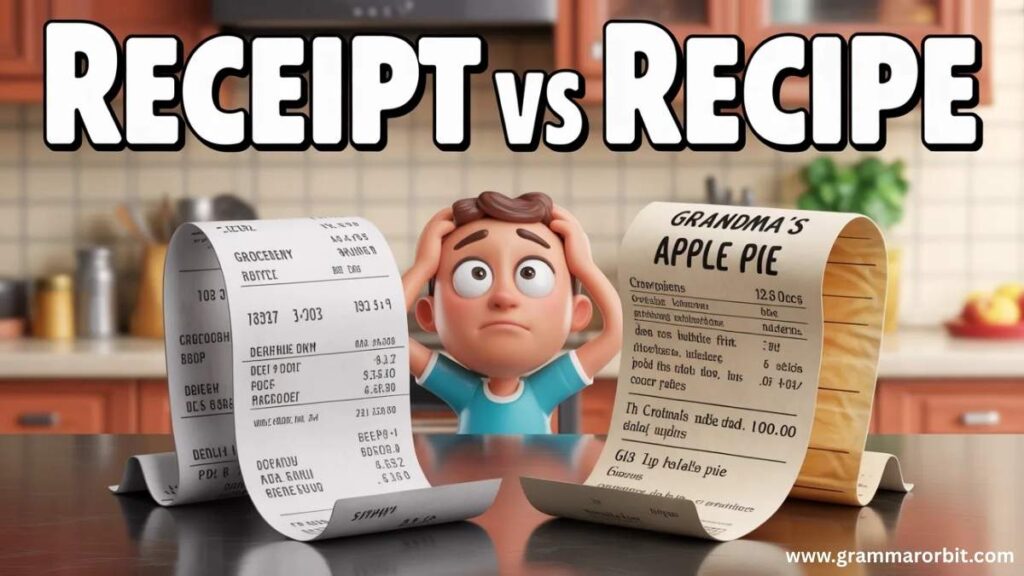
Have you ever opened an old cookbook and paused at a “receipt” for cookies, wondering if your grandmother had invented a secret financial trick instead of a sweet treat? Fear not she wasn’t doubling as an accountant. The world of receipt vs recipe is more than a spelling debate; it’s a delicious journey through historical recipes, 19th century cooking terms, and the quirks of old-fashioned kitchens. From vague instructions like “bake until done” to secret family tips scribbled in margins, understanding receipt or recipe meaning is like uncovering culinary treasure. Let’s stir the pot, explore the history, and see why one word stuck and the other got retired.
Origins of “Receipt” and “Recipe”
To understand the receipt vs recipe meaning in cooking, we need to explore their etymology and early uses. Both words share a common Latin origin but took distinct paths into English culinary language.
- Receipt Meaning
- Comes from Latin recipere, meaning “to receive” or “take.”
- Originally applied to instructions in medicine and household tasks.
- By the 16th century, “receipt” referred to instructions for cooking, just as it did for medicinal remedies.
- Recipe Meaning
- Directly derived from Latin recipe, the imperative form of recipere, literally “take this.”
- Initially a medical term, meaning “take this medicine.”
- By the 19th century, “recipe” shifted primarily to the culinary world.
Historical Example:
In 1597, English texts might say:
“Take a pound of sugar and mix with butter according to this receipt…”
Here, “receipt” clearly refers to what we now call a recipe. The instruction assumed the reader had practical knowledge, much like a skilled cook or apothecary would.
| Term | Latin Origin | Original Use | Modern Meaning |
|---|---|---|---|
| Receipt | recipere | Instructions for medicine or cooking | Rarely used in cooking today; mostly a financial proof |
| Recipe | recipe | Prescription or formula | Standard culinary instructions today |
Receipt as a Culinary Term
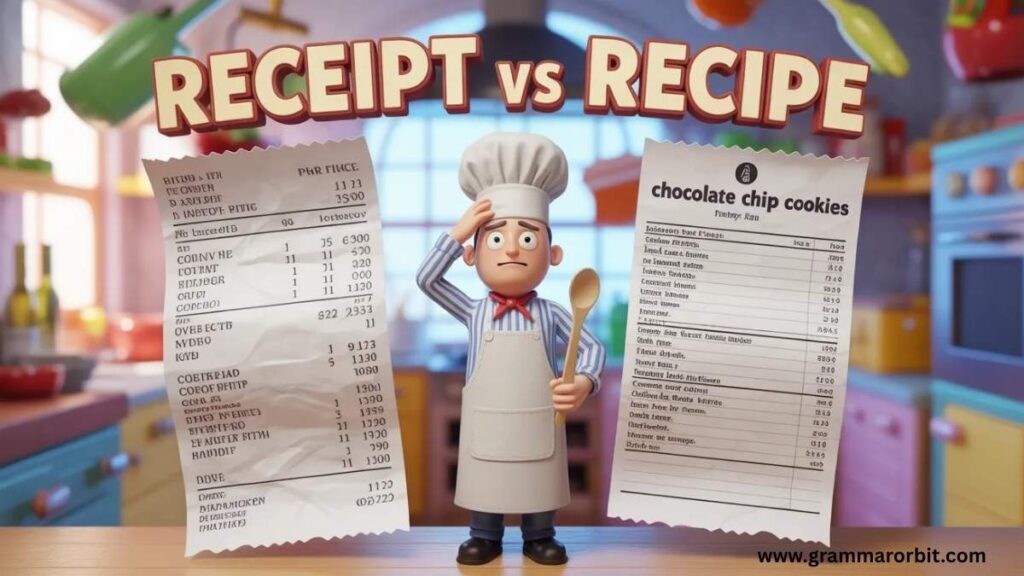
In the 18th and 19th centuries, the word receipt dominated cookbooks, household manuals, and family recipes. Here’s what makes it unique:
- Old-Fashioned Receipts
- Instructions were often brief and vague, expecting the reader to understand common techniques.
- Example from The Virginia Housewife (1838):
“Take a pound of sugar, mix it with butter, and bake in a moderate oven.”
- Beyond Cooking
- “Receipt” could also appear in medicine, perfumes, cleaning formulas, and even household maintenance.
- A single “receipt book” could combine cakes, remedies, and cleaning instructions, reflecting the multi functional nature of early household knowledge.
- Cultural Insight
- Using “receipt” emphasized practicality, skill, and hands-on experience. Unlike today’s recipes, precise measurements weren’t critical ntuition guided the cook.
The Transition from Receipt to Recipe
By the 19th century, “receipt” began to fade, replaced by the Latin rooted “recipe.” But why?
- Language and Literacy
- Education levels and literacy rates were rising. “Recipe” was considered clearer, more scholarly, and easier to standardize.
- Printing Press and Standardization
- As cookbooks became mass-printed, consistent spelling mattered. Publishers preferred “recipe” for clarity and professionalism.
- Cultural Preferences
- Urbanization and formal schooling contributed to adopting “recipe” over “receipt.”
- Readers expected precision, detail, and clarity, traits better served by “recipe.”
Timeline of the Shift:
| Century | Dominant Term | Context/Notes |
|---|---|---|
| 16th–17th | Receipt | Used for medicine and cooking, instructions were brief and assumed prior knowledge |
| 18th | Receipt | Common in both American and British cookbooks; sometimes interchangeable with recipe |
| 19th | Recipe emerges | Standardization in printing; modern spelling and usage began taking hold |
| 20th | Recipe dominates | Cooking language fully modernized; “receipt” mostly historical |
Receipt vs Recipe in 18th–19th Century Cookbooks
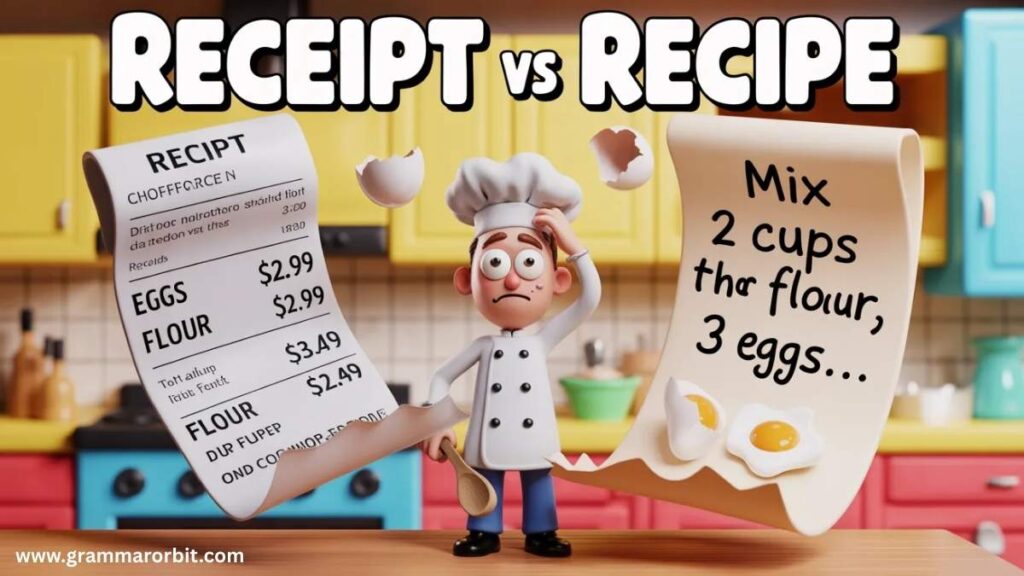
Examining historical recipes reveals regional and cultural differences in terminology.
- British Cookbooks: Often retained “receipt” well into the 1800s.
- American Cookbooks: Gradually shifted to “recipe,” especially after the mid-19th century.
Case Study: Confederate Receipt Book
The Confederate Receipt Book (1860s) is a treasure trove of Southern cooking traditions and old-fashioned receipts:
- Over 200 receipts for pastries, preserves, soups, and household remedies.
- Ingredients often listed vaguely (e.g., “sufficient sugar”), assuming cooks had intuition and prior experience.
- Reflects regional culture, economic constraints, and literacy levels.
Fun Fact: Many Confederate receipts included both culinary and medicinal formulas, showing the overlap between food and health in historical kitchens.
breakroom or break room The Correct Spelling
Receipt in Medicine vs Cooking
The word receipt has a fascinating dual life in history, appearing both in kitchens and in apothecaries. Understanding this overlap helps explain why it persisted for centuries and why it eventually gave way to the word recipe in the culinary world.
Receipt in Medicine
Originally, receipt came from the Latin word recipere, meaning “to take this.” In medicine, it referred to instructions or formulas for preparing remedies and medicines. Physicians, apothecaries, and household healers would write “receipts” as a guide for preparing:
- Herbal tinctures and poultices
- Syrups and tonics
- Pills and powders
Example from the 17th century:
“Take of rosemary, sage, and honey, mix and boil; give a spoonful twice daily.”
This formula wasn’t just a suggestion it was an essential instruction for treatment. The apothecary’s Receipt vs Recipe relied on precision in ingredients, but not the exact measurements we expect in modern medicine. Context and experience played a major role.
Interesting fact: Many medical receipts were passed down through families, much like family recipes, blurring the line between household medicine and culinary skill.
Steam vs Steem Understanding the Key Differences
Receipt in Cooking
At the same time, receipt was the word used for culinary instructions. In cookbooks from the 16th through the 19th centuries, a “receipt” was a set of directions for making:
- Cakes and pies
- Soups and sauces
- Pickles, preserves, and beverages
Example from The Virginia Housewife (1838):
“Take a pound of sugar, mix with butter, beat well, and bake in a moderate oven.”
Notice the similarity in style to medical receipts: short, instructive, and assuming prior knowledge. Just like a pharmacist’s directions, cooks were expected to understand technique, timing, and quantities without modern precision.
Similarities Between Medical and Culinary Receipts
| Feature | Medical Receipt | Culinary Receipt |
|---|---|---|
| Origin | Latin recipere (“take this”) | Latin recipere (“take this”) |
| Purpose | Prepare medicines or remedies | Prepare food or drinks |
| Style | Short, assumed knowledge, practical | Short, assumed knowledge, practical |
| Measurements | Often vague (handful, pinch, decoction) | Often vague (sufficient, as needed, moderate oven) |
| Audience | Apothecaries, household healers | Home cooks, household managers |
Both types of receipts relied heavily on experience and intuition. The shared style is why “receipt” worked equally well in kitchens and apothecaries for centuries.
Why the Shift Occurred
Over time, medicine and cooking diverged linguistically:
- Medicine transitioned to more formalized language, adopting the term prescription for clarity and precision.
- Cooking standardized measurements and instructions, adopting the term recipe in printed cookbooks by the 19th century.
- Printing and literacy played a key role: publishers favored “recipe” because it was clearly Latin in origin, easy to spell, and looked professional.
Quote: “In the 1700s, kitchens and apothecaries shared more than ingredients they shared a language of instruction, a common ‘receipt’ for success.” Karen Hess, culinary historian
What Does IHH Mean in Texting? The Complete Guide
Modern Usage: Recipe Rules Today
Today, “recipe” dominates. Receipt survives mostly in historical contexts, heritage cookbooks, and discussions of family recipes.
- Why Receipt Disappeared: Outdated spelling, lack of precision, and modern cookbook standards.
- Lingering Traces: Occasionally found in blogs or recreated 1800s cooking instructions.
- Comparison Table: Old vs Modern
| Feature | Old-Fashioned Receipt | Modern Recipe |
|---|---|---|
| Measurement | Approximate | Precise (cups, grams, teaspoons) |
| Instructions | Brief, assumed knowledge | Step-by-step, clear |
| Ingredients | Often mixed together | Categorized: wet, dry, garnish |
| Language | Archaic, sometimes poetic | Standardized, modern |
| Tools | Often implied | Clearly specified |
Practical Tip: Using “receipt” in reproductions signals historical authenticity, especially when referencing Confederate cooking recipes or 1800s cookbooks.
The Linguistic and Cultural Significance
The shift from receipt to recipe reflects broader patterns in language and culinary culture:
- Language Evolution: English simplified, standardized, and specialized terminology.
- Cultural Insights: Language mirrored social change—urbanization, literacy, and printing.
- Culinary Culture: Recipe standardization made cooking more accessible and consistent.
Sidebar Fun Fact: The phrase “a receipt for disaster” originally had a literal meaning—instructions to follow—linking back to the earliest use of “receipt.”
Key Takeaways
- Receipt vs Recipe Meaning: Receipt = old instruction, recipe = modern, precise instructions.
- Historical Recipes: Offer insights into vintage recipes, Southern cooking traditions, and traditional family recipes.
- Practical Tip: Use “receipt” in historical contexts for authenticity.
Exploring old cookbooks and Confederate Receipt Books is not just about nostalgia it’s a study in culinary history and linguistic evolution.
Reference Cambridge Dictionary Definitions
Here’s a trusted source for clear word meanings:
FAQs
What is the difference between a recipe and a receipt?
A receipt is the older term historically used for cooking instructions, dating back to the 16th–19th centuries. A recipe is the modern term for culinary instructions. While they mean the same thing in historical context, today recipe is standard, and receipt is mostly found in old cookbooks or heritage references.
Can receipt mean recipe?
Yes! In historical texts and old cookbooks, receipt meaning recipe was common. For example, a 19th century cookbook might list a “receipt for apple pie,” which is exactly what we would now call a recipe.
What does receipt mean?
Originally, receipt came from Latin recipere, meaning “to take.” In English, it referred to instructions or formulas both for medicine and cooking. Over time, its use in kitchens declined, and “recipe” became the standard term.
Why is it called a recipe?
The word recipe also comes from Latin recipe, the imperative form of recipere, meaning “take this.” It started as a medical prescription and evolved into a culinary term as printed cookbooks standardized the language in the 19th century.
What is recipe and receipt?
Both refer to instructions for cooking, but in different eras:
Recipe: Modern term used in contemporary cookbooks, blogs, and culinary instructions.
Receipt: Historical term used in 16th–19th century cookbooks.
Conclusion
So, next time you spot a “receipt” in an old cookbook, don’t panic your sugar cookies aren’t about to file taxes. That little word is a delicious slice of culinary history, a reminder that 19th century kitchens ran on intuition, tradition, and a sprinkle of mystery. From vague instructions to precise modern recipes, language has evolved, but the love of good food hasn’t. Whether you’re flipping through a Confederate Receipt Book or recreating old-fashioned receipts in your own kitchen, remember: every “receipt” tells a story, every recipe is a legacy, and every bite is proof that history tastes amazing.

JHON AJS is an experienced blogger and the creative voice behind the website grammarorbit.com, namely Grammar Orbit. With a keen eye for language and a passion for wordplay, he creates engaging grammar insights, word meanings, and clever content that make learning English enjoyable and interesting for readers.