
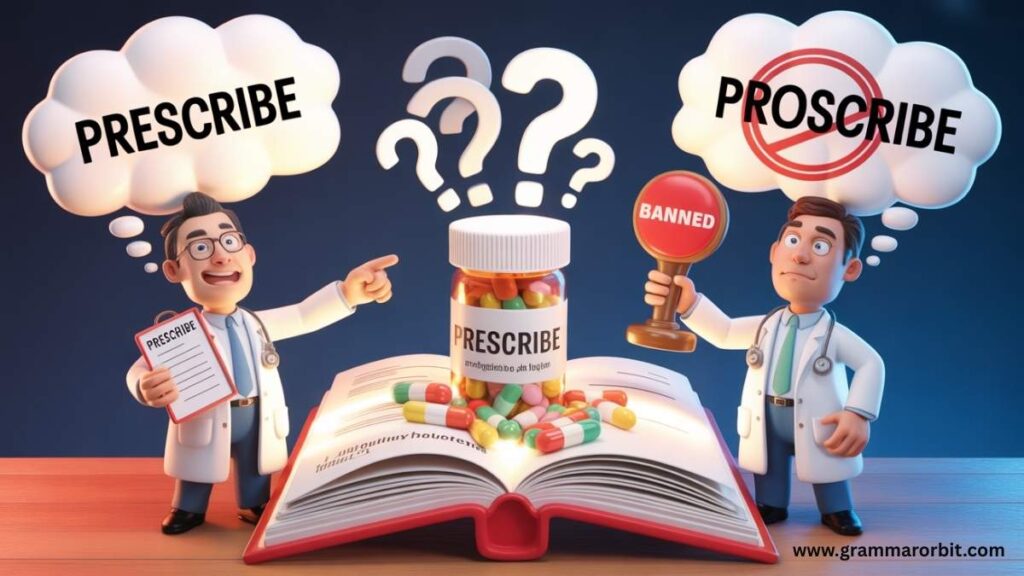
Ever stared at a sentence and thought, “This sounds smart… but is it secretly wrong?” Welcome to the world of prescribe vs proscribe, where one innocent looking letter can turn good advice into a strict ban. Mix them up, and suddenly a doctor is outlawing medicine or a law is approving crime. Awkward. These two words sound alike, dress alike, and show up in formal writing just to cause chaos. That’s why the prescribe vs proscribe confusion trips up writers, professionals, and grammar lovers alike. The good news? Once you see the difference clearly, you’ll never mix them up again and your sentences will finally say what you actually mean.
Prescribe vs Proscribe Meaning at a Glance
At their core, these two words do opposite jobs.
- Prescribe means to officially authorize, recommend, or set something.
- Proscribe means to formally forbid, ban, or prohibit something.
Think of them as verbal traffic signals.
- Prescribe gives the green light.
- Proscribe puts up a stop sign.
That contrast explains nearly every usage case.
Simple Definitions That Actually Stick
Before diving deeper, lock these meanings in clearly.
Prescribe Meaning
To officially approve, authorize, or lay down rules or instructions, usually from a position of authority.
Core idea:
“This is allowed, approved, or required.”
Proscribe Meaning
To formally forbid or ban something, often with legal or social consequences.
Core idea:
“This is not allowed.”
That’s the foundation of the prescribe vs proscribe difference.
Why These Words Exist and Why People Mix Them Up
Both words come from the Latin verb scribere, which means to write. Over time, prefixes changed how the action worked.
- Pre- relates to setting something beforehand
- Pro- in this case relates to removal or exclusion
Because both words share the same root and similar pronunciation, they fall into the category of similar sounding words in English and commonly confused words.
Add formal tone, and people hesitate. When writers hesitate, mistakes follow.
Prescribe Explained Clearly and Correctly
Prescribe Used in Medicine
This is the most familiar usage, and it sets the tone for all others.
When a doctor prescribes something, they don’t casually suggest it. They authorize it.
Doctors prescribe:
- Medications
- Dosages
- Treatment plans
- Physical therapy routines
Example:
The doctor prescribed a seven-day course of antibiotics.
Here, prescribe means:
- Approved
- Authorized
- Officially directed
That’s why medical terminology prescribe always implies responsibility and oversight.
Prescribe in Law Policy and Academia
Outside medicine, prescribe still carries authority.
In legal and academic contexts, it often means:
- To set official rules
- To define procedures
- To establish limits or standards
Examples:
The law prescribes a minimum sentence.
The handbook prescribes the required formatting style.
In these cases, prescribe doesn’t suggest choice. It sets expectations.
This distinction matters when discussing prescribe vs proscribe grammar, because switching the word reverses meaning.
Its Called vs It Called Understanding the Distinction Clearly
Prescribe as an Authoritative Recommendation
Sometimes prescribe means to recommend strongly, even outside official systems.
Example:
The trainer prescribed daily stretching exercises.
This still isn’t casual advice. It implies authority and expectation.
That’s the difference between recommend and prescribe. One suggests. The other directs.
Proscribe Explained Without the Drama
Historical Meaning of Proscribe
Historically, proscribe carried serious consequences.
In ancient societies, proscription meant public condemnation. Names appeared on lists. Property could be seized. Punishment followed.
That history explains why proscribe meaning still feels heavy today.
Proscribe Used in Law and Government
Modern usage appears most often in legal and political writing.
Governments proscribe:
- Organizations
- Activities
- Practices
- Materials
Example:
The government proscribed the organization due to security concerns.
This is not soft language. Proscribe used in law signals formal prohibition backed by authority.
That’s why the question is proscribe negative has a clear answer. Yes. Always.
WTH Meaning in Text: A Complete Clear and Practical Guide
Proscribe in Social and Workplace Contexts
People often misuse proscribe when they mean discourage or limit. That mistake exaggerates meaning.
Incorrect:
The company proscribed casual dress.
This sentence suggests casual dress is banned.
Correct:
The company discouraged casual dress.
Because proscribe definition involves banning, it rarely belongs in casual contexts.
The Core Difference Between Prescribe and Proscribe
This difference never fails.
- Prescribe tells people what to do.
- Proscribe tells people what not to do.
That’s the simplest and most reliable rule.
Prescribe vs Proscribe in a Sentence
Seeing the contrast side by side makes errors obvious.
Medical Examples
- Correct: The doctor prescribed pain medication.
- Incorrect: The doctor proscribed pain medication.
The second sentence means the medication is banned.
Legal Examples
- Correct: The law proscribes insider trading.
- Incorrect: The law prescribes insider trading.
One bans it. The other accidentally approves it.
Academic Examples
- Correct: The syllabus prescribes the reading list.
- Incorrect: The syllabus proscribes the reading list.
Again, meaning flips completely.
These prescribe vs proscribe examples show why precision matters.
It Is Must vs It Is a Must – The Correct Version Meaning
Why Prescribe and Proscribe Are So Confusing
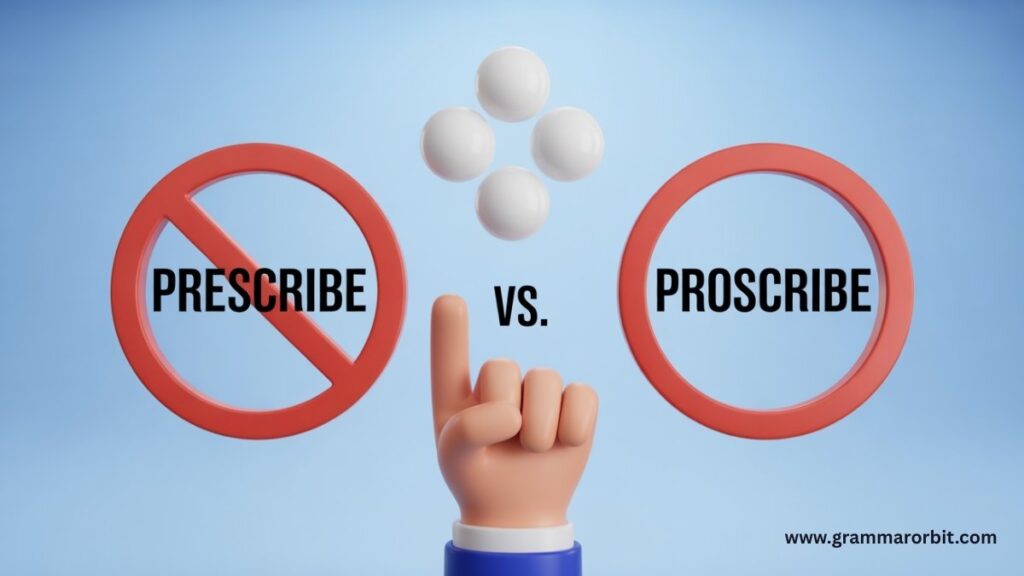
Several factors cause confusion.
- They sound almost identical
- They appear in formal English
- Spellcheck doesn’t catch misuse
- Both imply authority
Together, these factors make them classic English vocabulary mistakes and confusing English verbs.
Pronunciation Confusion Explained
Pronunciation doesn’t help.
- Prescribe: pri-SKRYBE
- Proscribe: pro-SKRYBE
In fast speech, the difference disappears. That’s why prescribe and proscribe sound similar and get swapped unintentionally.
How to Use Prescribe and Proscribe Correctly Every Time
Ask yourself one question before choosing.
Is this sentence allowing something or banning it?
- Allowing or setting → prescribe
- Banning or forbidding → proscribe
This quick check solves most mistakes instantly.
Memory Tricks That Actually Work
Forget clever rhymes. Use meaning-based memory.
- Prescribe connects to prescription → allowed
- Proscribe connects to prohibited → banned
Another way to think about it:
- Authorize vs prohibit meaning
- Ban vs recommend words
Anchor the word to the outcome.
Case Study: A Costly Word Choice Error
A policy draft once stated:
“The department prescribes unauthorized demonstrations.”
That sentence approved them instead of banning them.
The corrected version read:
“The department proscribes unauthorized demonstrations.”
One letter fixed the policy’s meaning entirely.
This example shows why formal writing tips emphasize clarity over vocabulary flair.
Common Myths About Prescribe vs Proscribe

“Pro always means for”
Not in this case. In proscribe, it signals exclusion.
“Prescribe only applies to medicine”
False. Rules, laws, and methods are often prescribed.
“They’re interchangeable in formal writing”
They are opposites, not alternatives.
These myths fuel confusing English vocabulary issues.
Quick Comparison Table
| Feature | Prescribe | Proscribe |
|---|---|---|
| Meaning | Authorize or set | Ban or forbid |
| Tone | Neutral or constructive | Strict and negative |
| Common use | Medicine, law, academia | Law, regulation |
| Risk if misused | Sounds controlling | Sounds extreme |
| Typical objects | Treatments, rules | Activities, groups |
This table alone prevents most misuse.
Prescribe vs Proscribe Explained Simply
Here’s the easiest explanation possible.
- Prescribe = approve or require
- Proscribe = forbid or ban
That’s it.
No complicated grammar rules needed.
Reference: Cambridge Dictionary Definitions
Here’s a trusted source for clear word meanings:
FAQs
Q1: What is the difference between prescribe and proscribe?
The difference between prescribe and proscribe is simple but critical. Prescribe means to officially allow, authorize, or set something, often from a position of authority. Proscribe, on the other hand, means to formally forbid or ban something. One gives approval. The other removes permission entirely. Mixing them up flips the meaning of a sentence, which can cause serious confusion in formal writing.
Q2: Why do people confuse prescribe and proscribe?
People confuse prescribe vs proscribe because the words look similar, sound similar, and appear in formal English where writers try to sound precise. Spellcheck doesn’t help, and both words imply authority, which adds to the confusion. Add fast reading or writing under pressure, and it’s easy to grab the wrong one without realizing it.
Q3: Does prescribe mean allow?
Yes. Prescribe meaning includes allowing, approving, or officially setting something. Medicine, a doctor prescribes treatment. In law or policy, rules prescribe procedures. In every case, the idea is the same: the action is permitted or required, not forbidden.
Q4: Does proscribe mean ban?
Yes. Proscribe meaning is always negative. To proscribe something is to ban it, forbid it, or declare it unacceptable. The word often appears in legal, political, or regulatory contexts, where violations can lead to penalties or consequences.
Q5: How can I remember prescribe vs proscribe easily?
Use meaning based memory instead of spelling tricks. Prescribe connects to prescription, which means approved or allowed. Proscribe connects to prohibited, which means banned. If the sentence allows something, choose prescribe. If it forbids something, choose proscribe. This method works every time.
Conclusion
At the end of the day, prescribe vs proscribe isn’t a tricky grammar puzzle. It’s a meaning check. One word gives permission, the other slams the door shut. Mix them up, and your sentence goes from helpful to hostile in record time. That’s not a typo. That’s a full blown message meltdown. The fix is simple. If something is allowed, approved, or officially set, you prescribe it. If something is banned, forbidden, or absolutely not happening, you proscribe it. Get this pair right, and your writing instantly sounds clearer, sharper, and more confident no prescription required, and definitely no proscription needed.

JHON AJS is an experienced blogger and the creative voice behind the website grammarorbit.com, namely Grammar Orbit. With a keen eye for language and a passion for wordplay, he creates engaging grammar insights, word meanings, and clever content that make learning English enjoyable and interesting for readers.