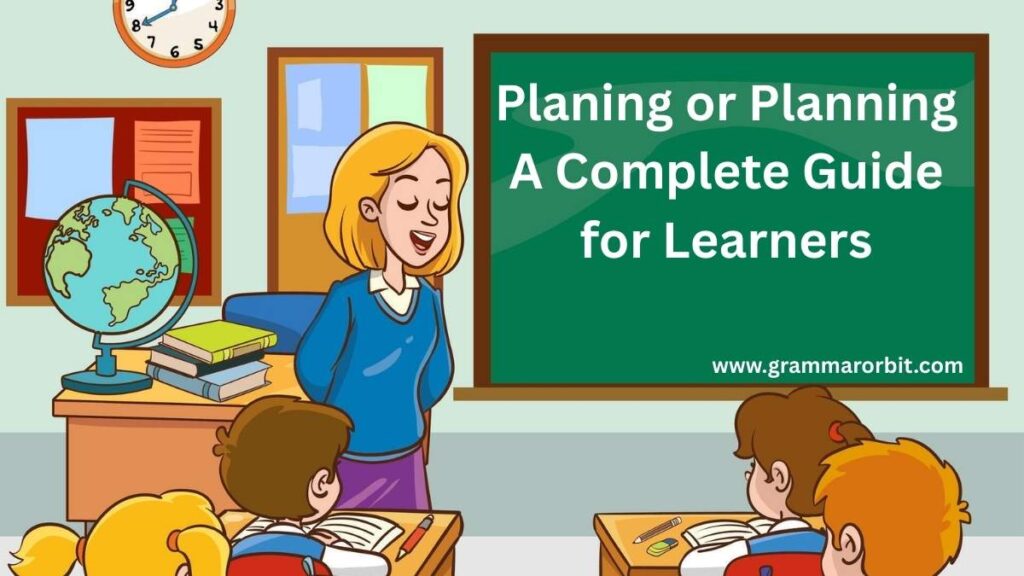
Planing or Planning why does English have to be so sneaky? One minute you’re confidently typing “I’m planning my weekend,” and the next, autocorrect has turned it into “I’m planing my weekend,” leaving your friends wondering if you’re starting a woodworking project instead of organizing brunch. If you’ve ever stared at a sentence, squinting at those two nearly identical words and asked, “Which one is correct: planing or planning?” you’re in the right place. This guide will untangle the confusion, give you clear rules, real-life examples, and even a few laughs along the way, so you’ll never mix them up again.
Quick Answer: Which One Should You Use?
Here’s the fast answer: if you’re talking about organizing, preparing, or scheduling something, the correct word is planning. If you’re talking about smoothing a surface, usually in woodworking or on a boat, the word is planing.
Think about it this way: if you’re thinking ahead, you’re planning. If you’re using a tool to smooth wood or a surface, you’re planing. Simple, right?
What Planning Means
Planning is all about preparation and organization. It’s when you take a moment to think ahead, schedule tasks, or work out strategies.
Planning can be a verb, like “I am planning my weekend,” or a noun, like “Effective planning is key to finishing projects on time.”
Some everyday examples of planning include:
- Organizing a birthday party
- Setting up a weekly work schedule
- Preparing a study plan for exams
- Planning a trip or vacation
Planning is everywhere, even if you don’t think about it. Anytime you’re thinking ahead or structuring your tasks, you are planning.
Common phrases with planning
- Strategic planning
- Event planning
- Daily planning
- Planning for the future
If your sentence involves organizing or preparing, planning is almost always the word you want.
What Planing Means
Planing is different. It’s a technical term that refers to smoothing or leveling a surface, usually with a planer tool. You’ll find it in woodworking, carpentry, metalworking, and boating.
Some examples of planing include:
- A carpenter smoothing a wooden plank with a hand plane
- A boat gliding over water as it planes at speed
- Smoothing metal sheets for precise fitting
Planing is always physical. It’s about changing a surface, not making plans for the future.
Bougie or Boujee What Do They Really Mean?
Why People Get Confused
Even native English speakers stumble over planing vs planning, and it’s easy to see why. At first glance, the two words look almost identical they both start with “plan,” end with “ing,” and sound very similar when spoken. But their meanings are completely different.
1. Similar Spelling Tricks the Eye
The words only differ by one letter: planning has a double “n,” while planing has a single “n.” When you’re typing quickly or relying on memory, it’s easy to skip that extra “n” and accidentally change the meaning of your sentence.
2. Pronunciation Confusion
Depending on your accent, planing and planning can sound nearly the same. That makes it easy to mix them up when writing based on how they sound rather than what they mean.
3. Context Is Key, But Easy to Miss
Many learners assume that because they’re “planning” something like a party or a trip they should just write planing. Without paying attention to the context, the wrong word slips in. For example: “I am planing my birthday party” sounds like you’re sanding a cake instead of organizing it.
4. Influence of Typing and Autocorrect
Autocorrect can actually make things worse. Sometimes your device doesn’t know the difference between planning and planing and may “correct” a word incorrectly. This is especially confusing in professional emails or school assignments.
5. Overlapping Grammar Rules
English has quirky rules for verbs ending in “l.” For example, plan → planning doubles the “n” because of the short vowel, but learners often forget this and use a single “n,” which makes the spelling look like the technical term planing.
Bottom line: The confusion happens because the words look alike, sound alike, and sometimes follow similar spelling patterns. The trick to mastering them is paying attention to context are you organizing something or smoothing a surface? That single question will save you from embarrassing mistakes.
British English vs American English
Many learners wonder if there’s a difference between British and American English. The good news: there isn’t.
- Planning is spelled the same and used the same in both varieties of English
- Planing is also consistent across English dialects
So whether you’re writing for an American audience or a British one, the rules don’t change.
Camisole Meaning Slang: A Complite guide 2026
Correct Usage Planing vs Planning
Here’s a clear breakdown to make things crystal:
When to Use Planning
Use planning whenever you’re talking about preparing, organizing, or thinking ahead.
Examples:
- I am planning my summer vacation
- Future planning examples include saving money and scheduling tasks
- She is planning her workday with a detailed checklist
When to Use Planing
Use planing only in technical or physical contexts.
Examples:
- The carpenter is planing the oak board before varnishing
- Boat planing allows it to glide smoothly over the water
- Metal sheets require planing for precise fitting in machinery
Comparison Table: Planing vs Planning
| Feature | Planning | Planing |
|---|---|---|
| Meaning | Organizing, preparing, thinking ahead | Smoothing or leveling a surface |
| Part of Speech | Verb/Noun | Verb |
| Common Context | Office, school, daily life, strategic tasks | Woodworking, carpentry, boating, metalwork |
| Example Sentence | “I’m planning my weekend activities.” | “He is planing the tabletop for finishing.” |
| Spelling Rule | Double the n after a short vowel in verbs ending with l | Single n for technical action |
Common Mistakes and How to Avoid Them
Even native speakers slip up. Here are some typical mistakes:
- Saying “I am planing a party” instead of “I am planning a party”
- Using “planning” when talking about smoothing wood
- Forgetting to double the n in planning after a short vowel
Tips to avoid errors:
- Pause and ask yourself: is this about organizing or smoothing?
- Look at the context: abstract preparation or technical action?
- Use a mnemonic: Plan → plan ahead (double n), Plane → plane the wood (single n)
Real-Life Examples
Planning in everyday life
- “We are planning our wedding for next summer.”
- “Financial planning is important for long-term security.”
- “She is planning her work schedule to fit family commitments.”
Planing in technical contexts
- “The carpenter is planing the oak board to remove rough edges.”
- “Boat planing allows the vessel to glide faster over waves.”
- “The metal sheets require careful planing before assembly.”
By reading these examples, the difference becomes obvious: one is mental, the other is physical.
Signer or Signor What’s the Real Difference?
How to Remember the Difference
Here are some tricks learners find helpful:
- Planning → think of “planning your life ahead”
- Planing → think of “plane the wood smooth”
- Ask: Are you preparing, or are you smoothing? Context is everything
Other English grammar tips:
- Verbs ending in l often double the n before adding ing → plan → planning, travel → travelling
- Proofreading helps avoid confusing words in English writing
Summary
- Planning = organizing, preparing, and thinking ahead
- Planing = smoothing or leveling surfaces
- Context determines which word is correct
- Double the n in planning after short vowels
- Proofread to avoid common English spelling mistakes
Quick tip: Visualize planning as thinking and preparing and planing as physically smoothing a surface. This simple mental check will keep your writing accurate and professional.
Practical Exercise
To reinforce your learning:
- Write 10 sentences using planning for everyday tasks.
- Write 5 sentences using planing in technical contexts.
- Read your sentences aloud to check the meaning.
Practicing this way will make the difference between planing vs planning second nature.
Reference Cambridge Dictionary Definitions
Here’s a trusted source for clear word meanings:
FAQs
What do you mean by planning?
Planning means organizing, preparing, or arranging tasks, events, or goals in advance. It’s about thinking ahead and making sure things run smoothly. For example: “She is planning her vacation to avoid last-minute stress.”
What’s the difference between planning and planing?
The difference is all about context:
- Planning refers to preparation and organizing tasks.
- Planing refers to smoothing or leveling a surface, usually in woodworking, metalwork, or boating.
Example: “I’m planning a party” vs “He is planing the wooden table.”
When would I use planning?
Use planning whenever you’re talking about preparation, organizing tasks, or scheduling events.
Examples include:
- Planning a trip
- Planning a work schedule
- Planning future goals
Is planing ever the right spelling?
Yes, but only in technical contexts. Planing is correct when referring to smoothing surfaces with a plane tool, leveling wood, metal, or even describing a boat gliding over water.
Is it planning or planing?
It depends on what you mean:
- Organizing tasks → planning
- Smoothing surfaces → planing
How do you spell planing a door?
If you’re talking about leveling or smoothing a door with a tool, the correct spelling is planing.
Example: “The carpenter is planing the door to fit the frame perfectly.”
Conclusion
So, next time you’re staring at your keyboard wondering, “Is it planing or planning?” remember this: if you’re organizing your life, it’s planning. If you’re sanding a wooden board or trying to make your boat skim the waves, it’s planing. English loves to mess with us, but a little attention to context goes a long way. Keep these rules in mind, proofread like a grammar ninja, and maybe chuckle at the idea of someone planing a birthday party. With practice, you’ll always know which word fits and you might even impress a carpenter or two along the way.

JHON AJS is an experienced blogger and the creative voice behind the website grammarorbit.com, namely Grammar Orbit. With a keen eye for language and a passion for wordplay, he creates engaging grammar insights, word meanings, and clever content that make learning English enjoyable and interesting for readers.