
If you’ve ever stared at a sentence and wondered, “Wait, should this be on to or onto?” don’t worry, you’re not alone. English has a sneaky way of turning simple phrases into tiny grammar landmines, and On to vs Onto is one of the trickiest. One wrong move, and suddenly your perfectly polished sentence reads like it was written by a cat walking across a keyboard. But fear not! In this guide, we’ll unravel the confusion, explain the difference between onto and on to, share real-life examples, and give you practical tips so your writing finally lands in the right place every time.
The Core Difference: On to vs Onto in Simple Terms
The difference between onto vs on to is straightforward once you understand the roles each phrase plays.
- Onto is a preposition that indicates movement toward a surface, position, or figurative awareness.
- On to is two separate words and usually occurs when “on” is part of a verb phrase and “to” belongs to an infinitive or another preposition.
Here is a clear comparison:
| Phrase | Type | Usage | Example |
|---|---|---|---|
| Onto | Preposition | Physical movement toward a surface or position | The cat jumped onto the windowsill. |
| Onto | Preposition | Figurative movement or awareness | He is onto a new strategy for marketing. |
| On to | Phrase (verb + to) | Continuation, transition, or moving forward | She moved on to the next chapter. |
| On to | Phrase | Verb + object + infinitive | He passed the document on to his colleague. |
Key takeaway: If you are showing physical or figurative movement onto a surface or object, use onto. If the “to” belongs to a verb phrase, use on to.
Why Understanding This Matters
Using onto vs on to incorrectly is a very common grammar mistake that affects writing clarity. Misuse can:
- Confuse readers about the action taking place.
- Make professional writing appear careless.
- Distract from the main message of emails, reports, or articles.
For example:
- Incorrect: He jumped on to the platform.
- Correct: He jumped onto the platform.
Even minor missteps can make a significant difference in writing professionally, especially in business communications, academic writing, or formal reports. Knowing the difference also ensures your writing remains precise and authoritative.
Vender vs Vendor Which Spelling Is Correct?
Grammar Rules & Mechanics

Onto: Preposition for Movement
Onto meaning relates to movement toward a surface or position. It can also describe awareness or figurative understanding.
Rules for using onto:
- Use after verbs that indicate movement or action toward a surface.
- Works with verbs such as climb, jump, step, fall, move, get.
- Can be used figuratively to indicate understanding or awareness.
Examples of onto in sentences:
- The child climbed onto the chair to reach the shelf.
- The dog jumped onto the bed without hesitation.
- The detective is onto a major clue in the case.
Physical vs abstract movement:
- Physical: Moving onto a surface or position.
- Abstract: Understanding or realizing something.
On to: Separate Words That Work Together
On to meaning appears when “on” is part of a verb, and “to” is connected to the next word, often an infinitive or object.
Rules for using on to:
- Often follows phrasal verbs such as move on to, carry on to, go on to.
- Indicates continuation, progression, or transition in a sequence.
Examples of on to in sentences:
- After finishing the first task, she moved on to the next one.
- He passed the message on to his supervisor.
- They went on to explain the next steps in detail.
Practical tip: If replacing “on to” with “onto” makes the sentence illogical, then “on to” is correct.
Capital vs Capitol The Complete Guide
Quick Decision Tools: Flowchart & Mnemonics

Here is a step-by-step approach to quickly decide between onto vs on to:
Step 1: Does the sentence involve physical movement toward a surface?
- Yes → Use onto
- No → Go to Step 2
Step 2: Is “to” part of a verb phrase or infinitive?
- Yes → Use on to
- No → Likely onto
Mnemonic to remember:
- Onto = climbing or touching a surface
- On to = moving forward in action or continuation
This simple mental trick helps avoid common mistakes in writing clarity.
Real-Life Contexts & Scenarios
Understanding the difference becomes easier when you see examples in physical and abstract contexts.
Physical Movement (Onto)
- She stepped onto the platform carefully.
- The cat jumped onto the counter.
- The hikers climbed onto the ridge for a better view.
Fact: Whenever the subject physically moves toward a surface or object, onto is required.
Abstract or Figurative Movement (On to)
- After the meeting, the team moved on to discuss the next project.
- She went on to become a leading expert in her field.
- The lecture finished, and the professor went on to explain the research findings.
Case study: Corporate emails often misuse “onto vs on to.” Correct usage makes instructions and progressions clear:
- Correct: Once the Q1 report is complete, we will move on to Q2 planning.
- Incorrect: Once the Q1 report is complete, we will move onto Q2 planning.
Common Pitfalls & How to Avoid Them
- Confusing phrasal verbs with movement
- Incorrect: He jumped on to a conclusion.
- Correct: He jumped onto the platform.
- Replacing on to with onto unnecessarily
- Incorrect: She moved onto the next task.
- Correct: She moved on to the next task.
- Overusing onto in figurative contexts
- Onto should only be used figuratively in clear cases like “He’s onto a new opportunity.”
- Ignoring grammar cheat sheets
- Keep a small table for on to grammar rules and phrasal verbs using on and to.
Reference Table:
| Verb | Correct Usage | Notes |
|---|---|---|
| Jump | Onto | Physical movement |
| Step | Onto | Physical movement |
| Move on | On to | Abstract progression |
| Go on | On to | Phrasal verb + infinitive |
| Pass | On to | Verb + object + to |
Goodmorning or Good Morning A Complete Guide
Advanced Insights & Edge Cases
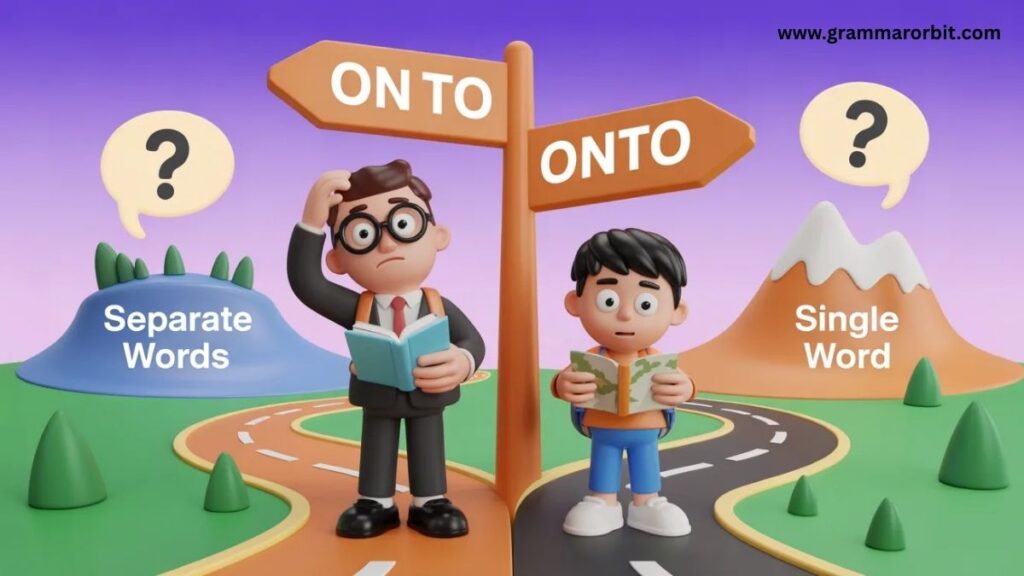
- Figurative onto: Sometimes “onto” describes awareness rather than physical movement:
- He’s onto a major breakthrough in science.
- Edge phrasal verbs: Some verbs, like “carry on to” or “go on to,” may confuse beginners. Always check if “to” is part of the verb phrase.
- Onto vs to: Do not confuse “onto” with “to” when describing movement:
- Wrong: He went onto the store.
- Correct: He went to the store.
- Regional differences: Usage is mostly consistent in US and UK English, though formal British writing may use abstract “onto” more freely.
Interactive Testing & Practice
Quiz: Fill in the blanks with “onto” or “on to”
- The dog jumped ___ the fence.
- After finishing the project, she moved ___ the next one.
- He’s ___ a new marketing strategy.
- Pass the documents ___ the manager.
Answers:
- Onto
- On to
- Onto
- On to
Regular practice helps internalize the rules and improves English writing skills over time.
Reference Cambridge Dictionary Definitions
Here’s a trusted source for clear word meanings:
FAQs
Is it onto or on to the next chapter?
When deciding between onto and on to, think about the context:
- On to the next chapter is correct here because “move on to” is a phrasal verb indicating progression.
- Onto would suggest physically moving onto a surface, which doesn’t make sense for reading.
Example:
- Correct: After finishing chapter one, she moved on to chapter two.
- Incorrect: After finishing chapter one, she moved onto chapter two.
What’s the difference between onto and unto?
- Onto shows movement toward a surface or figurative awareness.
- Unto is old-fashioned, mostly found in formal or biblical English, meaning “to” or “until”.
Example:
- Onto: He climbed onto the roof.
- Unto: Blessed are those who listen unto wisdom.
Tip: In modern writing, use onto for movement and avoid “unto” unless writing formally or quoting scripture.
Is it on to you or onto you?
- Onto you is correct if it involves physical contact or figurative transfer.
- On to you is used when “to” is part of a verb phrase, usually meaning passing something along.
Examples:
- Onto you (physical/figurative): The responsibility fell onto you.
- On to you (verb + to): I will pass the message on to you.
Is it walking onto or walking on to?
- Walking onto is used for physical movement onto a surface.
- Walking on to is used when “to” is part of the verb phrase or indicates a transition.
Examples:
- Walking onto: She is walking onto the stage to give her speech.
- Walking on to: After the first part of the tour, they are walking on to the next exhibit.
Conclusion
Mastering On to vs Onto might feel like trying to herd cats tricky, unpredictable, and slightly frustrating but once you get it, your writing suddenly looks sharp, professional, and downright smart. Remember: onto is for climbing, jumping, or realizing something, while on to is all about moving forward, continuing, or passing things along. Keep your flowcharts handy, practice with real sentences, and soon you’ll spot the difference without breaking a sweat. So go ahead step onto this grammar victory, move on to your next writing project, and watch your sentences stay upright instead of tumbling into confusion!

JHON AJS is an experienced blogger and the creative voice behind the website grammarorbit.com, namely Grammar Orbit. With a keen eye for language and a passion for wordplay, he creates engaging grammar insights, word meanings, and clever content that make learning English enjoyable and interesting for readers.