
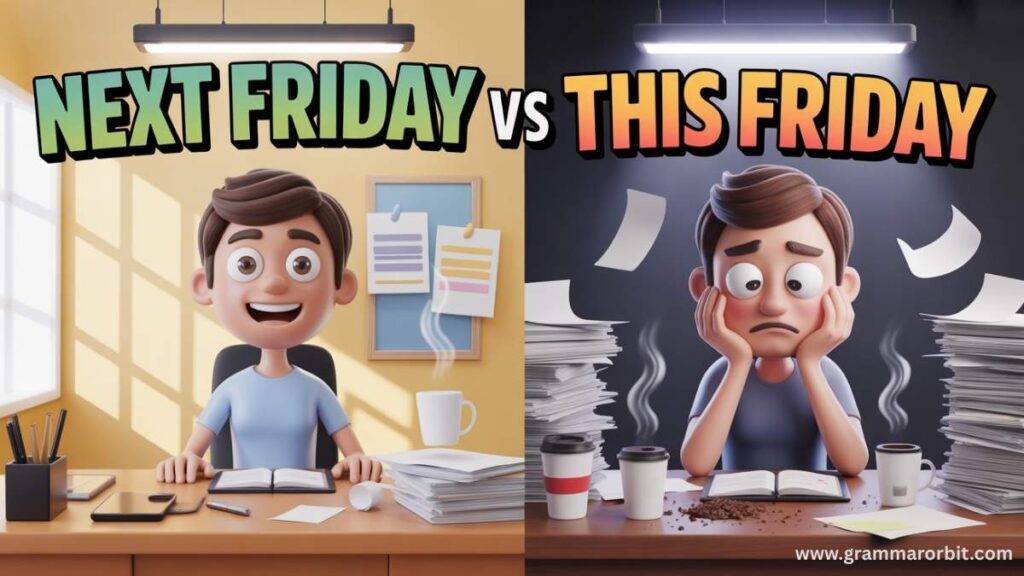
Have you ever scheduled a meeting, sent a text, or made weekend plans, only to realize later that next Friday vs this Friday totally confused everyone involved? Suddenly, your “quick catch up” turns into a game of calendar roulette. Friends show up a week early, coworkers wait in an empty conference room, and you’re left wondering if time itself is playing tricks. Don’t worry you’re not alone. Calendar confusion like this is surprisingly common, and it can turn even the simplest plans into chaos. In this guide, we’ll untangle the mess, clarify Friday date clarification, and make sure you never misread a Friday again.
Why “Next Friday” and “This Friday” Confuse Everyone
It may seem simple, but many people misinterpret next Friday vs this Friday, even in everyday conversations. The problem comes from ambiguity in dates and relative time expressions.
- Some people use this Friday to mean the closest upcoming Friday.
- Others say next Friday to indicate the Friday after the upcoming one.
Such small differences can create professional scheduling errors, text message scheduling issues, and everyday misunderstandings. Imagine telling a coworker, “Let’s meet next Friday,” and they show up a week too early or too late.
A recent workplace survey found that nearly half of employees admit to misreading date phrases at least once a month, often causing unnecessary rescheduling headaches.
Understanding the Core Difference This vs Next

To prevent date confusion, you need to grasp the core difference between this Friday and next Friday:
| Phrase | Common Interpretation | Example (Today: Monday, Dec 23, 2025) |
|---|---|---|
| This Friday | The closest upcoming Friday | Dec 27, 2025 |
| Next Friday | The Friday after the upcoming one | Jan 3, 2026 |
Key Points:
- This Friday usually means this week’s Friday.
- Next Friday usually refers to Friday of next week, though interpretations vary.
- Context, urgency, and even regional language differences can change understanding.
So When Is Next Friday?
Figuring out next Friday’s date isn’t always intuitive. A simple method.Figuring out next Friday isn’t always as simple as it seems. Misunderstanding this phrase is one of the most common causes of calendar confusion, meeting misunderstandings, and scheduling mistakes. The key lies in understanding relative time expressions and contextual date meaning.
- Identify today’s day of the week.
- Count the upcoming Friday as this Friday.
- The Friday after that is next Friday.
Example Table: Next Friday Calculation (Today: Wednesday, Dec 25, 2025)
| Today | This Friday | Next Friday |
|---|---|---|
| Wed, Dec 25, 2025 | Fri, Dec 27, 2025 | Fri, Jan 3, 2026 |
| Mon, Dec 23, 2025 | Fri, Dec 27, 2025 | Fri, Jan 3, 2026 |
| Sat, Dec 28, 2025 | Fri, Jan 3, 2026 | Fri, Jan 10, 2026 |
Tip: Always double-check your digital calendar to prevent digital calendar issues like incorrect interpretations of ambiguous time phrases.
The Seven Day Rule to Clarify Scheduling
One foolproof method to avoid confusion is the “seven-day rule” for Fridays:
- If the event is within seven days, call it this Friday.
- If it’s beyond seven days, call it next Friday or, better yet, include the exact date.
Why it works:
- Reduces miscommunication in scheduling.
- Helps in time-sensitive planning for remote teams or colleagues in different regions.
- Prevents planning errors caused by relative time expressions.
TB Meaning in Text Explained Polite Casual
Context Matters Casual vs Professional Use

The way you use next Friday vs this Friday depends on context.
Casual Conversations
- Friends may interpret “next Friday” loosely.
- Confusion is rarely serious but can still create minor inconveniences.
- Example: “Let’s grab lunch next Friday.” Clarifying the exact date avoids text message scheduling mix-ups.
Professional Communication
- Misunderstandings here can be costly.
- Professional scheduling requires precise dates to prevent meeting misunderstandings and deadline misunderstanding.
- Tip: Include the exact date in emails, chats, or calendar invites.
- Example: “Meeting scheduled for Friday, Jan 3, 2026, at 10 AM EST.”
Quote: “Clear communication saves more time than any calendar app ever could.”
How Digital Calendars Can Trip You Up
Even technology can’t fully eliminate calendar confusion.Even the most sophisticated digital calendars aren’t immune to calendar confusion. In fact, relying on apps can sometimes make next Friday vs this Friday even trickier. Here’s why:
- Some apps interpret next Friday differently depending on settings or locale.
- One app may schedule the nearest Friday, while another selects the Friday of the following week.
- International time differences can shift meetings a day forward or backward, leading to mistakes.
Tip: Always verify dates after entering ambiguous time phrases in your digital calendar to avoid professional scheduling errors.
Better Phrasing to Avoid Confusion
Precise language is essential. Here are recommended alternatives:
- Include the exact date:“Let’s meet on Friday, Dec 27, 2025, at 3 PM.”
- Use “this coming Friday” versus “Friday next week”.
- In professional contexts, include the time zone for remote teams.
- Avoid ambiguous time phrases in emails or calendar invites.
Table: Recommended Phrasing
| Ambiguous Phrase | Clear Alternative |
|---|---|
| Next Friday | Friday, Jan 3, 2026 |
| This Friday | Friday, Dec 27, 2025 |
| Friday of next week | Friday, Jan 3, 2026 |
| Upcoming Friday | Friday, Dec 27, 2025 |
TYVM Meaning What It Stands for and How to Use It
Why This Really Matters

Miscommunication in scheduling isn’t just inconvenient it can be costly:
- Surveys show nearly half of professionals report lost productivity due to misread date phrases.
- A single mistake in professional scheduling once caused a company to miss a $25,000 contract because the client showed up on the wrong Friday.
- Even in personal life, missed gatherings or double bookings can strain relationships.
Clear communication prevents planning errors, meeting misunderstandings, and deadline misunderstandings.
Regional and Cultural Variations
International time differences and regional language differences affect interpretation.Understanding next Friday vs this Friday isn’t just about English grammar it’s also about regional language differences and cultural habits. What seems clear in one country can cause total calendar confusion in another.
English Speaking Countries
United Kingdom: Brits often use next Friday to mean the closest upcoming Friday, which is the opposite of most American usage. Imagine scheduling an international Zoom call without clarifying the exact date you could end up talking to an empty room.
United States: People usually interpret next Friday as the Friday after the upcoming one, while this Friday refers to the closest Friday. However, many Americans still mix them up in casual conversation, which can lead to meeting misunderstandings or deadline misunderstanding.
- UK English: “Next Friday” often means the upcoming Friday.
- US English: “Next Friday” usually refers to the Friday after the nearest one.
- Non-English contexts: Many languages avoid relative date phrases, reducing ambiguity.
Tip for global teams: Always clarify dates explicitly. Use good calendar invite etiquette to prevent confusion across time zones.
TTM Meaning in Text and How to Use It
Tips to Avoid Friday Confusion Forever

Avoiding calendar confusion around next Friday vs this Friday takes more than luck it takes strategy. Here’s how to make sure you never misread a Friday again:
1. Always Specify the Exact Date
- Instead of saying “next Friday,” say “Friday, January 3, 2026”.
- Adding the month and day eliminates ambiguous time phrases and meeting misunderstandings.
- Works in text messages, emails, calendar invites, and casual chats.
- Always specify the date. Don’t rely on “next” or “this” alone.
- Verify digital calendar entries to avoid digital calendar issues.
- Use the seven-day rule for clarity.
- Communicate clearly with remote teams, considering international time differences.
- Keep a quick reference table handy for professional scheduling.
Reference Cambridge Dictionary Definitions
Here’s a trusted source for clear word meanings:
FAQs
Do you say this Friday or next Friday?
You say this Friday when referring to the closest upcoming Friday. Use next Friday for the Friday after that. If the timing isn’t obvious, include the exact date to prevent calendar confusion and scheduling mistakes.
What is the difference between this Tuesday and next Tuesday?
This Tuesday refers to the nearest Tuesday on the calendar, while next Tuesday usually means the Tuesday following that. Context matters especially for professional scheduling or remote team coordination so clarifying the date is always safer.
Which is correct, this Sunday or next Sunday?
Both are correct depending on what you mean:
- This Sunday: The Sunday coming up in the current week.
- Next Sunday: The Sunday after the upcoming one.
To avoid meeting misunderstandings or deadline misunderstanding, specify the calendar date.
When to use this vs next?
Use this for events within the current week and next for events beyond the upcoming week. A handy rule is the seven-day rule: if the date is within seven days, it’s this; if it’s farther away, it’s next.
Do you say next Monday or this Monday?
- This Monday: The Monday closest to today.
- Next Monday: The Monday after the upcoming Monday.
If you’re coordinating with international teams, double-check for international time differences and avoid ambiguous time phrases to prevent planning errors.
Conclusion
So, there you have it next Friday vs this Friday decoded, demystified, and served with a side of sanity. No more awkward texts, empty conference rooms, or surprise deadlines. With the seven day rule, precise dates, and a little calendar common sense, you can dodge calendar confusion, scheduling mistakes, and meeting misunderstandings like a pro. Remember, a misplaced Friday isn’t just a minor slip up it’s a full blown planning crime. Keep your dates clear, your invites exact, and your sanity intact. Now go forth, schedule confidently, and may all your Fridays be exactly when you expect them!

JHON AJS is an experienced blogger and the creative voice behind the website grammarorbit.com, namely Grammar Orbit. With a keen eye for language and a passion for wordplay, he creates engaging grammar insights, word meanings, and clever content that make learning English enjoyable and interesting for readers.