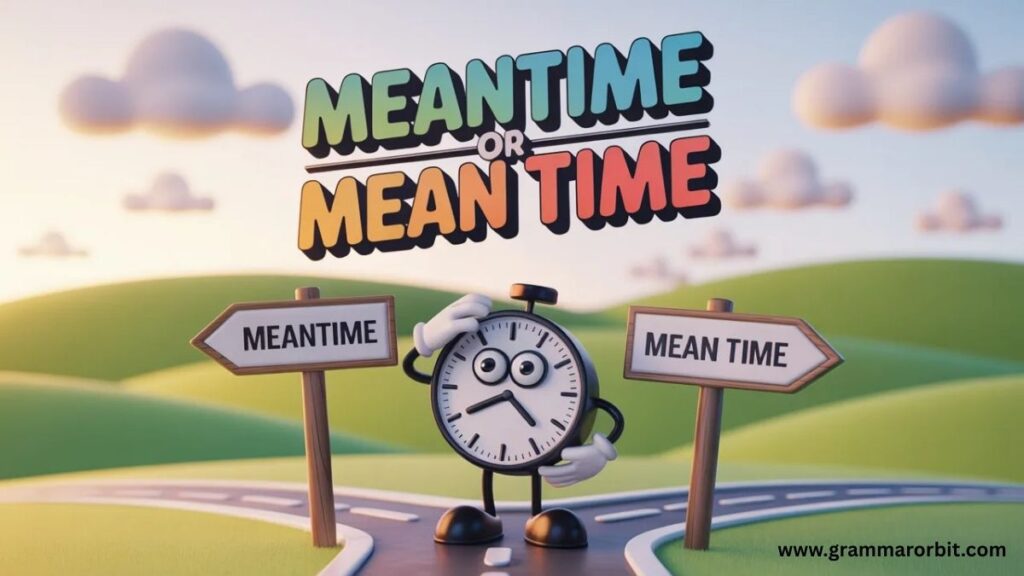
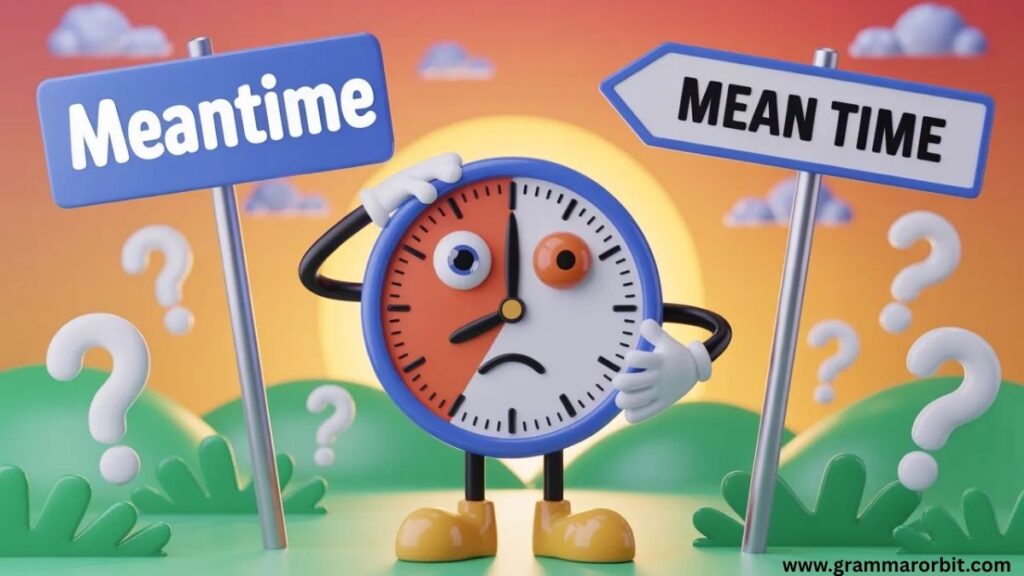
Have you ever stopped mid-email and thought, “Wait… is it meantime or mean time?” That tiny space can feel like a grammar landmine, just waiting to explode your confidence. One version sounds friendly and natural. The other suddenly makes your sentence feel like it belongs in a physics lab. The problem is, both look right at first glance, and spellcheck just shrugs and walks away. This confusion shows up everywhere from professional emails to student essays and casual messages. So before you second guess yourself again, let’s clear up the meantime or mean time mystery once and for all, with clarity, logic, and zero stress.
Meantime or Mean Time: The Quick, Accurate Answer
Here’s the clear rule most people are looking for.
Meantime (one word) is correct in everyday English.
It means the time between two events.
Mean time (two words) is correct only in technical, scientific, or mathematical contexts where mean means average.
If you are writing:
- Emails
- Articles
- Essays
- Messages
- Business documents
The correct choice is almost always meantime.
If you are writing about averages, measurements, systems, or calculations, then mean time may be correct.
This distinction explains nearly all confusion around meantime or mean time usage.
What Meantime Means in Modern English
Meantime Meaning Explained Simply
The word meantime refers to an interval. It describes the period that exists between two events, actions, or points in time.
In plain terms, it means:
- while waiting
- during the interval
- between now and then
This is why it appears so often in everyday English usage.
Meantime Usage in Sentences
Here are clear, natural examples:
- The manager will join us at noon. In the meantime, review the agenda.
- The website is under maintenance. In the meantime, use the mobile app.
- Dinner starts at seven. In the meantime, relax and unwind.
In all these examples, meantime connects two events and fills the gap between them.
Is Meantime One Word or Two?
In modern English, meantime is always one word when used with this meaning.
Major dictionaries confirm this:
- Merriam-Webster: https://www.merriam-webster.com/dictionary/meantime
- Cambridge Dictionary: https://dictionary.cambridge.org/dictionary/english/meantime
Using two words in these cases is considered incorrect in modern English writing.
Mean Time Meaning and Technical Usage
Definition
Mean time is not a casual phrase. It is a technical term.
In this context:
- mean means average
- time refers to a measured duration
So mean time meaning is the average amount of time calculated across multiple events.
This definition places the phrase firmly in technical and analytical language.
Where Mean Time Is Correct
You’ll encounter mean time in fields such as:
- Engineering
- Computer science
- Physics
- Reliability analysis
- Astronomy
Common examples include:
- Mean Time Between Failures (MTBF)
- Mean Time to Repair (MTTR)
Example sentences:
- The mean time between failures for this system is 3,500 hours.
- Engineers reduced the mean time to repair by 18 percent.
In these cases, using meantime would be incorrect because the sentence discusses averages, not waiting periods.
Meantime vs Mean Time: Understanding the Difference
Meantime or Mean Time Difference at a Glance
| Feature | Meantime | Mean Time |
|---|---|---|
| Word form | One word | Two words |
| Core meaning | Time between events | Average or standard time |
| Common usage | Everyday English | Technical and scientific language |
| Tone | Neutral, conversational, professional | Analytical, precise |
| Typical mistake | Misspelling | Misused in casual writing |
This table highlights why spacing matters. A single space shifts the meaning from conversational to technical.
Why Writers Get Confused
Similar Sound, Different Meaning
Both forms sound exactly the same when spoken. English relies heavily on context, and without seeing the sentence written out, the difference disappears.
Spacing Changes Meaning
English contains many word pairs where spacing changes meaning:
- everyday vs every day
- anytime vs any time
- already vs all ready
Meantime vs mean time grammar follows the same pattern. Writers who are unaware of this rule often assume either form works.
Spellcheck Is Not Reliable Here
Most spellcheck tools do not flag “mean time” as incorrect, even when it is wrong in context. That’s why understanding the rule matters more than relying on software.
Steam vs Steem Understanding the Key Differences
Historical Origin of Meantime and Mean Time
Where Meantime Comes From
The word meantime originated in Middle English. It evolved from the idea of an intermediate or intervening period of time.
Over centuries, English speakers combined the phrase into a single compound word. This happened as usage became more frequent and standardized.
This process mirrors how many common English words developed.
Why Mean Time Stayed Separate
In contrast, mean time remained separate because it retained a mathematical definition. Scientific and technical fields resist linguistic shortcuts because precision matters.
This is why phrases like Greenwich Mean Time never merged into one word.
Meantime in British English vs American English
Is There a Difference?
There is no spelling difference between British English and American English for this word.
- Meantime in British English: one word
- Meantime in American English: one word
Both varieties follow the same grammar rules.
This consistency makes the correct spelling easier to remember.
What Does IHH Mean in Texting? The Complete Guide
In the Meantime vs In the Mean Time
Which One Is Correct?
In the meantime is the correct expression in modern English when referring to a waiting period.
In the mean time is generally incorrect unless you are specifically referring to an average time measurement.
Examples:
- Correct: The documents are being reviewed. In the meantime, prepare the presentation.
- Correct (technical): In the mean time required for processing, the system runs diagnostics.
The second example is rare and highly specialized.
Everyday English Usage and Real Examples
Email and Professional Writing
Correct usage improves clarity and credibility.
Correct:
- The meeting has been postponed. In the meantime, complete your tasks.
Incorrect:
- In the mean time, complete your tasks.
This mistake often appears in professional emails, where it subtly undermines writing quality.
Formal vs Informal English
The word meantime works across registers:
- Informal conversation
- Business writing
- Academic essays
- News articles
It is standard, accepted, and neutral.
breakroom or break room The Correct Spelling
Common Mistakes and How to Avoid Them
Frequent Errors
- Writing mean time when no average is involved
- Assuming two words sounds more formal
- Copying outdated usage from older texts
- Trusting spellcheck without understanding context
A Simple Editing Rule
Ask one question:
Are you talking about waiting or calculating?
- Waiting: use meantime
- Calculating: use mean time
This rule prevents nearly every mistake.
Search Trends and Real Usage Data
Search behavior reflects real language use.
- Queries for “meantime meaning” and “is meantime one word or two” far outnumber technical searches.
- Searches for “mean time technical term” cluster around engineering and IT topics.
This shows that meantime or mean time confusion is mostly a general writing issue, not a scientific one.
Keyword Variations and Writing Intent
| Keyword Phrase | Primary Intent |
|---|---|
| meantime or mean time correct | Grammar accuracy |
| meantime vs mean time difference | Comparison |
| is meantime one word or two | Spelling |
| mean time definition | Technical explanation |
| in the meantime vs in the mean time | Usage clarity |
Understanding intent helps writers choose the correct form faster.
Case Study: One Space, One Mistake
Workplace Email Example
Original sentence:
The software update is scheduled for Friday. In the mean time, continue normal operations.
Problem:
The phrase suggests an average time, which makes no sense in this context.
Corrected sentence:
In the meantime, continue normal operations.
The correction restores clarity and professionalism with a single change.
Reference Cambridge Dictionary Definitions
Here’s a trusted source for clear word meanings:
FAQs
Is it correct to say “for the meantime”?
No, it is not standard English. The correct expression is in the meantime.
Example:
- Correct: The report will arrive tomorrow. In the meantime, review the notes.
- Incorrect: For the meantime, review the notes.
“For the meantime” is a common mistake, likely influenced by other prepositional phrases, but it is not considered proper grammar.
What is the meaning of the mean time?
Mean time is a technical term. It refers to the average amount of time calculated between events or occurrences.
Examples:
- The mean time between failures (MTBF) is 3,500 hours.
- Engineers reduced the mean time to repair (MTTR) by 20%.
It is rarely used in everyday conversation and should only appear in scientific, engineering, or technical contexts.
What is the meaning of at the mean time?
The phrase at the mean time is incorrect in modern English. People sometimes use it mistakenly when they mean “in the meantime,” but it does not follow standard grammar rules.
Correct usage:
- In the meantime, finish your homework before dinner.
“Mean” in this context should only refer to average or calculated time, not a waiting period.
Do we say “in the mean time”?
Generally, no. The correct expression for everyday English is in the meantime, which means during the interval between two events.
Correct Example:
- The class hasn’t started yet. In the meantime, read the introduction chapter.
“In the mean time” may appear in very old texts or highly technical writing, but it is not recommended in modern English.
Do we say mean time?
Yes, but only in technical or scientific contexts, where “mean” refers to average time.
Correct Example:
- The mean time to failure for this machine is 4,200 hours.
- Greenwich Mean Time is the standard for global time measurement.
In all casual, professional, or everyday writing, use meantime instead.
Conclusion
At the end of the day, the debate over meantime or mean time isn’t as scary as it looks. One tiny space can change everything, but once you know the rule, it sticks for good. If you’re talking about waiting, pausing, or filling the gap between two events, meantime is your go-to. If you’re crunching numbers, tracking averages, or living deep in technical territory, mean time earns its keep. That’s it. No drama. No second-guessing. Just clear, confident writing. And in the meantime, enjoy the quiet satisfaction of spotting this mistake in the wild and knowing you got it right.

JHON AJS is an experienced blogger and the creative voice behind the website grammarorbit.com, namely Grammar Orbit. With a keen eye for language and a passion for wordplay, he creates engaging grammar insights, word meanings, and clever content that make learning English enjoyable and interesting for readers.