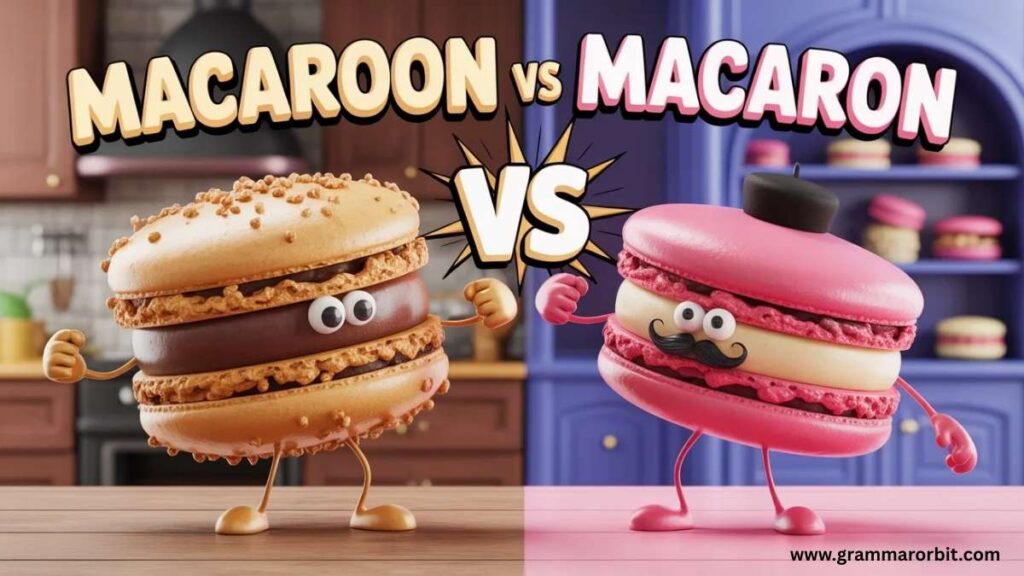
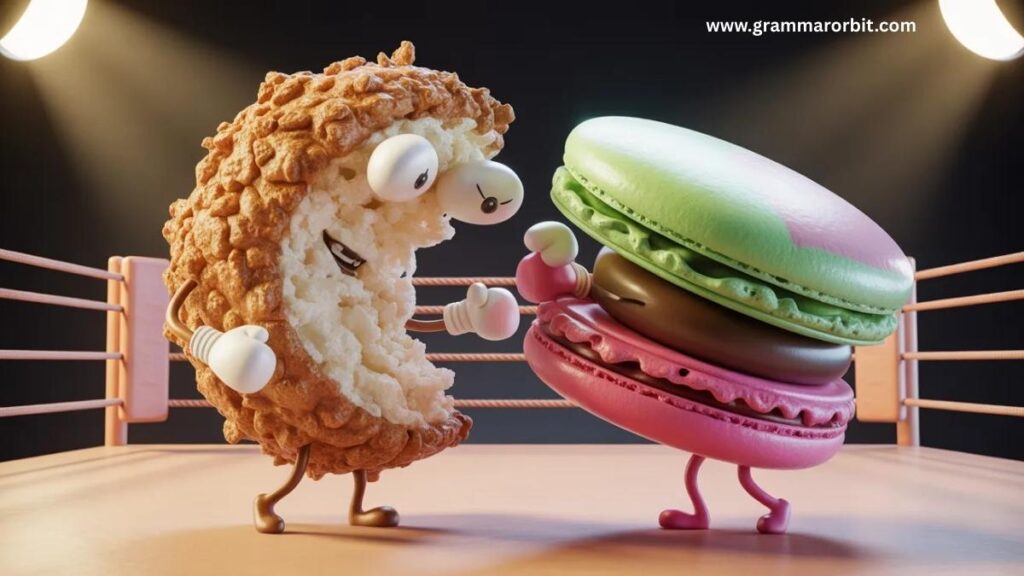
You’d think the macaroon vs macaron debate would be simple. It’s just one extra “o,” right? Wrong. That tiny vowel has caused bakery meltdowns, awkward café orders, and more confused dessert lovers than anyone wants to admit. One is a chewy coconut mound your aunt brings to holiday dinners. The other is a colorful French macaron cookie that looks like it belongs in a jewelry box. Mix them up and you might bite into shredded coconut when you expected silky ganache. Ouch. If you’ve ever wondered about the real difference between macaroon and macaron, you’re about to get the sweet, shocking truth.
Macaroon vs Macaron The Quick Answer
Before diving deep, here’s the direct explanation:
- A macaroon is a coconut-based cookie made with shredded coconut, egg whites, and sugar.
- A macaron is a French almond flour meringue cookie filled with buttercream, ganache, or jam.
They are not regional spelling variations,They are not the same recipe and
They are not interchangeable.
Understanding this simple distinction solves most confusion immediately.
Macaroon vs Macaron Comparison Table
Sometimes clarity hits faster when you see it visually.
| Feature | Macaroon | Macaron |
|---|---|---|
| Primary Ingredient | Shredded coconut | Almond flour |
| Structure | Single mound cookie | Sandwich cookie |
| Texture | Dense, chewy | Crisp shell, soft center |
| Origin | Italian roots, evolved in UK/US | France |
| Baking Difficulty | Easy | Advanced |
| Average Price (US) | $1–$2 each | $2.50–$5 each |
| Gluten-Free | Yes | Yes |
| Appearance | Rough and rustic | Smooth and glossy |
This macaroon vs macaron comparison makes the difference obvious at a glance.
The Origin of Macarons and Macaroons
To understand the difference, you have to look at pastry history.
Both cookies trace back to the Italian word maccarone, which means paste. That paste originally referred to ground almonds.
From that shared origin, two completely different desserts evolved.
Origin of Macarons
The origin of macarons begins in Italy but becomes refined in France.
Many historians associate the cookie’s arrival in France with Catherine de’ Medici, who brought Italian pastry chefs when she married into French royalty in the 16th century.
Early macarons were simple almond meringue rounds. No filling. Just crisp cookies made from almond paste and egg whites.
In the early 20th century, the Parisian bakery Ladurée transformed the cookie into the modern macaron sandwich cookie by adding a flavored filling between two shells. That innovation defined what we now call the French macaron cookie.
Today, macarons represent technical precision in French pastry culture.
Origin of Macaroons
The origin of macaroons followed a more practical path.
As recipes spread through Europe and eventually America, almonds were sometimes replaced with shredded coconut. Coconut was more affordable and easier to store. That substitution led to the coconut macaroon cookie.
Macaroons became especially popular in Jewish communities because they contain no flour. During Passover, when leavened grains are restricted, macaroons offered a sweet solution.
So while macarons became a symbol of refined patisserie, macaroons became a staple holiday cookie.
What Is a Macaron?
A macaron is an almond flour meringue cookie with a smooth shell and a creamy filling.
It contains:
- Egg whites
- Granulated sugar
- Powdered sugar
- Almond flour or almond meal
- Food coloring (optional)
- Filling such as buttercream, ganache, or jam
It’s classified as a meringue-based confection. Whipped egg whites create structure and volume. The almond flour provides body. The folding process determines texture.
Professional pastry chefs use a technique called macaronage. The batter must be folded until it flows like lava. Too stiff and the shells crack. Too loose and they flatten.
The shells must rest before baking so a thin skin forms on top. That skin allows the famous “foot” to develop during baking.
Macarons are delicate. They demand patience. Humidity above 50 percent can ruin a batch.
That’s why they’re often associated with professional pastry kitchens rather than casual home baking.
What Is a Macaroon?
A macaroon is a dense coconut cookie that requires far less precision.
Traditional macaroon ingredients include:
- Shredded coconut
- Egg whites
- Sugar
- Sometimes sweetened condensed milk
- Optional chocolate coating
There is no complicated folding technique. No aging egg whites. No resting period.
You mix the ingredients, scoop them onto a tray, and bake.
The result is chewy in the center with lightly crisp edges. The surface looks textured and rustic.
If you compare the two side by side, the difference in appearance alone answers the macaroon vs macaron meaning question.
Macaroon Ingredients vs Macaron Ingredients
Ingredient structure explains everything.
| Component | Macaroon Ingredients | Macaron Ingredients |
|---|---|---|
| Base | Shredded coconut | Almond flour |
| Binder | Egg whites | Whipped egg whites |
| Sweetener | Sugar or condensed milk | Granulated + powdered sugar |
| Filling | None | Buttercream, ganache, or jam |
| Texture Agent | Coconut fibers | Fine almond flour |
Coconut creates density.
Almond flour creates delicacy.
That one substitution changes the entire baking science.
Pricy or Pricey Which Spelling Is Correct
Macaroon Texture vs Macaron Texture Difference
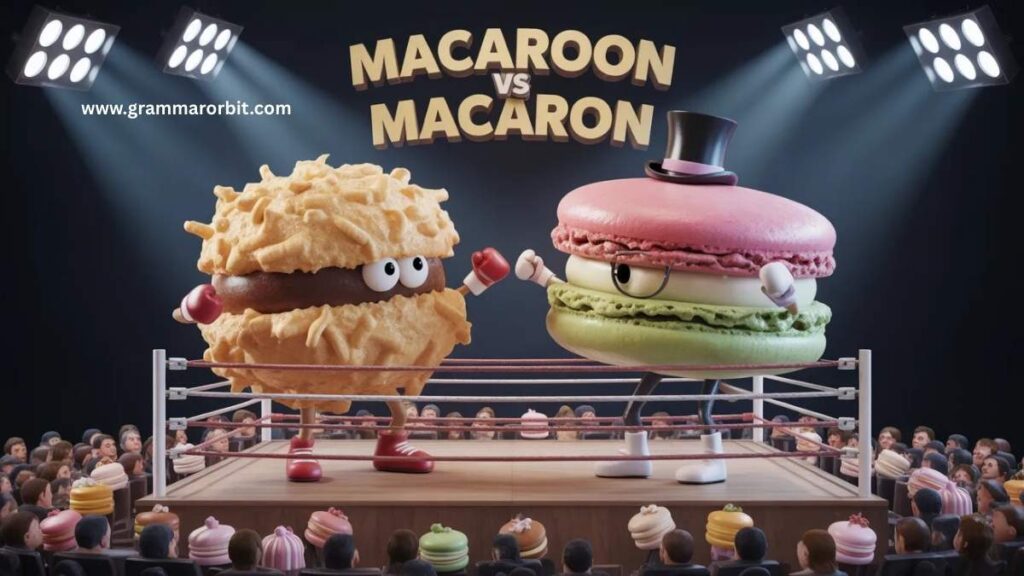
Texture is where confusion disappears instantly.
Macaroon texture:
- Chewy
- Moist interior
- Crisp edges
- Coarse surface
Macaron texture:
- Thin crisp shell
- Slightly chewy center
- Smooth glossy top
- Creamy filling inside
When someone asks about macaroon vs macaron texture difference, this is what they’re really asking: Do I want dense coconut chew or airy almond elegance?
The mouthfeel couldn’t be more different.
Macaroon vs Macaron Pronunciation Guide
Pronunciation causes more social anxiety than the recipe itself.
How to pronounce macaroon:
mack-uh-ROON
How to pronounce macaron:
mack-uh-RAHN
The final syllable carries stress in both words. The difference lies in the ending sound.
Macaron has a softer, French-style ending.
Macaroon has a clear “roon” sound.
If you say mack-uh-roon when ordering a French macaron cookie, you’re asking for coconut.
Knowing how to pronounce macaron and how to pronounce macaroon removes that hesitation.
Macaroon vs Macaron Meaning Explained Clearly
Let’s state it plainly for search clarity:
The difference between macaroon and macaron is not spelling variation. It is a difference in ingredients, structure, origin, and texture.
Macaroon refers to a coconut cookie.
Macaron refers to an almond flour meringue sandwich cookie.
They share linguistic roots. They do not share culinary identity.
Taste Profile Coconut vs Almond Cookie
Flavor defines personality.
Macaroon taste profile:
- Strong coconut flavor
- Toasted sugar notes
- Sometimes dipped in dark chocolate
- Rich and chewy
Macaron taste profile:
- Subtle almond base
- Filling determines flavor
- Balanced sweetness
- Light and refined
French macarons flavors range widely:
- Pistachio
- Raspberry
- Lemon
- Salted caramel
- Chocolate
- Coffee
- Rose
- Matcha
The filling defines the experience.
Macaroons remain coconut-forward almost every time.
Footnote Before or After Period A Complete Guide
Why Are Macarons Expensive?
This question appears constantly in search data.
Macarons cost more because:
- Almond flour costs significantly more than shredded coconut
- Egg whites must be whipped precisely
- The failure rate during baking is high
- Each cookie requires piping and filling
- Presentation packaging is premium
In most US cities, a single macaron ranges from $2.50 to $5.
Macaroons usually cost $1 to $2 each.
The price reflects labor and skill, not just ingredients.
Baking Difficulty Home Baker vs Professional Pastry
Macaroons are forgiving.
Macarons are technical.
Here’s a clear breakdown:
| Skill Level | Better Choice |
|---|---|
| Beginner baker | Macaroon |
| Intermediate | Macaroon |
| Advanced baker | Macaron |
| Professional pastry chef | Macaron |
Humidity, oven calibration, and timing all impact macarons heavily.
Macaroons tolerate variation.
Holiday Cookie Facts
Macaroons gained popularity during Passover because they contain no flour. That makes them naturally gluten-free and compliant with dietary restrictions during the holiday.
Macarons are also gluten-free because they rely on almond flour instead of wheat flour.
Both qualify as gluten-free dessert options, which increases their modern popularity.
Deep Seated vs Deep Seeded Which One Is Correct?
History of Macarons and Macaroons in America
Macaroons appeared in American cookbooks as early as the 1800s, especially in Jewish and European immigrant communities.
Macarons surged in popularity in the United States during the 2010s. Social media played a major role. Their pastel colors and perfect symmetry made them visually appealing.
Search trends show spikes during Valentine’s Day, Christmas, and wedding season.
The macaroon vs macaron cookies confusion increased as macarons became more mainstream.
Common Mistakes in the Macaroon vs Macaron Debate
People often:
- Assume macaron is French spelling for macaroon
- Order the wrong dessert at cafes
- Spell macaron with two o’s
- Connect macaron to macaroni and cheese
Despite similar spelling, macaron has no relationship to pasta.
The shared root word refers to paste, not noodles.
Nutritional Comparison Snapshot
While neither cookie qualifies as health food, here’s a general estimate:
| Nutrient | Macaroon | Macaron |
|---|---|---|
| Calories | 100–150 | 70–100 |
| Sugar | High | High |
| Fat | Moderate to high | Moderate |
| Protein | Moderate | Moderate |
Macaroons contain more fat from coconut.
Macarons contain more sugar concentration from filling.
Both are sweet treats meant for enjoyment, not daily consumption.
Coconut Macaroons Recipe vs French Macaron Method
Coconut macaroons recipe overview:
- Combine shredded coconut, egg whites, and sugar
- Scoop onto baking sheet
- Bake at 325°F for 20–25 minutes
French macaron method overview:
- Sift almond flour and powdered sugar
- Whip egg whites to stiff peaks
- Fold carefully to correct consistency
- Pipe uniform circles
- Rest shells
- Bake at 300°F
- Fill and mature 24 hours
One takes about 30 minutes total.
The other can take several hours.
Why Are They Called Macaron and Macaroon?
The answer lies in language evolution.
The Italian word maccarone referred broadly to paste-based mixtures. Over centuries, spelling variations developed as recipes traveled across borders.
French preserved the shorter form macaron.
English added an extra “o,” creating macaroon.
From there, ingredient substitutions cemented the difference.
What began as a shared almond paste cookie split into two distinct desserts.
Reference Cambridge Dictionary Definitions
Here’s a trusted source for clear word meanings:
FAQs
What is the difference between macaroon and macaron?
The difference between macaroon and macaron comes down to ingredients, texture, and structure.
A macaroon is a coconut-based cookie made with shredded coconut, egg whites, and sugar. It’s dense, chewy, and usually shaped like a small mound.
A macaron is a French almond flour meringue cookie filled with buttercream, ganache, or jam. It has a crisp shell, a soft interior, and a smooth, colorful appearance. It’s also a sandwich cookie.
In short: coconut vs almond. Chewy cluster vs delicate sandwich.
Do the French say macaron or macaroon?
The French say macaron.
In France, the word macaroon isn’t used for the almond sandwich cookie. The correct term is macaron, pronounced mack-uh-RAHN with a soft ending.
The coconut cookie known in English as a macaroon developed separately and is not part of traditional French pastry vocabulary in the same way.
If you’re in Paris and ask for a macaroon, you’ll likely need to clarify what you mean.
Are macarons halal?
Macarons can be halal, but it depends on the ingredients used in the filling.
The basic macaron shell contains:
- Egg whites
- Almond flour
- Sugar
These ingredients are generally halal.
However, some fillings may include:
- Alcohol-based flavor extracts
- Gelatin
- Liqueur-infused ganache
If halal certification matters to you, check with the bakery about specific ingredients. Many bakeries offer halal-friendly options, especially for fruit-based or buttercream fillings.
Why is a macaron so expensive?
Macarons are expensive because they require precision, skill, and costly ingredients.
Here’s what drives the price:
- Almond flour costs significantly more than regular flour
- Egg whites must be whipped and folded perfectly
- The failure rate during baking is high
- Each cookie is piped, rested, baked, filled, and matured
- Presentation and packaging are often premium
A single macaron typically costs between $2.50 and $5 in the United States. You’re not just paying for sugar and almonds. You’re paying for technique, consistency, and craftsmanship.
Conclusion
So here we are. One tiny letter. One massive dessert misunderstanding.
The macaroon vs macaron confusion isn’t about fancy spelling or food snobbery. It’s about coconut versus almond. Chewy mound versus delicate sandwich cookie. Comfort baking versus precision pastry. Once you understand the difference between macaroon and macaron, the mystery melts away faster than buttercream on a warm day.
Next time you step up to a bakery counter, you won’t panic. You’ll order with confidence. Want shredded coconut and toasted sweetness? Say macaroon. Craving a crisp almond flour meringue cookie with silky filling? Ask for a macaron.

JHON AJS is an experienced blogger and the creative voice behind the website grammarorbit.com, namely Grammar Orbit. With a keen eye for language and a passion for wordplay, he creates engaging grammar insights, word meanings, and clever content that make learning English enjoyable and interesting for readers.