
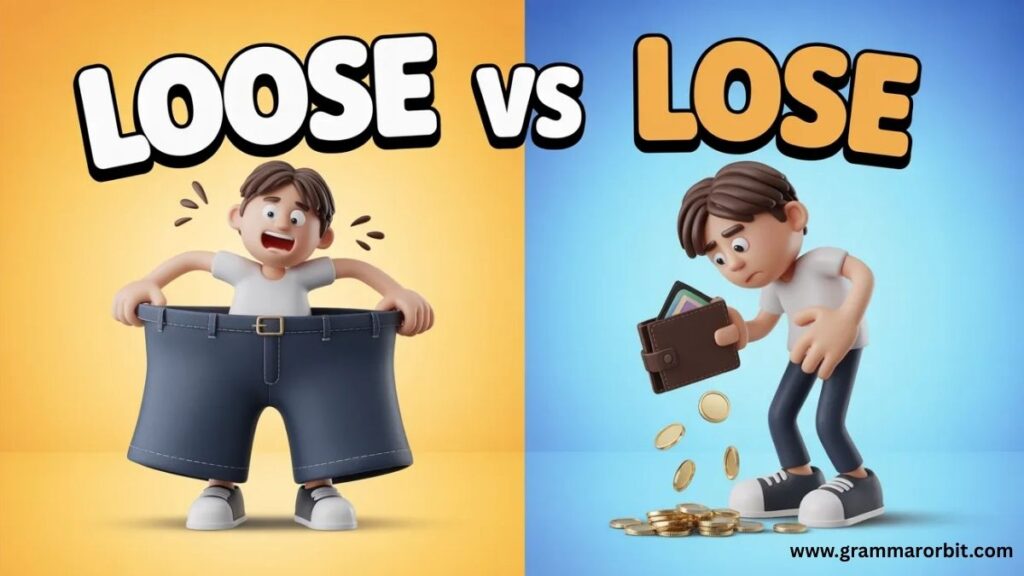
If you’ve ever typed “I hope I don’t loose my keys” and immediately felt a tiny panic, you’re not alone. The loose vs lose dilemma is like that one sock that always vanishes in the dryer mysterious, frustrating, and somehow unavoidable. Writers, students, and even seasoned professionals stumble over these homophones, turning a simple sentence into a mini grammar nightmare. But don’t worry this article is your safety net. We’ll break down the loose vs lose meaning, explore everyday examples, share clever memory tricks, and give practical tips to avoid confusing loose and lose in writing, so your sentences stay sharp, clear, and mistake-free.
Understanding the Basics
Before diving into rules and examples, it is important to understand the loose vs lose difference clearly.
What Loose Means
- Part of speech: Adjective
- Meaning: Not tight, free, or detached
- Everyday examples:
- “The jacket is too loose around my shoulders.”
- “The dog’s collar was loose, and it slipped off easily.”
- “He prefers wearing loose clothing on hot days.”
Quick tip: If you are describing a thing, object, or condition, chances are you need loose.
What Lose Means
- Part of speech: Verb
- Meaning: To fail to keep, misplace, or be defeated
- Everyday examples:
- “Don’t lose your phone while traveling.”
- “We might lose the game if we don’t play carefully.”
- “She tends to lose track of time while reading.”
Quick tip: If the word describes an action, it is almost always lose.
Key Difference in Usage
| Word | Part of Speech | Meaning | Example |
|---|---|---|---|
| Loose | Adjective | Not tight, free | “The rope is loose and unsafe to climb.” |
| Lose | Verb | Fail to keep or misplace | “I don’t want to lose my wallet today.” |
Traveled or Travelled How to Use the Correct Spelling
Origins and Etymology
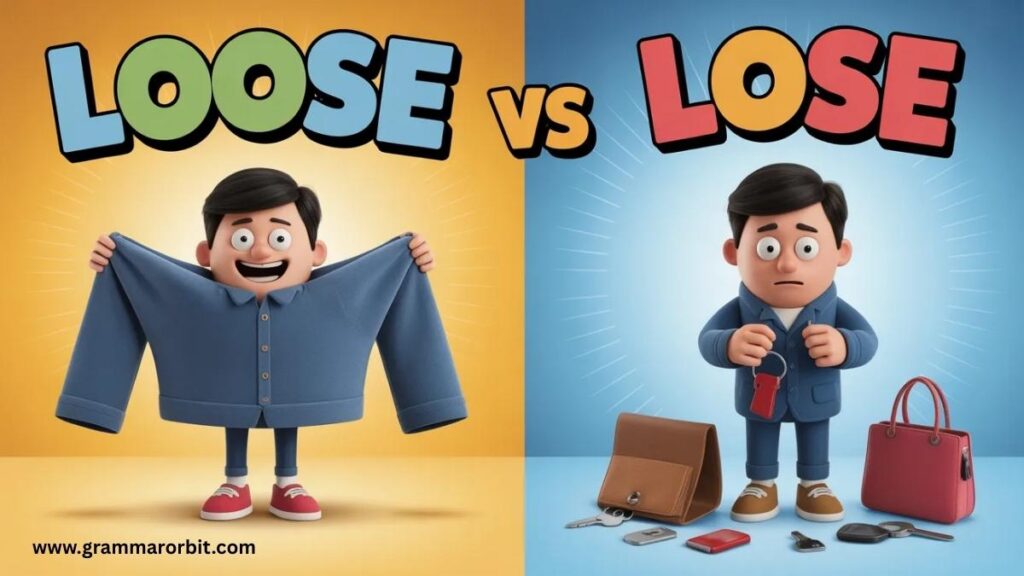
Understanding where a word comes from can help you remember its meaning.
- Loose: Comes from Old English los, meaning “free” or “unbound.” Its focus has always been on something not tight or restricted.
- Lose: Comes from Old English losian, meaning “to be lost” or “perish.” Its root emphasizes action and loss.
Fun fact: Even though they sound similar, their roots are completely different. Loose describes a state, while lose describes an action.
Grammar and Word Class Differences
Grammar is where most writers make mistakes.
Loose (Adjective)
- Modifies nouns: “The hat is too loose for me.”
- Can describe physical objects, clothing, or abstract concepts like behavior: “He has a loose approach to rules.”
Lose (Verb)
- Indicates an action: “I always lose my keys.”
- Conjugation: lose → lost → losing
- Often used in idioms and expressions: “Don’t lose your mind.”
Common mistakes include:
- “I don’t want to loose my keys” ❌
- Correct: “I don’t want to lose my keys” ✅
Memory trick: If it is something you hold onto or can misplace, you lose it.
Spelling and Pronunciation
Understanding spelling and pronunciation is crucial for mastering loose vs lose, because these homophones sound alike but are spelled differently and have distinct meanings. Even native speakers often get tripped up when writing quickly or texting.
Spelling Differences
The good news is that loose vs lose is spelled the same way in both British and American English. The confusion doesn’t come from spelling rules but from remembering which word to use in context.
Key points to remember:
- Loose has double “o” – think of something stretched out or not tight.
- Lose has a single “o” – think of losing something, which is usually an action.
Quick mnemonic:
- Loose = double O = clothing or objects not tight
- Lose = single O = misplace or fail
Common spelling mistakes:
- Writing “loose” instead of “lose” in sentences like: “Don’t loose your wallet” ❌
- Writing “lose” instead of “loose” when describing: “The screw is lose” ❌
Correct examples:
- “The rope is loose and needs tightening.” ✅
- “I hope I don’t lose my keys today.” ✅
Pronunciation
Though the words are homophones, careful listening reveals subtle differences. Understanding these differences can improve your spoken English and help reinforce correct spelling.
| Word | Phonetic | How it Sounds Like | Example Sentence |
|---|---|---|---|
| Loose | /luːs/ | Long “oo” like “goose” | “The jacket is too loose around the waist.” |
| Lose | /luːz/ | “z” sound like “choose” | “Don’t lose your phone on the train.” |
Tips for mastering pronunciation:
- Stretch the O for loose: Pretend you’re holding a rope and stretching it. “Looose.”
- Buzz the Z for lose: Think of the action of something disappearing, like a buzz or a zap. “Looze.”
Trick for remembering:
- Loose → think of things that are loose, floppy, or hanging (stretch the sound).
- Lose → think of losing something (z sound = action happening).
Regional Variations
- In some dialects, the difference in vowel length is subtle, making context even more important.
- British and American English both use the same spelling rules, but pronunciation may vary slightly with accent.
Practice Tip
To reinforce spelling and pronunciation:
- Read sentences aloud: “The rope is loose” vs “I don’t want to lose it.”
- Record yourself saying them; the long “oo” for loose and the “z” sound for lose will train your ear and brain.
- Use mnemonic flashcards: One side “Loose – double O – adjective,” the other side “Lose – single O – verb.”
This expanded section now gives readers clear spelling rules, pronunciation guidance, mnemonics, practical exercises, and tables to master loose vs lose confidently.
Common Mistakes and How to Avoid Them
Even professional writers sometimes mix these words. Here are the most frequent mistakes:
- Swapping the words in sentences:
- ❌ “I hope I don’t loose my job.”
- ✅ “I hope I don’t lose my job.”
- Confusing adjectives with verbs:
- ❌ “The rope is too lose to climb safely.”
- ✅ “The rope is too loose to climb safely.”
- Using sound-based spelling:
- ❌ Writing “loose” because it sounds right.
- ✅ Focus on meaning, not just sound.
- Mixing casual text or social media slang:
- ❌ “I’ll loose it if this happens.”
- ✅ “I’ll lose it if this happens.”
- Misinterpreting idioms:
- ❌ “He went a bit loose after hearing the news.”
- ✅ “He went a bit loose on his tie” (correct context).
Proofreading tip: Ask yourself: “Am I describing something or talking about losing something?”
Etc or Ect The Correct Spelling with Examples
Everyday Usage and Contextual Examples
Seeing loose vs lose examples in everyday contexts helps with retention:
Loose Examples
- Clothing: “My pants are too loose.”
- Objects: “The wheel is loose and needs tightening.”
- Behavior: “He has a loose attitude towards deadlines.”
Lose Examples
- Items: “I always lose my keys.”
- Competitions: “We don’t want to lose the championship.”
- Abstract concepts: “Don’t lose hope during tough times.”
Mini exercise: Fill in the blanks:
- The dog’s leash is too _____. (loose/lose)
- Don’t _____ your temper in public. (loose/lose)
Answer: 1. loose, 2. lose
Idioms, Expressions, and Phrases
Idioms often cause confusion because they are figurative:
- Lose track of time → forget the time
- Cut loose → act freely
- Loose cannon → unpredictable person
- Let loose → release something restrained
Tip: If the idiom involves action, it usually uses lose. If it describes a state or characteristic, it uses loose.
Visual Aids and Diagrams
Visual aids improve understanding and retention:
Comparison Table
| Loose (Adjective) | Lose (Verb) |
|---|---|
| Not tight, free | Misplace or fail |
| Describes nouns | Describes actions |
| The rope is loose | Don’t lose your keys |
| Clothing, objects, behavior | Games, items, abstract concepts |
Pronunciation Chart
| Word | Phonetic | Example |
|---|---|---|
| Loose | /luːs/ | The rope is loose |
| Lose | /luːz/ | I don’t want to lose it |
Mind map idea: Link loose to adjectives and physical states; lose to verbs and actions.
Woman vs Women Pick the Right Word
Usage Trends and Data
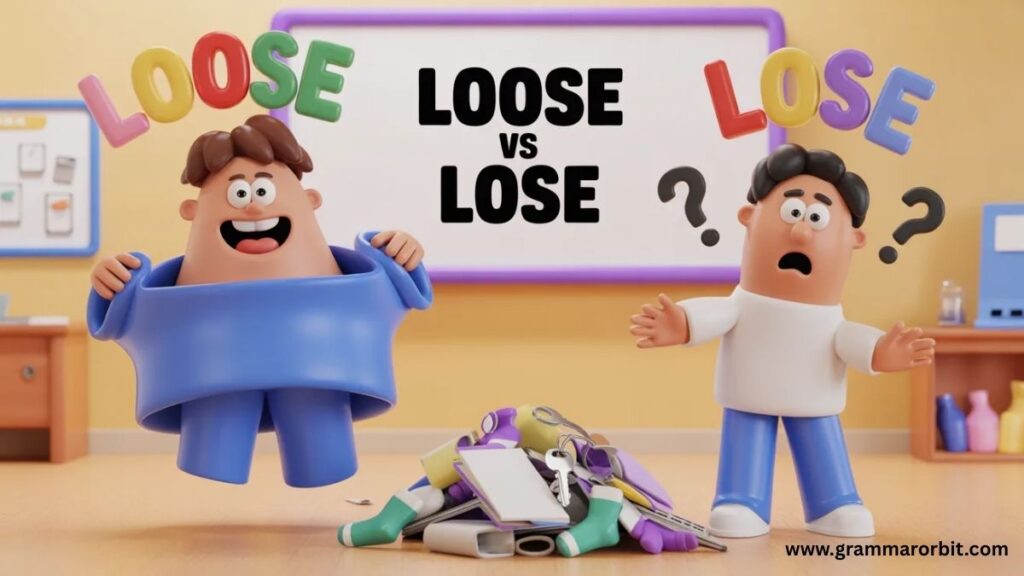
Confusion between loose vs lose is widespread:
- Google Trends: Searches for “loose vs lose” spike during back to school season and exam periods.
- Real-world data: Studies show over 40% of online submissions by English learners contain mistakes with these words.
- Social media: Incorrect usage like “I hope I don’t loose my phone” is still frequent on platforms like Instagram and TikTok.
Insight: Homophones and spelling mistakes in English are the main causes of confusion.
Tips, Tricks, and Proofreading Hacks
Here are strategies to avoid confusing loose and lose in writing:
Mnemonic Devices
- Loose has double O → think of clothing or things not tight.
- Lose has Z → you don’t want to lose anything.
Proofreading Tips
- Read your sentence aloud. Is it describing something or indicating an action?
- Highlight all verbs first. If it is an action, it is likely lose.
Practice Strategies
- Keep a notebook of sentences with loose vs lose examples and review weekly.
- Apply idioms and everyday examples in your writing.
Professional Writing Hack
- Use grammar tools or spellcheckers.
- Double-check homophones before submitting emails, reports, or articles.
Reference Cambridge Dictionary Definitions
Here’s a trusted source for clear word meanings:
FAQs
Which is correct, lose or loose?
Lose is a verb meaning to misplace, fail, or be defeated.
Loose is an adjective meaning not tight or free.
- Correct: “I don’t want to lose my keys.”
- Correct: “The rope is too loose.”
Is it lose or loose weight?
The correct word is lose because it is an action.
- Correct: “I want to lose 5 pounds.”
- Incorrect: “I want to loose 5 pounds.”
Do you loose or lose a person?
You always use lose, as it describes misplacing or no longer having someone.
- Correct: “I don’t want to lose a friend over a small argument.”
- Incorrect: “I don’t want to loose a friend.”
Is it loose or lose in a game?
The correct choice is lose, because it indicates failure or defeat.
- Correct: “We might lose the game if we don’t focus.”
- Incorrect: “We might loose the game.”
Conclusion
So, the next time you’re staring at a sentence wondering if it should be loose or lose, remember this simple rule: if it’s describing something, it’s loose; if it’s about misplacing, failing, or letting go, it’s lose. Think of loose as your comfy, baggy sweater and lose as the moment you accidentally misplace your coffee mug one keeps you cozy, the other makes you panic. With a few tricks, mnemonics, and practice, you can finally write like a grammar hero and never let these two pesky words trip you up again.

JHON AJS is an experienced blogger and the creative voice behind the website grammarorbit.com, namely Grammar Orbit. With a keen eye for language and a passion for wordplay, he creates engaging grammar insights, word meanings, and clever content that make learning English enjoyable and interesting for readers.