

Ever found yourself staring at a sentence like “All freshman must attend orientation” and thinking, Wait… is that right? Welcome to the wild world of Freshmen vs Freshman, where one tiny “s” can make you look like a grammar genius or a complete newbie. Whether you’re a high school student, college newbie, or a teacher grading essays, knowing the freshman definition and freshmen meaning is essential. Don’t worry we’ll break it down with examples, tables, and even some memory tricks so you’ll never confuse freshman vs freshmen again. By the end, you’ll write confidently and maybe even impress a few students.
Freshman vs Freshmen – Quick Answer
Let’s cut through the confusion with a quick cheat sheet:
- Freshman – singular, refers to one first-year student.
Example: “The freshman is excited about joining the debate club.” - Freshmen – plural, refers to two or more first-year students.
Example: “The freshmen attended orientation together.”
💡 Pro Tip: Ask yourself, “Am I talking about one student or a group?” If it’s one, it’s freshman. If it’s many, it’s freshmen. Simple, right?
Vender vs Vendor Which Spelling Is Correct?
Origins and Etymology
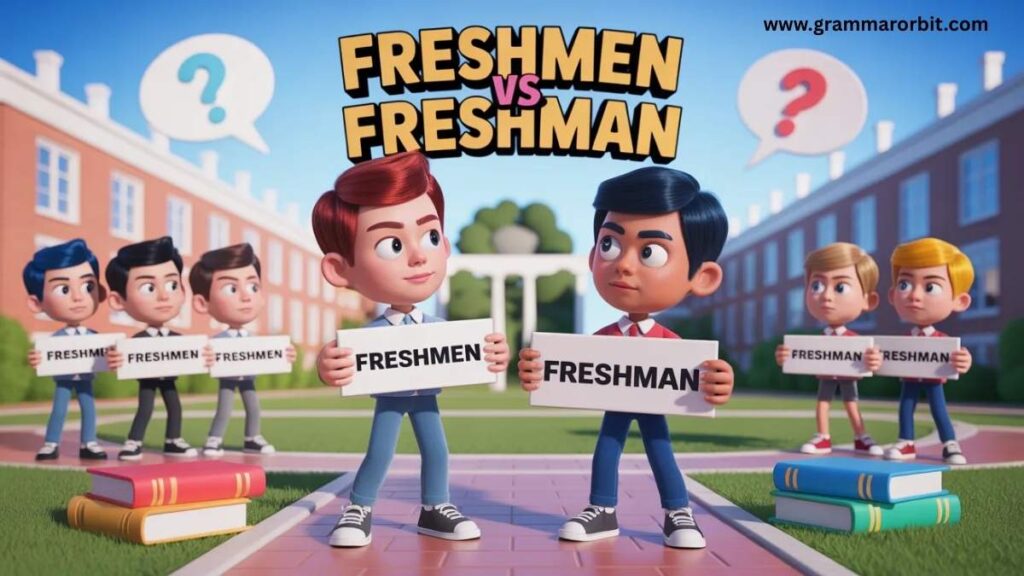
Knowing a word’s history can actually make remembering it easier.
- Freshman appeared in the 14th century, originally meaning a “newcomer” or “novice.” Back then, it didn’t just refer to students it could mean anyone new to a group or profession.
- It comes from “fresh” (new) and “man” (person). So literally, it meant a “new person.”
- Over the centuries, it became tied to schools, eventually referring specifically to first-year students.
- Freshmen is the plural form, following the old English rule of man → men.
So next time you write freshman vs freshmen, remember: you’re using a word with hundreds of years of history. And yes, that tiny “s” really matters it’s a nod to centuries of English tradition.
Singular vs Plural: Detailed Explanation
Here’s where people usually trip up: knowing when to use singular and plural forms.
| Term | Form | Meaning | Example Sentence |
|---|---|---|---|
| Freshman | Singular | One first-year student | “The freshman is nervous about the first day of class.” |
| Freshmen | Plural | Two or more first-year students | “The freshmen arrived together for orientation.” |
Grammar rules to keep in mind:
- Always use freshman for one student and freshmen for more than one.
- Never use freshman as a plural it’s a common grammar mistake.
- Check subject-verb agreement:
- Correct: “The freshman is excited.”
- Incorrect: “The freshman are excited.”
💡 Memory trick: Freshmen = many → think of the “n” in men as “numerous.”
Regional Differences: American English vs British English
English isn’t uniform worldwide, so context matters.
- American English:
- Commonly uses freshman/freshmen in high schools and universities.
- Example: “High school freshmen are required to attend orientation.”
- British English:
- Prefers first-year student over freshman/freshmen.
- Example: “All first-year students are expected to attend the welcome lecture.”
📌 Tip: If writing for a global audience, first-year student is safe, neutral, and gender-friendly.
Capital vs Capitol The Complete Guide
Correct Usage Across Contexts

Using freshman vs freshmen correctly depends on context. Let’s dive in.
Academic Writing
Formal writing demands precision:
- Singular: “The freshman must submit their essay by Friday.”
- Plural: “All freshmen are expected to attend the seminar.”
- Avoid casual slang or abbreviations.
- Check freshman grammar rules: Always match the verb to the number of students.
Academic Writing Tips:
- Proofread carefully; many students slip here.
- Use first-year student if you want to sound neutral or international.
- Make sure your examples are consistent: singular stays singular, plural stays plural.
Casual Conversation
Here, rules are a bit more relaxed, but clarity is still important:
- “The freshmen were excited for the football game.”
- “That freshman seems really smart.”
Other examples in casual conversation:
- “High school freshmen are meeting in the gym.”
- “Each freshman gets a mentor assigned.”
- “The freshmen group chat is already buzzing.”
Notice how naturally you can switch between singular and plural. This is where freshman/freshmen examples really help you remember the rules.
Formal Letters or Emails
Even in professional writing, you’ll encounter freshman/freshmen:
- “Dear Freshman Parent, your child has been assigned a counselor.”
- “The freshmen must complete their registration forms by Monday.”
💡 Pro Tip: Capitalize Freshman/Freshmen when it’s part of a formal title.
Social Media & Modern Contexts
Social media can be tricky people often ignore grammar. But you still want clarity:
- Correct: “Our freshmen orientation photos are now online!”
- Incorrect: “All freshman should check their emails.”
Using the freshman plural form correctly keeps your writing professional even on Instagram or Twitter.
Common Mistakes and Misconceptions
Here are the top grammar mistakes to avoid:
- Using freshman as plural:
❌ “All freshman must attend.”
✅ “All freshmen must attend.” - Confusing with first-year student:
- Freshman = first-year student, but first-year student is neutral and universal.
- Ignoring gender-neutral language:
- Use first-year student if you want to avoid “man → men” implications.
- Spelling errors:
- Plural = freshmen, not freshmans.
Comparison Table
A handy reference for freshman grammar rules and freshmen grammar rules:
| Term | Singular/Plural | Correct Context | Example Sentence |
|---|---|---|---|
| Freshman | Singular | One student | “The freshman is ready for classes.” |
| Freshmen | Plural | Two or more students | “The freshmen attended orientation.” |
| First-year student | Singular/Plural | Neutral alternative | “Each first-year student must submit their forms.” |
Goodmorning or Good Morning A Complete Guide
Everyday Examples of Freshman vs Freshmen

Here’s a mini case study from a typical school week:
- Monday: “The freshman in my chemistry class is asking a lot of questions.”
- Tuesday: “All freshmen are required to attend the assembly.”
- Wednesday: “During student orientation, freshmen meet their faculty advisors.”
- Thursday: “A freshman forgot their ID card and had to return home.”
- Friday: “High school freshmen often feel nervous but excited at the same time.”
Notice the pattern: singular freshman for one, plural freshmen for a group. Real-life examples like these stick better than abstract rules.
Usage Statistics & Trends
Curious about popularity? Data helps:
- Google Trends: Searches for freshmen spike in August–September (school start season).
- Freshman searches are steadier throughout the year due to assignments and academic references.
- American English dominates; British English prefers first-year student.
Fun fact: Some schools even use “freshers” (UK slang) to refer to first-year students during welcome week.
Tips & Memory Tricks
Here’s how to never mix up freshman vs freshmen:
- One vs Many – Freshman = one, Freshmen = multiple.
- “n” = numerous – Remember, “men” = more than one.
- Ask yourself – Am I talking about a group or a single student?
- Visualize it – Picture a line of students: one is a freshman, a crowd = freshmen.
- Practice with examples – Use real-life freshman/freshmen examples in sentences.
Reference Cambridge Dictionary Definitions
Here’s a trusted source for clear word meanings:
FAQs
Is it spelled freshman or freshmen?
Freshman is singular, referring to one first-year student.
Freshmen is plural, referring to two or more first-year students.
Examples:
- Singular: “The freshman joined the soccer team.”
- Plural: “The freshmen attended the orientation together.”
💡 Tip: Remember, if you’re talking about more than one student, add the “n” → freshmen.
Can you call a girl freshman?
Yes! The term freshman applies to any first-year student, regardless of gender.
- Example: “The freshman in my chemistry class asked a question.”
- For fully gender-neutral language, some schools prefer first-year student instead of freshman/freshmen.
What is the difference between freshman and freshmen?
The difference is simple:
| Term | Meaning |
|---|---|
| Freshman | Singular: One first-year student |
| Freshmen | Plural: Two or more first-year students |
Quick trick: One = freshman, many = freshmen.
What is a freshman and a sophomore?
- Freshman: A first-year student in high school or college.
- Sophomore: A second-year student in high school or college.
Example:
- “The freshman is nervous on the first day of school.”
- “The sophomore already knows the campus well.”
💡 Think of it like a ladder: freshman = step 1, sophomore = step 2.
Do British people say freshman?
Not really. In British English, people usually say first-year student instead of freshman or freshmen.
- Example (UK): “All first-year students must attend the welcome lecture.”
- In American English, you’d say: “All freshmen must attend orientation.”
Conclusion
Mastering freshman vs freshmen might seem like a tiny detail, but trust me, it makes a big difference. Remember: freshman = one brave first year student, freshmen = a whole squad of newbies navigating hallways, cafeterias, and endless group projects. Sprinkle in first-year student when you want to be fancy or gender-neutral, and you’re golden. Next time you’re writing an essay, email, or even a group chat message, you’ll confidently avoid those pesky grammar traps. So go ahead impress your teachers, your classmates, and even yourself. Because knowing the difference between freshman vs freshmen isn’t just smart, it’s practically legendary.

JHON AJS is an experienced blogger and the creative voice behind the website grammarorbit.com, namely Grammar Orbit. With a keen eye for language and a passion for wordplay, he creates engaging grammar insights, word meanings, and clever content that make learning English enjoyable and interesting for readers.