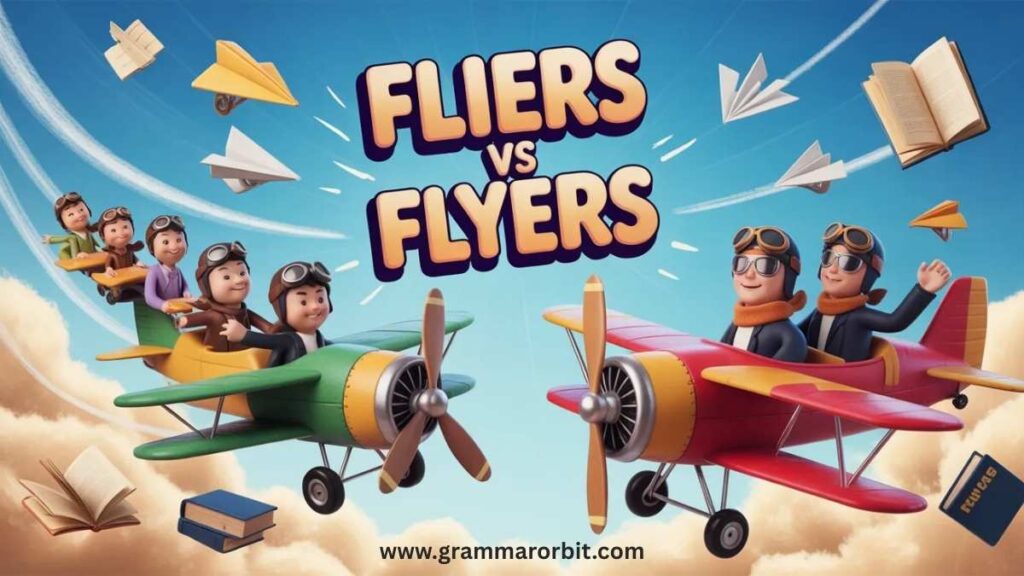
Staring at your screen, you type a sentence, sip your coffee, and suddenly grammar taps you on the shoulder. Wait. Is it fliers vs flyers again? Yep. The sneaky twins of the English language are back, ready to hijack your confidence and make you question everything you learned in third grade. One letter changes. Panic rises. Your delete key starts sweating. Relax. You’re not alone in this spelling soap opera, and you’re definitely not doomed to guess forever. Once you see why these two spellings exist and how readers interpret them, the fog clears fast. Let’s sort it out and get you writing boldly again.
Why English ended up with two spellings
English didn’t grow in a neat laboratory. It grew in markets, ports, and printing shops. Spelling shifted. People copied what they saw. Industries formed habits and stuck with them.
Many nouns that describe someone who performs an action use the -er ending. Runner. Driver. Speaker. Over time, though, some words also developed an -ier twin. Think of words like drier and dryer.
Neither side defeated the other. They settled into different neighborhoods of meaning.
That history created today’s puzzle of flyer vs flier.
The role dictionaries play
Open major dictionaries and you’ll see both entries. No alarm bells. No angry warnings.
Merriam-Webster
Lists them as variants. It commonly shows flyer connected with advertising and flier with people who fly.
Oxford English Dictionary
Documents centuries of mixed usage. Modern writing, however, tends to specialize.
Cambridge Dictionary
Often presents flyer broadly, especially for leaflets, while still accepting flier.
Dictionaries don’t command language. They report what careful readers already recognize.
Meaning matters more than nationality
Writers often hunt for an American vs British spelling rule. Geography influences preference, sure. Still, meaning usually carries more weight than location.
Instead of asking where your audience lives, ask what they picture when they read the word.
Paper in a hand?
Or wings in the sky?
That image usually answers everything
Me Either vs Me Neither Which One Is Correct
When you mean a printed advertising leaflet
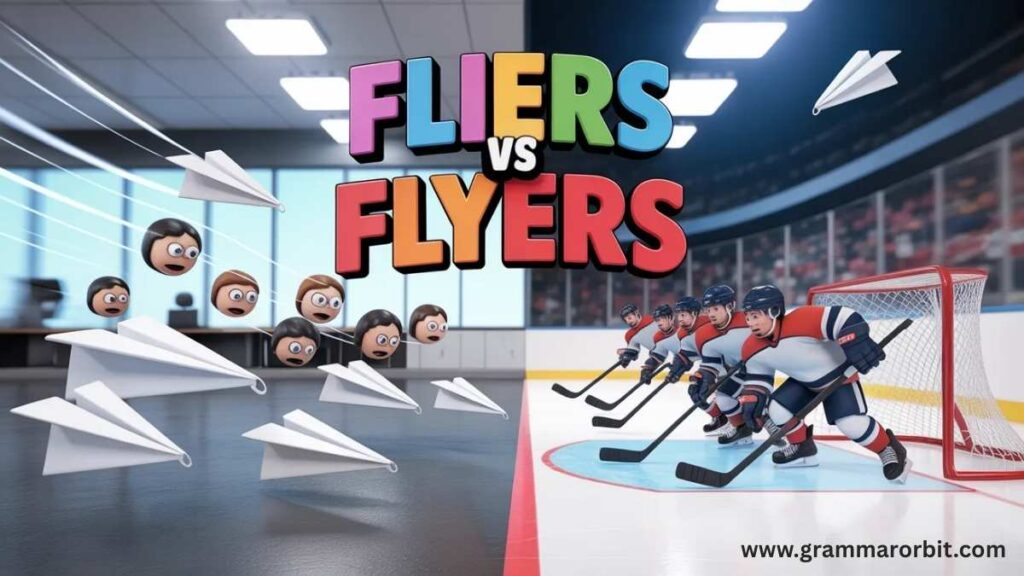
In marketing, retail, and event promotion, flyers dominates. Customers see it daily. Printers label products this way. Design templates follow suit.
This is the everyday flyers meaning most people know.
Examples feel natural immediately:
- We handed out concert flyers at the mall.
- The store mailed holiday flyers.
- Volunteers posted flyers on community boards.
Use fliers here and many readers will assume you slipped.
When you mean people or creatures that fly
Shift into aviation, wildlife, or metaphor. Now many editors prefer fliers.
This version signals tradition. It appears in military histories, museum displays, and specialized journalism.
Here the fliers meaning connects to ability, movement, and air travel.
Examples:
- Early Arctic fliers navigated with minimal equipment.
- Falcons are powerful fliers.
- Test fliers trained under harsh conditions.
Notice how comfortable that looks in a serious context.
Why popularity pushes flyers into more places
Walk through an airport. Listen to announcements. Browse travel ads. You’ll constantly hear about frequent flyers.
Marketing departments love the familiar spelling. It sounds modern and friendly. Over time, that exposure spreads the word into everyday speech.
So when someone asks, can flyers refer to people, the answer is yes. Millions already use it that way.
Formal editors might still reach for flier. Casual readers rarely blink.
Style guides influence professional habits
If you write for an organization, house style usually beats personal preference.
Associated Press
Newsrooms guided by AP style spelling tend to use flier for aviators. Advertising references usually remain flyer.
Chicago Manual of Style
Under Chicago style spelling, many publishers also keep flier in aviation contexts.
Why? Tradition builds authority. Readers expect continuity from issue to issue.
The difference between flyers and fliers at a glance
Here’s a practical snapshot.
| Situation | What readers expect |
|---|---|
| supermarket ads | flyers |
| nightclub promotions | flyers |
| pilots in wartime | fliers |
| migrating birds | fliers |
| informal conversation | either |
If uncertainty creeps in, this table pulls you back to solid ground.
Common mistakes writers make
Even sharp writers stumble because one spelling becomes muscle memory.
Using flier for promotions
In commercial writing, this often looks accidental.
Switching midway
Nothing weakens credibility faster than inconsistency.
Assuming one form must die
English keeps both alive because each serves a purpose.
A fast memory trick
Need something sticky?
Think of the I in flier as a person saying “I fly.”
Think of the Y in flyer as the shape of a sheet of paper spreading out.
It’s playful. It works.
Time Flies or Time Flys The Complete Grammar Guide
Flyers vs fliers examples that clarify instantly
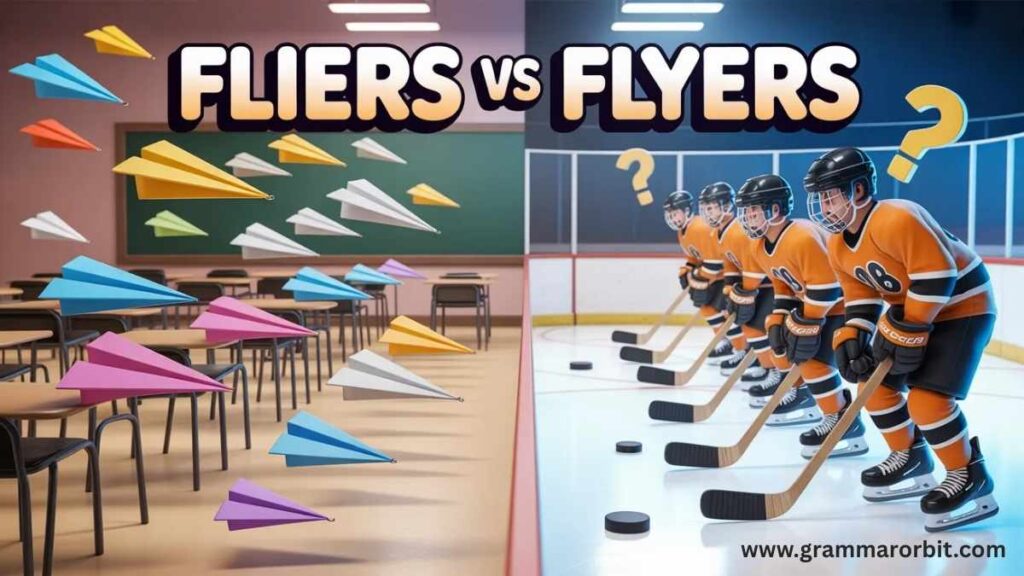
Flyers
- Political flyers covered the table.
- The gym printed discount flyers.
- Bright flyers filled the lobby.
Fliers
- Brave fliers crossed the Atlantic.
- These bats are agile night fliers.
- Record-setting fliers inspire young pilots.
Context makes the decision feel obvious.
Journalism usage versus business language
Here’s where expectations split.
Journalism usage respects inherited style. Editors guard those choices carefully.
Businesses chase recognition and search habits. If customers type flyers, marketing copies flyers.
Neither side is wrong. They serve different goals.
Is flyers always right
It can feel that way because advertising surrounds us. Yet in technical or historical writing, many readers still expect flier.
Rightness depends on audience.
Is flier outdated
Not remotely. Aviation museums, scholarly books, and veteran organizations use it daily. A word doesn’t vanish simply because another becomes trendy.
Plural of flyer and plural of flier
Thankfully, this part stays simple.
| Singular | Plural |
|---|---|
| flyer | flyers |
| flier | fliers |
Just remember that meaning still guides which base word you choose.
How editors think about the choice
Editors chase clarity. They want readers to glide, not stumble.
If a spelling surprises the audience, it distracts from the message. That distraction costs trust.
So they pick the form readers expect and apply it everywhere.
When should I use flyers
Use it when you’re talking about:
- a sale announcement
- an event handout
- a coupon sheet
- promotional distribution
In short, anything that lives in someone’s hand or mailbox.
When should I use fliers
Choose it when you describe:
- pilots
- air crews
- birds
- insects
- metaphorical high achievers
If wings or flight ability drive the meaning, flier often fits best.
4PF Meaning: Definition, Origin, and Cultural Impact
Are fliers and flyers interchangeable
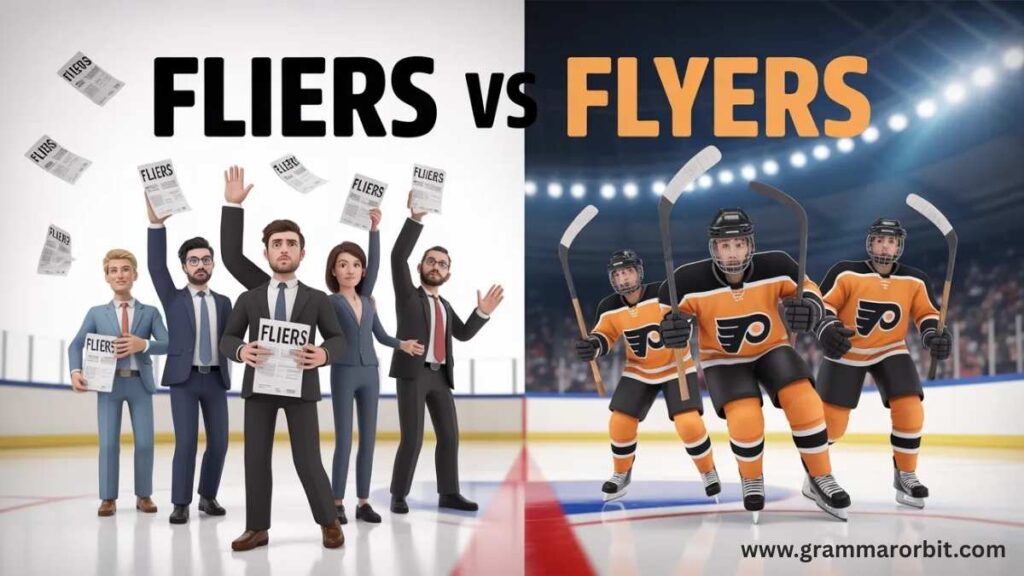
Sometimes. Casual writing allows flexibility. Formal environments usually prefer precision.
If you’re publishing professionally, follow the rule your organization trusts.
What do editors use most often
In marketing departments, flyers wins by a mile.
In aviation or historical reporting, flier remains strong.
Knowing your readership matters more than winning an abstract debate.
A decision guide you can keep nearby
Talking about promotion or paper?
1. flyers
Talking about someone or something airborne?
2. often fliers
Still unsure?
3. match your organization’s style
Simple. Repeatable. Effective.
Real world scenario: planning a charity event
You’re organizing volunteers. Thousands of sheets will advertise date, time, and location. Community members expect the familiar term.
Calling them flyers avoids confusion. It aligns with printing services and public habit.
Communication becomes frictionless.
Real world scenario: writing museum text
Now imagine describing pioneering women pilots. Visitors expect traditional editorial language.
Labeling them fliers supports credibility and continuity with historical documents.
Different audience. Different expectation. Same language.
Why this debate keeps surviving
Because English balances history with popularity. New habits grow. Old ones remain respected.
That tension keeps both spellings alive. It also gives writers flexibility when they understand the terrain.
Reference Cambridge Dictionary Definitions
Here’s a trusted source for clear word meanings:
FAQ
Is it a flyer or flier for a paper?
If you’re talking about a printed advertising leaflet, most readers expect flyer. Print shops label their products that way. Customers search for that term. Marketing teams use it without blinking.
You can find flier in older or highly formal material, yet in everyday business writing, flyer feels natural and immediately clear.
Which is correct flier or flyer?
Both are correct. The right choice depends on meaning.
Use flyer when the topic involves promotion or distribution of paper.
Use flier when describing someone or something that flies, especially in traditional or editorial contexts.
When people ask, which spelling is correct flyers or fliers, they usually want a single winner. English refuses to cooperate. Context makes the call.
Is a brochure a flyer or flier?
A brochure falls into the world of marketing materials. Readers expect flyer.
Think of it this way. If it advertises, sells, or invites, flyer will rarely raise eyebrows. That expectation has grown from decades of commercial habit.
Is it flyer or flier in Canada?
Canadian usage blends British tradition with North American marketing language. In practice, businesses overwhelmingly write flyer for promotional pieces.
In aviation or historical writing, you may still see flier. Editors in those spaces often follow long-standing style preferences.
So the safest approach mirrors elsewhere: paper equals flyer, wings often equal flier.
Is it high flyers or high fliers?
You’ll see both, which makes this one fun.
In business headlines and motivational language, high flyers appears more often because it feels modern and energetic. In journalism or formal prose, some editors still prefer high fliers.
Neither will stop a reader cold. Choose the tone that matches your audience, then keep it consistent.
Can flyers refer to people?
Yes. Everyday language proves it every time someone mentions frequent flyers. Popular usage has stretched the word far beyond paper.
Formal editors might still lean toward fliers for pilots or aircrew. Casual readers rarely notice the difference.
Is flyers always right?
It can seem that way because advertising surrounds you. Yet in specialized aviation or historical contexts, many professionals still expect flier.
Always right depends on where your writing lands.
Do dictionaries prefer flyer or flier?
Major dictionaries list both. They usually note that flyer dominates in marketing while flier often labels people who fly.
In other words, dictionaries describe the pattern rather than forcing a verdict.
What do editors use?
Editors pick the spelling their audience expects. News organizations often maintain flier for aviators. Businesses almost always choose flyer.
Clarity beats ideology every time.
How to remember flyers vs fliers?
Try a quick mental picture.
If you can hold it in your hand, think flyer.
If it can flap, soar, or log air miles, flier might be the better fit.
Simple images stick when rules blur.
conclusion
Grammar loves a tiny showdown, and fliers vs flyers might be its favorite plot twist. One vowel steps aside, confusion marches in, and suddenly everyone in the room has an opinion. Writers debate flyers vs fliers in offices, classrooms, and marketing meetings, and no one leaves without a strong preference.
Here’s the calm, sensible landing. If paper is involved, readers usually expect flyers. If wings or aviation enter the chat, many editors lean toward fliers. Context decides the winner in the flyers vs fliers battle, so match the meaning, stay consistent, and keep moving.
Will someone, somewhere, still disagree? Of course. It’s English. Debates over flyers vs fliers are part of the furniture.
But now you’re choosing on purpose instead of guessing. That confidence shows. Your writing feels smooth, clear, and professional. And that, you could say, really takes flight.

JHON AJS is an experienced blogger and the creative voice behind the website grammarorbit.com, namely Grammar Orbit. With a keen eye for language and a passion for wordplay, he creates engaging grammar insights, word meanings, and clever content that make learning English enjoyable and interesting for readers.