
Have you ever typed “Dutchess of Cambridge” and immediately felt a tiny, judging eyebrow raise from the grammar gods? Don’t worry, you’re not alone. The dutchess vs duchess debate has tripped up writers, royal fans, and social media enthusiasts alike for decades. One extra “t” can turn a regal lady into a geographical landmark or worse, make you look like you skipped English class that day. From formal invitations to news headlines, knowing the correct spelling duchess isn’t just pedantic it’s essential. Stick with us, and you’ll never confuse duchess vs dutchess spelling again, while having a few laughs along the way.
The Origin of the Duchess Title
The word duchess has a fascinating history. It comes from the Latin word dux, meaning leader, which passed into Old French as duchesse. English borrowed the term in the 14th century to refer to a woman holding the rank equivalent to a duke.
A duchess wasn’t just a fancy title. In medieval Europe, she often wielded real power. Some governed vast estates, negotiated political marriages, and even acted as regents when their husbands were away at war. Famous historical duchesses, like Anne of Brittany, held tremendous influence and shaped their countries’ histories.
The misspelling Dutchess seems to have originated from phonetic errors or misreading, and today it persists mainly in certain U.S. place names, like Dutchess County in New York. Outside these exceptions, using it for royalty is incorrect.
Dutchess vs Duchess: Understanding the Difference
Here’s the simple truth: when talking about a royal title, it’s always Duchess. One “t,” no exceptions.
- Duchess – The correct word for a female noble title. Examples include the Duchess of Cambridge, Duchess of Cornwall, and Duchess of Sussex.
- Dutchess – Mostly used for place names or historical references in America, like Dutchess County or Dutchess Hotel.
Think of it this way: if she wears a crown, it’s Duchess. If it’s on a map, it’s Dutchess.
Clutz or Klutz Which Spelling Is Correct in English?
Comparison Table Dutchess vs Duchess
| Term | Correct Usage | Notes | Example |
|---|---|---|---|
| Duchess | Royal title / female noble | Always formal | Duchess of Cambridge |
| Dutchess | U.S. geographic locations | Historical or regional | Dutchess County, NY |
This table makes it easy to spot the difference at a glance.
When to Use Each Spelling
Knowing is it duchess or dutchess depends entirely on context. Here’s a practical breakdown:
- Royalty and Nobility – Always use Duchess.
- Place Names – Dutchess is correct in U.S. regions with that spelling.
- Social Media or Informal Posts – Stick with Duchess unless referring to a location.
- Formal Writing – Essays, journalism, and historical papers require the correct spelling.
A simple rule of thumb: one “t” = nobility, two “t’s” = geography.
Common Mistakes and Why They Happen
Even experienced writers mix these up. Here’s why:
- Autocorrect – Phones and word processors may default to Dutchess in regions like New York.
- Phonetic confusion – The extra “t” seems logical to some writers, even though it’s wrong.
- Casual writing – Tweets, Instagram posts, and memes often ignore traditional spelling rules.
Real-Life Example: In 2021, a number of online news articles mistakenly wrote Dutchess of Cambridge, prompting corrections across multiple media outlets. It shows how even professional writers can stumble on a single letter.
Ninth vs Nineth Which Spelling Is Correct?
Dutchess vs Duchess in Everyday Life
Let’s put it into real-world scenarios.
Emails
Incorrect: “Looking forward to meeting Dutchess Cambridge at the event.”
Correct: “Looking forward to meeting Duchess Cambridge at the event.”
News Headlines
Incorrect: “Dutchess Meghan Announces Charity Initiative”
Correct: “Duchess Meghan Announces Charity Initiative”
Social Media
Incorrect: “Can’t wait to see Dutchess Kate today!”
Correct: “Can’t wait to see Duchess Kate today!”
Formal Writing
Historical essays, biographies, or royalty-focused articles should always use Duchess when referring to a noble title. Using Dutchess here is a glaring error
Duchess Meaning Explained
The duchess meaning is layered:
- Formal Definition – A woman holding the rank of a duke’s wife or ruling a duchy in her own right.
- Informal Usage – Sometimes used affectionately or in storytelling to signify elegance, status, or authority.
Examples in Sentences:
- “The Duchess of Sussex attended the gala in a royal-blue gown.”
- “In the historical novel, the duchess ruled her estates with intelligence and grace.”
Understanding this distinction ensures you know the duchess meaning formal vs informal and can use it correctly in any context.
Duchess Title: History and Etymology
- Latin roots – Dux, meaning leader.
- Old French – Duchesse, indicating a female ruler.
- English adoption – Duchess, since the 14th century, consistently referring to noblewomen.
Duchesses ranked above countesses but below princesses in most hierarchies. They often played pivotal roles in political and social matters, especially during periods when women had limited legal authority outside of marriage.
Fun Fact: A duchess could sometimes inherit estates and influence politics in her own right, which was rare for women in medieval Europe.
Comparative Royal Titles
It helps to see where duchess fits in the nobility structure.
| Title | Rank / Role |
|---|---|
| Princess | Typically higher than a Duchess |
| Duchess | Mid-high noble rank; wife or female duke |
| Countess | Below Duchess; wife or female earl |
This table clarifies the hierarchy and shows why precision matters when addressing or writing about these titles.
Party’s or Parties Which One Is Correct
Spelling Rules for Duchess
Getting the spelling of duchess right is easier than it seems, once you know the rules. Small mistakes can change meaning or make you look careless, especially when writing about royalty or history.
One “t” for Royal Titles
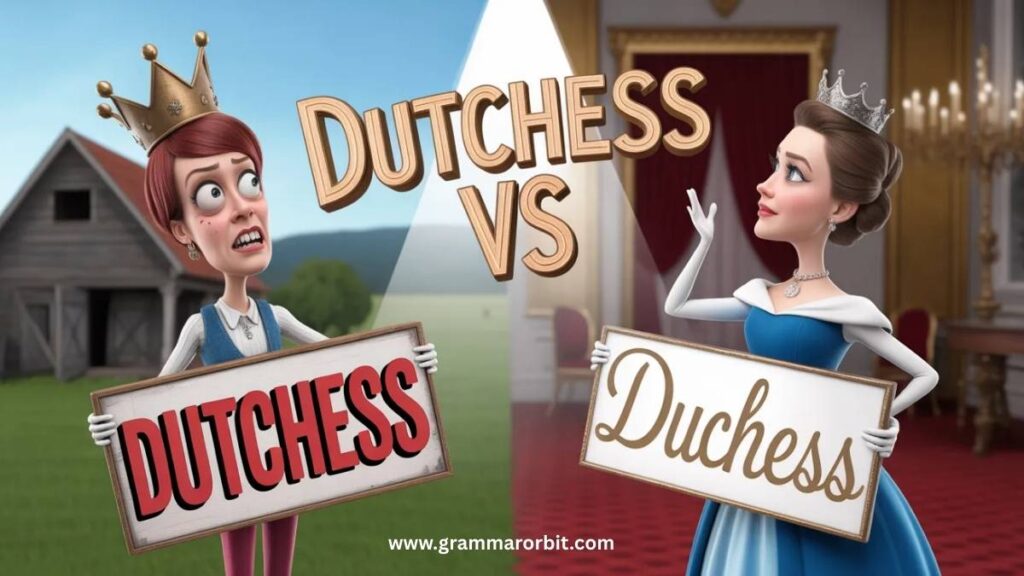
The word duchess always has one “t” when it refers to a female noble or royal title.
- Correct: Duchess of Cambridge, Duchess of Cornwall
- Incorrect: Dutchess of Cambridge
Tip: If she’s wearing a crown, it’s one “t.”
Two “t’s” for Place Names Only
The spelling Dutchess is mostly seen in geographic or historical contexts in the U.S., not royalty.
- Correct: Dutchess County, New York
- Incorrect for royalty: Dutchess of Sussex
Think of it as “two t’s = a map,” which helps you remember the rule.
Capitalize the Title Properly
When referring to a specific duchess, always capitalize it.
- Correct: Duchess Meghan attended the gala.
- Incorrect: duchess meghan attended the gala.
Plural Form
The plural of duchess is duchesses.
- Example: The royal ball was attended by several duchesses from Europe.
Avoid Confusion with Duke
Remember that a duchess is always the female counterpart to a duke, never a standalone or unrelated title.
- Correct: Duchess and Duke of Cambridge
- Incorrect: Duchess Cambridge (without Duke reference can still be okay in context, but know the male counterpart exists)
Mnemonic to Remember
- One “t” → royalty and noble title
- Two “t’s” → geography and historical place names
Common Mistakes to Avoid
- Adding an extra “t” when writing about royalty
- Using Dutchess in social media captions about royal events
- Forgetting capitalization in formal writing
Example in a sentence:
- Correct: The Duchess of Sussex attended the charity gala.
- Incorrect: The Dutchess of Sussex attended the charity gala.
By keeping these rules in mind, you’ll never mix up duchess vs dutchess spelling, whether you’re writing history essays, social posts, or professional emails.
Practical Tips to Avoid Mistakes
- Read carefully before hitting send on emails or posts.
- Use reference materials when in doubt.
- For news or academic work, always double-check the spelling against reliable sources.
- Teach others! Explaining the difference to colleagues or students helps reinforce the rule in your own mind.
Reference Cambridge Dictionary Definitions
Here’s a trusted source for clear word meanings:
FAQs
Is it spelled duchess or dutchess?
The correct spelling for a royal title is duchess with one “t.” Dutchess is generally a misspelling unless referring to U.S. place names like Dutchess County in New York. Always use duchess when talking about a female noble or royal figure.
What does dutchess mean?
Dutchess is mostly a geographic name, not a title. For example, Dutchess County, New York uses this spelling. Outside of places, it’s usually considered a misspelling of duchess.
Is dutchess a royal title?
No. Dutchess is not a royal title. The correct term for a female noble who holds a duchy or is married to a duke is duchess. Using Dutchess for royalty is always incorrect.
Why is it called dutchess?
The spelling Dutchess likely came from phonetic misinterpretations of the word duchess. In the U.S., it became attached to place names, like Dutchess County, and stuck. It is not related to royalty; it’s mostly historical and geographical.
Conclusion
So, there you have it duchess vs dutchess decoded, spelled out, and polished to perfection. One “t” keeps you in royal company, two “t’s” might land you on a map. Next time you write about the Duchess of Cambridge or scroll through social media, you’ll no longer cringe at that sneaky extra “t.” Grammar wins, history stays intact, and you look impressively informed. Remember, a title isn’t just a word it’s centuries of nobility, gossip, and occasionally, very fancy hats. Spell it right, wear your invisible crown, and let the duchesses (and your readers) applaud.

JHON AJS is an experienced blogger and the creative voice behind the website grammarorbit.com, namely Grammar Orbit. With a keen eye for language and a passion for wordplay, he creates engaging grammar insights, word meanings, and clever content that make learning English enjoyable and interesting for readers.