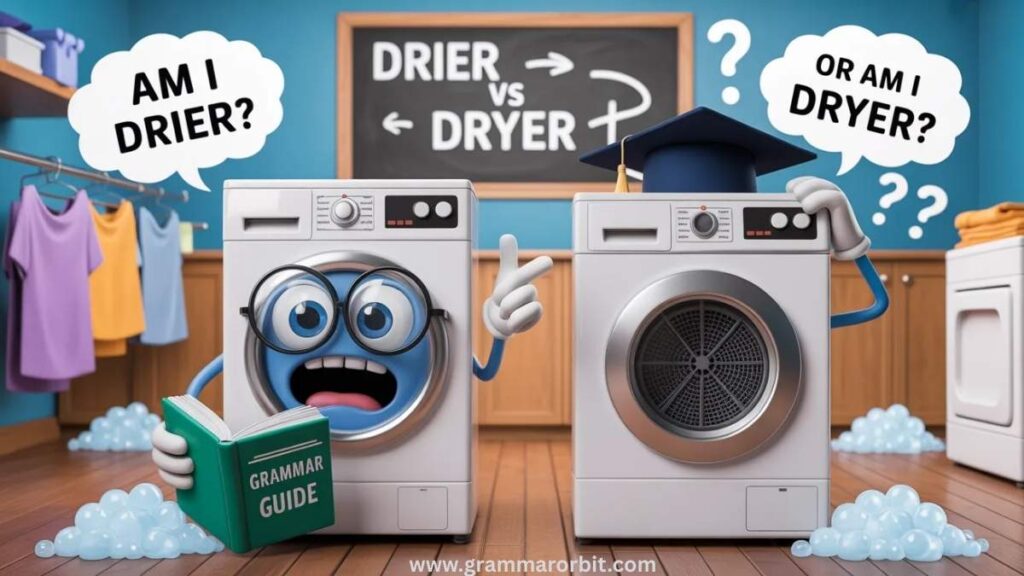
Drier vs dryer might look like twins separated at birth, but trust me, they live very different lives. One compares moisture levels like a weather reporter on caffeine. The other sits in your laundry room and occasionally eats socks. Yet because they sound exactly the same, they trip up smart writers all the time. You type confidently, then pause. Wait… is it drier or dryer? Suddenly your sentence feels less polished than your freshly folded towels. Don’t worry. This isn’t one of those grammar mysteries wrapped in chaos. It’s a simple rule once you see it clearly. Let’s untangle the confusion and settle it for good.
The Simple Difference
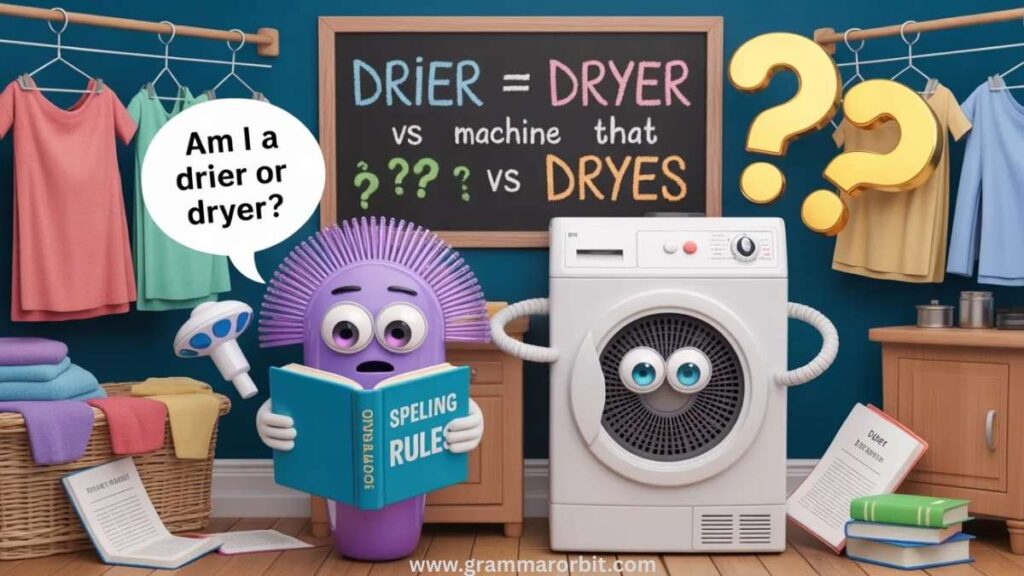
Here’s the rule you can remember without overthinking it:
- Drier compares dryness.
- Dryer names a machine that removes moisture.
That’s it. One letter changes the job of the word.
When to Use Drier
Start with the base word: dry.
When English compares something, it usually adds -er to short adjectives:
- Cold → colder
- Warm → warmer
- Dry → drier
Because dry ends in y, the spelling changes to -ier when it becomes comparative. That’s standard grammar.
So drier simply means more dry.
Examples
- “The air feels drier today.”
- “These towels are drier than they were this morning.”
- “My sense of humor gets drier every year.”
In each sentence, you’re comparing one thing to another. You could swap in “more dry” and the meaning would stay the same. It might sound clunky, but it would work. That’s your clue that you need drier.
If you’re ever unsure, ask yourself: Am I comparing moisture levels?
If the answer is yes, use drier.
When to Use Dryer
Now switch gears.
A dryer is a noun. It’s something you can touch, plug in, or repair.
You probably use one every week.
Common Examples Drier vs Dryer
- Clothes dryer
- Hair dryer
- Hand dryer
- Industrial dryer
In these cases, dryer refers to an appliance that removes moisture. The spelling follows a common English pattern where -er turns a verb into a thing that performs the action:
- Print → printer
- Wash → washer
- Dry → dryer
A dryer is simply “a thing that dries.”
That’s why you’d write:
- “The dryer isn’t heating.”
- “Clean the dryer vent regularly.”
- “She grabbed the hair dryer.”
You would never use drier in those sentences.
Why the Confusion Happens
The problem isn’t grammar. It’s sound.
Both words are pronounced the same way. When you speak, there’s no difference. When you write, there is.
That makes them homophones, like:
- There / their / they’re
- Than / then
- Affect / effect
Spellcheck won’t always catch the mistake because both words are spelled correctly. The error only appears in context.
For example:
“The weather is dryer today.”
Spellcheck won’t flag that. But it’s wrong. The weather isn’t a machine. It’s being compared. The correct word is drier.
Theater or Theatre Which Spelling Is Correct?
A Quick Side-by-Side Comparison Drier vs Dryer
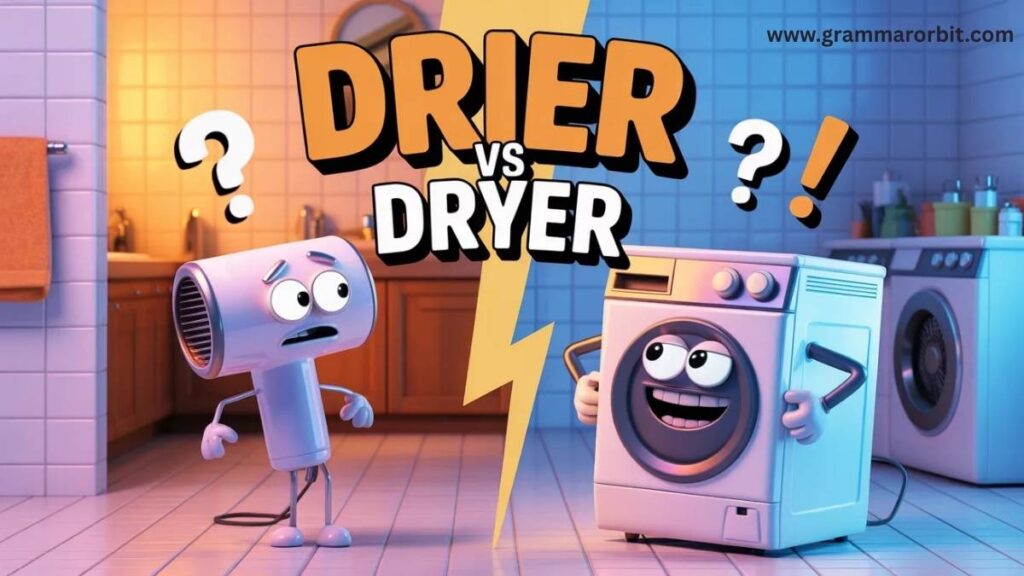
Here’s a simple breakdown:
| Word | What It Is | What It Does | Example |
|---|---|---|---|
| Drier | Adjective | Compares dryness | “The climate is drier here.” |
| Dryer | Noun | Names a machine | “The dryer needs repair.” |
If you remember nothing else, remember this table.
Does British or American English Change the Rule?
Here’s the short answer: no.
Whether you’re writing in American English or British English, the rule stays exactly the same.
- Drier = more dry
- Dryer = a machine that dries
No transatlantic plot twist. No secret spelling switch. Just one steady rule on both sides of the pond.
American English: No Surprises Here
In the United States, writers use:
- Drier for comparisons
- The air in Nevada is drier than in Florida.
- Dryer for machines
- The clothes are still in the dryer.
Open any American dictionary and you’ll see the same distinction. For example, Merriam-Webster clearly separates the comparative adjective from the appliance.
Simple. Consistent. No drama.
British English: Same Rule, Same Logic
Cross over to the UK and nothing changes.
British English also uses:
- Drier as the comparative of dry
- Dryer as the noun for a drying device
You’ll find the same definitions in Oxford English Dictionary.
So if you’re writing for London instead of Los Angeles, relax. You don’t need to switch spellings.
Why People Assume It’s Different
Here’s where the confusion creeps in.
British and American English often do change spelling patterns:
| American | British |
|---|---|
| Color | Colour |
| Theater | Theatre |
| Center | Centre |
Because those differences exist, many writers assume drier/dryer must follow a similar split.
It doesn’t.
Both varieties treat these words the same way because the distinction isn’t about regional spelling. It’s about grammar. One is an adjective. The other is a noun.
Grammar doesn’t pack a suitcase when it crosses the Atlantic.
Tweek vs Tweak Clarifying the Difference and Usage
What About “Tumble Dryer”?
Here’s one subtle difference worth noting.
In the US, people usually say clothes dryer.
In the UK, people often say tumble dryer.
Same machine. Different label.
But notice something important. The word dryer doesn’t change. Only the description in front of it does.
So while vocabulary may shift, the spelling rule stays locked in.
The Real Takeaway
If you’re writing for an American audience, use the rule.
If you’re writing for a British audience, use the same rule.
There’s no alternate version. No hidden exception. No linguistic curveball.
Just ask yourself one simple question:
- Am I comparing moisture? → Drier
- Am I naming a machine? → Dryer
That works in New York. It works in Manchester. It works everywhere English is spoken.
A Practical Test You Can Use
When you’re stuck, try this trick:
Replace the word with “more dry.”
If the sentence still makes sense, you need drier.
- “The air is more dry today.”
→ That works, so use drier.
If replacing it with “more dry” makes no sense, you probably mean dryer.
- “The more dry is broken.”
→ That’s nonsense. So you need dryer.
It’s not fancy, but it works every time.
Scenarios
Sometimes seeing context makes everything click.
Scenario 1: Weather Report
“The region experienced a drier summer than usual.”
That’s a comparison. Use drier.
Scenario 2: Laundry Room
“The dryer stopped working.”
That’s a machine. Use dryer.
Two completely different roles. Same pronunciation. Different spelling.
Common Mistakes to Avoid
Here’s where people usually trip:
1 Mistake:
“The climate is dryer this year.”
→ It should be drier.
2 Mistake:
“I need to buy a new drier.”
→ It should be dryer.
3 Mistake:
“The dryer air is irritating my skin.
→ It should be drier air.
Notice a pattern? The mistake almost always happens when someone is comparing dryness.
Laid or Layed Which One Is Correct?
Why It Matters
You might think, It’s just one letter. Does it really matter?
Yes.
Spelling affects clarity. It signals attention to detail. In professional writing especially, small errors quietly chip away at credibility.
Readers may not consciously say, “That’s incorrect,” but they feel it. Clean writing builds trust. Sloppy writing erodes it.
Reference Cambridge Dictionary Definitions
Here’s a trusted source for clear word meanings:
FAQs
What is the difference between drier and dryer?
The difference comes down to grammar and meaning.
- Drier is the comparative form of dry. It means more dry.
- Dryer is a noun. It usually refers to a machine that removes moisture.
If you’re comparing levels of dryness, use drier. If you’re talking about an appliance, use dryer.
When should I use drier?
Use drier when you’re comparing two things.
For example:
- “This winter feels drier than last year.”
- “The towels are drier now.”
- “Her humor is getting drier with age.”
If you can replace the word with more dry and the sentence still makes sense, you need drier.
When should I use dryer?
Use dryer when referring to a device that removes moisture.
Common examples:
- Clothes dryer
- Hair dryer
- Hand dryer
- Industrial dryer
You’d say:
- “The dryer isn’t working.”
- “Clean the dryer filter.”
- “She used a hair dryer.”
In all of these, you’re naming a thing.
Laid or Layed Which One Is Correct?
Is drier a noun or an adjective?
Drier is an adjective.
It modifies a noun and compares dryness:
- “Drier air”
- “Drier skin”
- “Drier climate”
It does not function as a noun in modern usage.
Is dryer a noun or an adjective?
Dryer is a noun.
It names an object, typically a machine. In phrases like “dryer vent” or “dryer sheet,” it still acts as a noun modifying another noun.
Are drier and dryer pronounced differently?
No. They are pronounced the same way. That’s why they’re often confused.
Because they’re homophones, spelling mistakes usually happen in writing, not in speech.
Does British English use different spelling rules for drier and dryer?
No. Both American and British English follow the same rule:
- Drier = comparative adjective
- Dryer = noun
There’s no regional spelling difference here.
Why doesn’t spellcheck catch the mistake?
Because both words are spelled correctly.
Spellcheck checks spelling, not meaning. If you write “The weather is dryer,” it won’t flag it because dryer is a real word. The issue is grammatical context, not spelling accuracy.
Can dryer ever describe something instead of naming a machine?
In modern English, no. It functions as a noun.
Historically, it could refer to a person who dries something. Today, that usage is rare. In everyday writing, dryer almost always means a machine.
What’s an easy way to Drier vs Dryer remember the difference?
Try this quick test:
If it compares moisture, use drier.
If it plugs into the wall, use dryer.
That one sentence will save you every time.
Conclusion
So here’s the bottom line about Drier vs Dryer. One extra letter can make your sentence sparkle… or short-circuit it.
When you’re comparing moisture in the classic Drier vs Dryer debate, go with drier. When you’re talking about the loud metal box that eats socks for breakfast, choose dryer. One describes. One spins. Big difference.
That’s the heart of Drier vs Dryer. It isn’t about pronunciation. It isn’t about regional spelling. It’s about function. Are you comparing how dry something feels? Or are you naming the appliance in your laundry room?
It may seem small. Still, tiny slip-ups in the Drier vs Dryer showdown can quietly chip away at your credibility. Readers might not grab a red pen, yet they’ll notice. And once they notice, that polished first impression starts to wrinkle.
The bright side? You won’t hesitate anymore. You understand the real difference in Drier vs Dryer. You’ll write it once. You’ll write it right. Then you’ll move on with confidence.
Because great writing isn’t just about big ideas. Sometimes it’s about winning small battles like Drier vs Dryer and refusing to get hung out to dry over one stubborn vowel.

JHON AJS is an experienced blogger and the creative voice behind the website grammarorbit.com, namely Grammar Orbit. With a keen eye for language and a passion for wordplay, he creates engaging grammar insights, word meanings, and clever content that make learning English enjoyable and interesting for readers.