
If you have ever paused mid-sentence wondering whether it is “cryer vs crier,” you are not alone, and honestly, you are in good company with the rest of the English language survivors. These two words look like twins who dressed differently for no clear reason. One tiny letter changes everything, and suddenly you are either talking about a public announcer from medieval times or someone’s last name. English really loves these little traps. In this article, we will break down “cryer vs crier” in a simple, funny, and crystal-clear way so you never second-guess yourself again when writing, reading, or quietly judging grammar online.
The Quick Reality Check
Before we go deeper, let’s clear the fog right away.
- Crier is the correct standard English word
- Cryer is usually a surname or a spelling mistake when people mean crier
That’s the heart of the issue.
So if you are writing an essay, article, or professional text, you almost always want crier.
What Crier Actually Means
The word crier has a very specific job in English. It refers to a person who announces news out loud, usually in public.
Think of someone standing in a town square calling out important updates before newspapers or phones existed. That person is a crier.
Simple meaning of crier
A crier is someone who:
- Announces news loudly
- Shares official messages in public spaces
- Works in formal or ceremonial roles in some cases
Where the word comes from
The word comes from the verb “cry,” but not in the emotional sense. Here, “cry” means to shout or call out.
So a crier is literally someone who cries out information.
Related Articles You May Find Helpful
Encorporate vs Incorporate the Complete Guide
What a Crier Looks Like in Real Life
To make this more real, imagine a busy medieval town.
A bell rings. People start gathering. A person steps forward and reads a message from the local authority.
That person is the town crier.
Historical role
Town criers were extremely important before modern communication systems existed. They:
- Announced laws
- Shared royal or government messages
- Warned people about danger
- Spread public information quickly
In many ways, they were the original news broadcasters.
Even today, you might still see ceremonial town criers in parts of the UK. They appear at festivals or official events, not as a daily job but as a tradition.
What Cryer Means (And Why It Confuses Everyone)
Now let’s talk about cryer.
Unlike crier, cryer does not have a standard dictionary meaning as a job or role in modern English.
Instead, it shows up in three main ways:
1. As a surname
Cryer is commonly used as a last name. You will see it in real people’s names, fictional characters, and branding.
2. As a spelling mistake
Many people accidentally type cryer when they actually mean crier.
3. Rare or informal usage
Sometimes writers use it in fiction or stylistic contexts, but it is not considered standard grammar.
So when someone asks “is cryer a word,” the honest answer is yes, but only in limited situations.
It is not the correct term for a public announcer.
Related Articles You May Find Helpful
Courtesy vs Curtesy Which one is Correct
The Core Difference Between Cryer vs Crier

Let’s break it down in a way that actually sticks in your mind.
Crier
- A real English noun
- Describes a job or role
- Used in history and formal settings
- Means someone who announces news aloud
Cryer
- Not a standard job title
- Usually a surname
- Often a spelling error
- Sometimes used in fiction or branding
If you are choosing between them in writing, the decision is almost always simple.
Use crier unless you are dealing with a name.
Why This Confusion Happens
English is full of odd spelling patterns. This is one of those cases where sound and spelling don’t match neatly.
Both words sound identical when spoken. That’s the main problem.
When we hear the word, we naturally think of “cry” and add “er.” That leads many people to assume cryer is correct.
But English doesn’t always follow that logic.
The spelling pattern issue
In English, nouns formed from verbs sometimes change spelling slightly:
- cry becomes crier
- try becomes trier
- fly becomes flier
So crier follows a historical spelling pattern, not a modern phonetic one.
That’s why it feels confusing at first glance.
Where You Will Actually See “Crier”
Even though the role is old, the word is still alive in certain places.
Courtrooms
A court crier may announce the arrival of a judge or call cases.
Auctions
Auction criers still exist in some places. They rapidly call out bids in a rhythmic style.
Historical reenactments
You will often see town criers in festivals or heritage events.
Literature and storytelling
Writers use the word to give a historical or traditional feel.
Related Articles You May Find Helpful
Bony vs Boney Which Spelling Is Correct
Common Mistakes People Make
This is where most confusion shows up in real writing.
Using cryer for an announcer
This is the most common error.
Wrong: The cryer announced the news
Correct: The crier announced the news
Thinking it means an emotional person
Some people assume crier refers to someone who cries emotionally.
That is incorrect in this context.
If you want to describe an emotional person, English uses words like:
- weeper
- sensitive person
- emotional person
Crier here has nothing to do with tears.
Treating both words as interchangeable
They are not interchangeable in formal writing. Only crier is standard.
Related Articles You May Find Helpful
Seing Vs Seeing Which one is Correct
Easy Way to Remember the Difference
Here’s a simple mental trick that actually works.
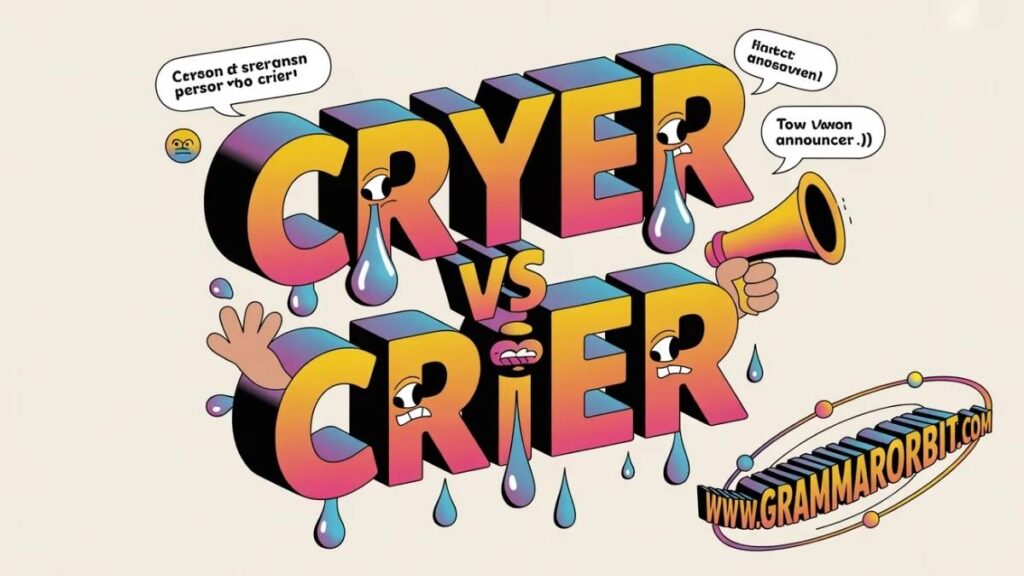
Crier = calls out news
Cryer = usually a name
If it involves shouting announcements, it is always crier.
If it looks like a family name on a sign, it might be Cryer.
Modern Equivalent of a Crier
In today’s world, we don’t rely on public shout announcements anymore. So what replaces the crier?
The closest modern equivalent would be:
- announcer
- broadcaster
- news reporter
- public speaker
So when you compare crier vs announcer, you are really comparing old communication systems with modern ones.
Why “Crier” Survived in English
You might wonder why the word still exists if the job is mostly gone.
The answer is simple. Language keeps historical words when they still have cultural meaning.
Crier survived because:
- It appears in history books
- It is used in ceremonies
- It adds authenticity in storytelling
- It is part of legal and traditional language
So even if you never see a real town crier in daily life, the word still matters.
Here’s a trusted source for clear word meanings:
fAQs
Is it crier or cryer for someone who cries?
It is not “crier” or “cryer” when you mean a person who cries emotionally. The correct word is actually “crier” only in a different sense, but it does not mean an emotional person.
If you mean someone who cries easily, English does not use crier or cryer for that idea. Instead, you can say:
- emotional person
- sensitive person
- weeper (old-fashioned or literary)
- tearful person
So in simple terms, neither word correctly describes someone who cries often in modern everyday English.
What does it mean to be a cryer?
A cryer is not a standard English term for an emotional person.
Most of the time, “cryer” refers to:
- a surname (like a family name)
- a misspelling of “crier”
So if someone says “he is a cryer,” it is usually either incorrect grammar or used informally in a non-standard way.
If the meaning is emotional crying, English would use:
- “he cries easily”
- “he is emotional”
- “he is a weeper” (less common, more literary)
What is the meaning of cryer?
The meaning of cryer depends on context, but in standard English it is NOT a recognized job or role.
It usually means:
- a surname (proper noun)
- an incorrect spelling of “crier”
The correct word for someone who announces news is crier, not cryer.
So:
- Cryer = name or spelling error
- Crier = official announcer or historical messenger
How do you say “crying” in a fancy way?
If you want more expressive or elegant ways to say “crying,” English has plenty of options depending on tone:
Formal or poetic:
- weeping
- sobbing
- lamenting
- shedding tears
- tearful expression
More dramatic or literary:
- overcome with emotion
- breaking down in tears
- eyes welling up
- emotionally overwhelmed
Example:
Instead of “She was crying,” you could say:
“She was weeping quietly as the moment sank in.”
What’s slang for crying?
English slang for crying is often casual and expressive. Here are some common ones:
- bawling (crying loudly)
- crying your eyes out
- tearing up
- ugly crying
- blubbering (very informal, slightly humorous)
- sniffling
Example:
- “He was bawling after the movie ended.”
- “She started ugly crying during the speech.”
These phrases are more natural in everyday conversation and social media.
Conclusion
So here we are at the finish line, and hopefully cryer vs crier doesn’t feel like a grammar horror movie anymore. The truth is simple once you see it clearly. A crier is the loud, official voice of history, the one announcing news in town squares and courtrooms. A cryer, on the other hand, mostly shows up as a name tag or an accidental typo that sneaks into your sentence when your brain is moving faster than your spelling skills.
English does this kind of mischief all the time, and cryer vs crier is one of its classic tricks. One letter shifts the meaning, and suddenly you are either describing a job or someone’s surname. That is the whole heart of cryer vs crier confusion. But now you know the trick. If it shouts news, it is crier. If it looks like it belongs on a family tree, it is Cryer. Simple, right?
And just like that, you have officially survived another grammar battle—and yes, cryer vs crier will never trip you up the same way again.

JHON AJS is an experienced blogger and the creative voice behind the website grammarorbit.com, namely Grammar Orbit. With a keen eye for language and a passion for wordplay, he creates engaging grammar insights, word meanings, and clever content that make learning English enjoyable and interesting for readers.