
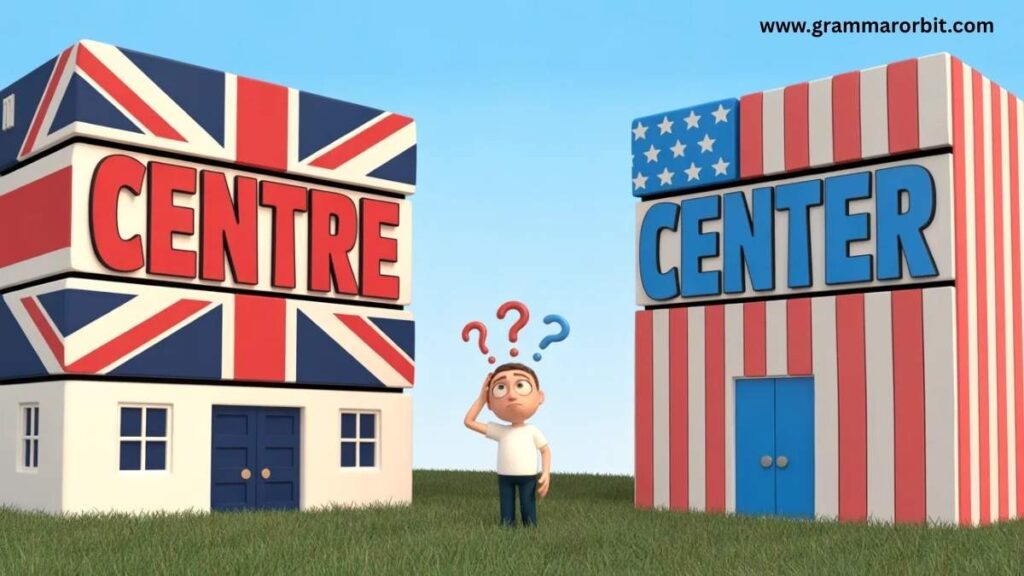
Ever typed a perfectly good sentence, reached the middle of it, and suddenly spiraled into an identity crisis over centre vs center? You’re not alone. Two spellings. Same pronunciation. Same meaning. Yet somehow your brain freezes like it’s defusing a grammar bomb. Is it British? Is it American? Did your keyboard just betray you? The centre vs center debate has quietly confused students, writers, businesses, and even teachers for years. It’s the kind of tiny detail that feels small until it isn’t. Pick the wrong one for your audience and suddenly your polished paragraph looks slightly… off. Let’s settle this spelling showdown once and for all.
Centre vs Center The Clear Answer
Here’s the straightforward rule:
- Center is the standard spelling in American English.
- Centre is the standard spelling in British English.
Same meaning. Same pronunciation and grammar role.
Different spelling system.
That’s it.
But the real story gets more interesting once you ask why.
Where the Spelling Split Began
Language never changes by accident. It evolves because people reshape it.
The divide between centre and center traces back to the early 19th century and the influence of Noah Webster. Webster believed American English should break away from British traditions. He pushed for spelling reforms that were simpler and more phonetic.
In his dictionary, An American Dictionary of the English Language, he standardized spellings like:
- centre → center
- theatre → theater
- metre → meter
- colour → color
He removed the French-style -re endings and replaced them with -er. Americans adopted the change. Britain did not.
That decision created one of the most recognizable examples of British vs American spelling rules.
The Original Roots of the Word
Long before Webster, the word had already traveled across languages.
It began in Greek as kentron, meaning a sharp point or pivot. It moved into Latin as centrum. From there, Old French shaped it into centre, which influenced British spelling conventions.
American English later simplified it.
So when people ask which is correct centre or center, the honest answer is that both spellings have legitimate historical roots.
Do They Sound Different?
No.
Both are pronounced the same way: sen-ter.
Accent might shift slightly depending on whether someone speaks with a British or American tone, but the word itself doesn’t change phonetically.
This is purely a spelling difference.
Orgo Slang Meaning, Definition & Real Life Usage
The Meaning of Centre vs Center

Let’s clear up another misconception. There is no difference in meaning.
Both words refer to:
- The middle point of something
- A place where activity is concentrated
- A position of importance
- A focal point in a discussion
Examples in American English:
- The center of the circle
- The medical center
- The center of attention
Examples in British English:
- The centre of the room
- The town centre
- The centre of political debate
Same definition. Same usage. Only the spelling shifts.
Regional Usage: Who Uses What?
Understanding regional English usage prevents awkward mistakes.
United States
Americans use center. You’ll see it in schools, government documents, businesses, and media.
United Kingdom
Brits use centre. It appears in academic writing, signage, and official publications.
Canada
Canadian English generally follows British spelling rules. You’ll often see centre in formal writing. However, American influence sometimes appears in branding and advertising.
Australia and New Zealand
Both follow British spelling conventions. Centre is standard.
If you’re writing for a specific region, match that region’s spelling norms. It’s a simple way to show awareness and professionalism.
A Side-by-Side Comparison
Here’s a clean centre center comparison to keep things clear:
| Feature | Center | Centre |
|---|---|---|
| English Variant | American English | British English |
| Pronunciation | Same | Same |
| Meaning | Identical | Identical |
| Plural | Centers | Centres |
| Verb Form | Centered, Centering | Centred, Centring |
Notice that grammar stays identical. Only spelling changes.
Writen or Written? Which Form Is Correct?
Noun and Verb Forms
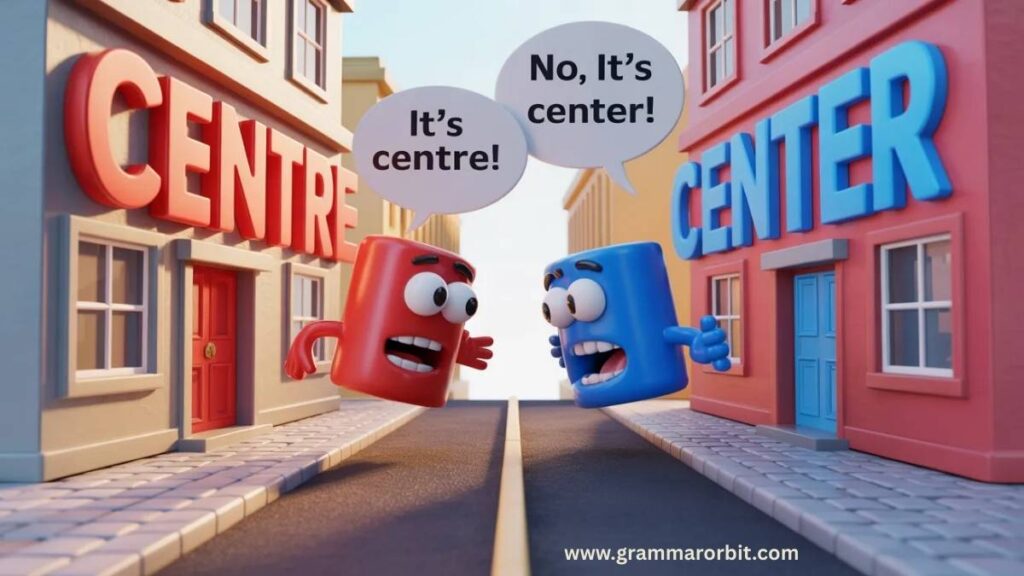
The word functions as both a noun and a verb.
As a noun:
- The center of the table
- The community centre
Plural forms differ by region:
- Centers in the US
- Centres in the UK
As a verb:
- Please center the image on the page.
- The company centred its strategy on innovation.
Derived forms follow the same pattern. If you choose centre, you must also write centred and centring. If you choose center, stick with centered and centering.
Mixing systems in one document feels sloppy. Readers notice.
Physical vs Metaphorical Usage
The word applies to both physical locations and abstract ideas.
Physical meaning:
- The center of a circle
- The centre of the city
- The geographic center of a country
Metaphorical meaning:
- The center of attention
- The centre of controversy
- Emotionally centered
Whether physical or abstract, the meaning remains stable across language variants.
Common Mistakes Writers Make
Even experienced writers slip up.
Mixing spellings in one document
Writing “city centre” in one paragraph and “shopping center” in another creates inconsistency.
Ignoring audience expectations
Using British spelling for an American academic paper may cost points. Using American spelling in a UK publication may raise eyebrows.
Forgetting derived forms
If you write centre, don’t suddenly switch to centered. Stay consistent.
Assuming one spelling is superior
Neither is more correct. They reflect different spelling conventions.
Why Spelling Consistency Matters
Consistency builds trust.
Imagine reading an article that switches between color and colour, theater and theatre, center and centre. It feels careless.
Spelling consistency shows:
- Attention to detail
- Awareness of audience
- Professional credibility
- Even small inconsistencies can distract readers from your message.
Choosing or Chosing Which One Is Correct?
Centre vs Center in Professional Writing
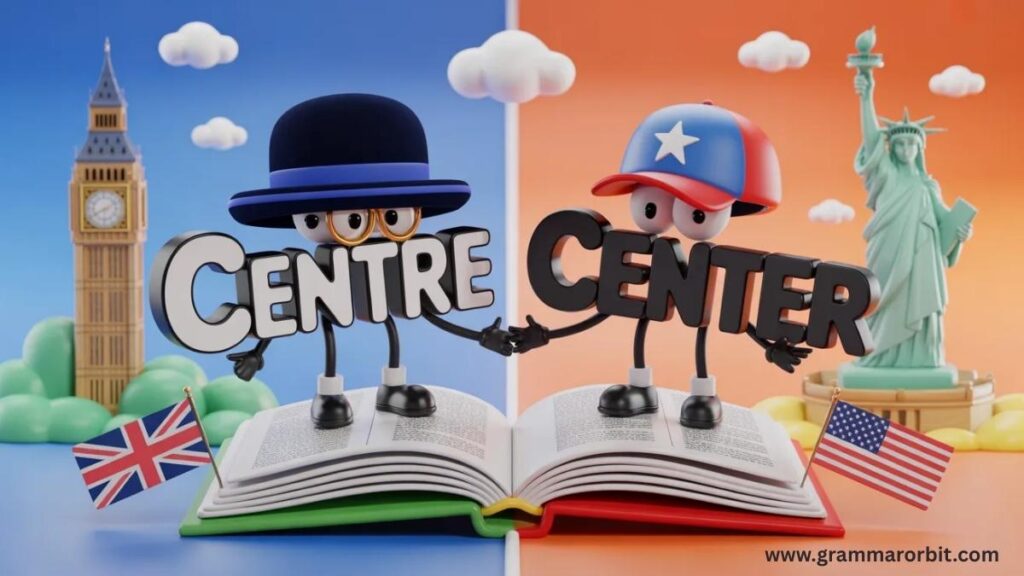
In business, spelling choices reflect brand identity.
American companies write:
- Data center
- Customer service center
- Innovation center
British companies write:
- Data centre
- Community centre
- Sports centre
Global organizations often localize spelling based on audience region.
For example, a multinational tech company might use center on its US website and centre on its UK website. The product remains the same. The spelling adapts.
Academic and Style Guide Expectations
Universities and publishers follow specific spelling systems.
American institutions require American spelling rules. That means center.
British institutions require British spelling rules. That means centre.
Exams often align with regional standards. English language learners should choose one variant and stick with it throughout essays and reports.
Switching back and forth can cost marks.
Related Spelling Differences
Centre vs center is not an isolated case. It fits into a broader pattern of English language spelling variations.
Here are other common examples:
| American | British |
|---|---|
| Color | Colour |
| Theater | Theatre |
| Meter | Metre |
| Fiber | Fibre |
| Organize | Organise |
Understanding these patterns helps you recognize the difference in spelling conventions across English variants.
How to Choose the Right Spelling
When deciding between Centre or Center, ask yourself three simple questions:
Who is my audience?
If they’re American, use center. If they’re British, use centre.
What style guide am I following?
Academic, corporate, and publishing guidelines often specify spelling systems.
Where will this writing appear?
Local businesses should match local spelling norms.
If your audience spans multiple countries, choose one system and stay consistent throughout the piece.
Why This Debate Still Matters
You might wonder why such a small difference deserves attention.
Because spelling signals identity.
It quietly tells readers where the writing originates. It shows cultural alignment and reflects linguistic history.
And in professional settings, details matter.
Using the correct regional spelling shows that you understand your audience. It builds subtle credibility.
A Simple Memory Trick
If you struggle to remember which version belongs where, try this:
American English often simplifies spellings.
British English often preserves traditional forms.
So if the word ends in -er, think American.
If it ends in -re, think British.
Short. Practical. Easy to recall.
Reference Cambridge Dictionary Definitions
Here’s a trusted source for clear word meanings:
FAQs
Is There a Difference Between Center and Centre?
Spelling Difference Only
Here’s the simple truth. The meaning stays the same. The spelling changes depending on location.
- Center = American English
- Centre = British English
That’s it. No hidden grammar trap. No secret definition shift.
In the United States, dictionaries like Merriam-Webster list center as standard. In the UK, sources such as Cambridge University Press use centre.
Same word. Different spelling tradition.
How Do You Spell Center in Australia?
Australia Uses “Centre”
Australia follows British English spelling rules.
So you’ll write:
- Shopping centre
- Medical centre
- Town centre
- Exam centre
If you write “center” in Australia, it won’t be illegal. It’ll just look American.
Is It an Exam Center or an Exam Centre?
It Depends on the Country
Think location first.
- In the US → exam center
- In the UK or Australia → exam centre
When filling out official forms, always match the spelling used by the institution. Consistency matters more than preference.
Does Center Mean Middle?
Yes, But It Can Mean More
At its core, “center/centre” means the middle point of something.
For example:
- The center of a circle
- The center of the room
But it can also mean:
- A place for activities (fitness center, research centre)
- A hub of action (city center)
- A position in sports
So yes, it means “middle,” though it can stretch beyond that.
Is the T Silent in Center?
No, It’s Not Silent
In American pronunciation, “center” sounds like:
SEN-ter
The “t” blends softly into the “er” sound. It isn’t sharply pronounced like in “top,” though it’s definitely there.
In British pronunciation of “centre,” it sounds like:
SEN-tuh
The “t” remains lightly pronounced.
How Do We Say Middle?
Simple and Clear: “MID-uhl”
The word “middle” is pronounced:
MID-uhl
The “dd” blends into a soft “d” sound. The “le” becomes a light “uhl.”
Think of it like this:
- MID + uhl
- Two quick beats
- Smooth and simple
No silent letters hiding in the shadows.
Conclusion
After all the back and forth, the great centre vs center mystery turns out to be far less dramatic than it seems. No hidden grammar trap. No secret rule book. Just geography doing its thing.
If you’re writing in American English, use center. If you’re writing in UK English or following British spelling conventions, use centre. Same meaning. Same pronunciation and role in a sentence. The only shift is regional spelling preference.
The real problem isn’t choosing one over the other. It’s switching mid-article like you changed passports halfway through a paragraph. That’s when readers start squinting.
English thrives on variation. It borrows, adapts, and evolves. Centre and center simply reflect that history. Think of them as twins raised on different continents. Different outfits. Same DNA.
So next time you hesitate, don’t overthink it. Match your audience. Stay consistent. Write with confidence.
Because strong writing doesn’t wobble over two letters.

JHON AJS is an experienced blogger and the creative voice behind the website grammarorbit.com, namely Grammar Orbit. With a keen eye for language and a passion for wordplay, he creates engaging grammar insights, word meanings, and clever content that make learning English enjoyable and interesting for readers.