Some spelling debates feel small until they hijack your brain at work. You’re writing an email, cruising along confidently, then you hit the phrase break room and freeze. One space or no space? Suddenly the coffee’s cold, productivity’s gone, and autocorrect is judging you. This tiny workplace word pops up everywhere, from HR documents to office signage, and it refuses to behave. Is it breakroom or break room? Is one wrong, informal, or secretly British? Relax. You’re not alone, and you’re not overthinking it. This guide untangles the confusion with clear rules, real examples, and zero grammar snobbery, so you can write with confidence.
Quick Answer: Is It Breakroom or Break Room?
Let’s start with clarity.
Break room (two words) is the correct and preferred spelling in formal and professional writing.
- Break room is standard in American English and British English.
- Breakroom (one word) is accepted in informal American usage.
- Both forms mean the same thing.
- When in doubt, use break room.
This single rule will keep your writing safe, polished, and universally understood.
What Is a Break Room?
Understanding meaning helps explain spelling choices.
Break Room Meaning
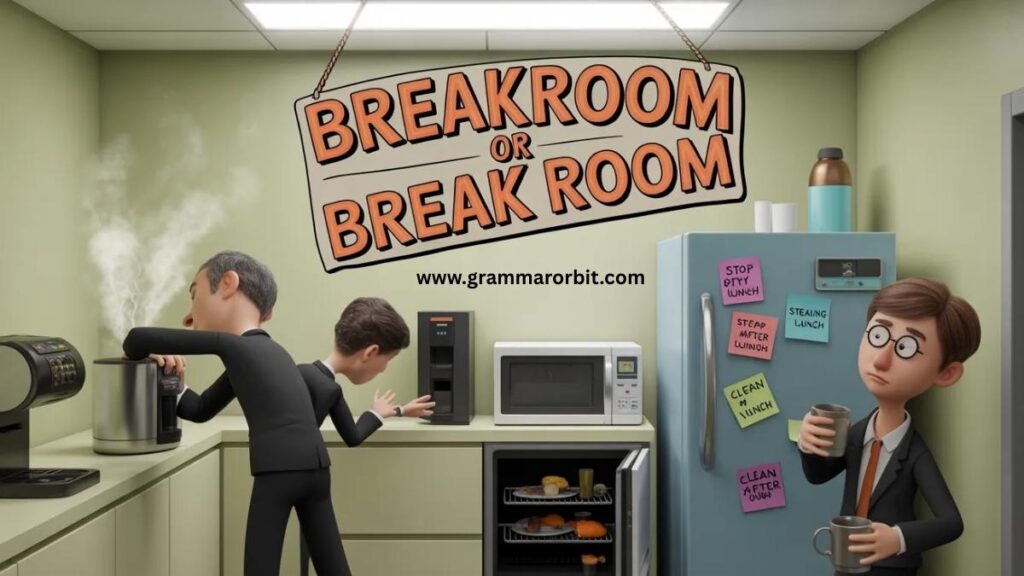
A break room is a designated space in a workplace where employees rest during scheduled breaks. It is not a meeting room, workspace, or restroom. Its purpose is recovery mental and physical during the workday.
Typical features include:
- Tables and seating
- A refrigerator or pantry
- Microwave or coffee machine
- Vending machines
- Notice boards or internal office signage
In everyday terms, it’s the office break room a shared employee break area designed for short pauses from work.
Breakroom Definition
The breakroom definition is identical.
There is no difference in meaning between:
- break room meaning
- breakroom meaning
Both refer to the same workplace break space, also known as:
- staff lunch room
- office rest area
- workplace break space
- staff relaxation space
The difference is spelling not definition.
The Origin of “Break Room”
The spelling debate makes more sense once you understand how the term developed.
Historical Context
The phrase break room emerged in the early 20th century as workplaces expanded and labor policies formalized. Employers began providing designated areas where employees could:
- Eat meals
- Rest briefly
- Step away from machinery or desks
At the time, English favored open compound nouns. As a result, break room was written as two words in:
- Company manuals
- Early labor policies
- Office design plans
The one-word form breakroom appeared much later as English evolved and compounds began closing.
Compound Nouns in English: Why Spelling Changes
The confusion around breakroom vs break room comes from how English handles compound nouns.
What Are Compound Nouns?
Compound nouns combine two or more words to express a single idea. English allows three forms:
- Open compounds (two words):
break room, dining room, post office - Closed compounds (one word):
workplace, bathroom, notebook - Hyphenated compounds:
check-in, dry-cleaning
Open vs Closed Compound Words
English does not follow strict rules for when compounds close. Instead, usage evolves over time.
Examples:
- Web site → website
- E-mail → email
- On line → online
Break room is currently in the open-compound stage, while breakroom represents a closing trend mostly informal and regional.
Charizarding Meaning: What “Charizarding” Really Means
breakroom or break room Is There a Difference?
This question appears often in searches like difference between breakroom and break room.
The Real Difference
There is no semantic difference. The distinction lies in:
- Tone
- Formality
- Regional preference
Side-by-Side Comparison
| Feature | Break Room | Breakroom |
|---|---|---|
| Word type | Open compound | Closed compound |
| Meaning | Same | Same |
| Formal writing | Preferred | Not advised |
| Informal usage | Common | Increasing |
| American English | Standard | Accepted |
| British English | Standard | Rare |
If consistency and professionalism matter, break room spelling remains the best choice.
American English vs British English Spelling
Spelling differences in English often reflect regional usage patterns.
American English Spelling
In American English:
- Break room is the dominant and safest form.
- Breakroom appears frequently in:
- Casual workplace communication
- Internal software labels
- Startup culture
This leads to common questions:
- Is breakroom American English?
- Is breakroom one word in the US?
Yes but mainly in informal contexts.
British English Spelling
In British English:
- Break room is the accepted standard.
- Breakroom is uncommon and often viewed as incorrect.
For international audiences, global companies, or UK-based writing, break room is the clear choice.
Which Spelling Should You Use?
This depends entirely on context.
Use “Break Room” When Writing:
- HR documents
- Company policies
- Employee handbooks
- Training materials
- Professional articles
- Workplace communication intended for clarity
Use “Breakroom” When Writing:
- Casual internal messages
- Informal American office settings
- UI labels or software menus
- Non-public internal tools
Professional writing standards always favor clarity over trendiness.
That’s why break room remains dominant.
Simpler or More Simple Grammar Rules Made Easy
Break Room Grammar: What Editors Prefer
From a grammar standpoint, break room aligns with established conventions.
- It follows standard compound noun rules.
- Major dictionaries list it as two words.
- Editors and style guides prefer it in formal writing.
If you’re asking:
- Which is correct: breakroom or break room?
- Should I write breakroom or break room?
The grammatically conservative answer is always break room.
Usage Trends and Search Behavior
Language evolution in English often mirrors search behavior.
Observed Trends
- Break room consistently receives higher search volume.
- Breakroom shows gradual growth in American contexts.
- Queries like is it breakroom or break room are increasing.
This reflects uncertainty not replacement.
English hasn’t fully closed this compound yet.
Common Mistakes Writers Make
Even experienced professionals stumble here.
Frequent Errors
- Switching between spellings in one document
- Using breakroom in formal HR documents
- Assuming one spelling changes the meaning
- Ignoring internal style guides
How to Avoid Them
- Choose one spelling per document
- Default to break room
- Match the formality of the context
- Stay consistent across signage and policies
JTFO Meaning: The Hilarious Slang Term Explained
breakroom or break room in Real Usage
Examples clarify intent.
Professional Context
“Employees may use the break room during scheduled rest periods.”
Informal Context
“I’ll be in the breakroom grabbing coffee.”
Workplace Signage
“Office Break Room →”
HR Policy Language
“Food storage is provided in the office break room.”
Each example fits its environment.
Case Study: Workplace Consistency in Action
A mid-sized U.S. corporation audited its internal language and found:
- HR documents used break room
- Internal apps used breakroom
- Office signs mixed both
This inconsistency caused confusion during onboarding.
The Solution
They standardized:
- Break room for all official documents
- Breakroom only inside internal tools
The result:
- Clearer workplace communication
- Improved professional tone
- Stronger brand consistency
Comparison Table
| Aspect | Break Room | Breakroom |
|---|---|---|
| Correct spelling | Yes | Yes (contextual) |
| Meaning | Identical | Identical |
| Professional writing | Best choice | Avoid |
| Informal usage | Acceptable | Common |
| American English | Standard | Informal |
| British English | Standard | Rare |
Reference Cambridge Dictionary Definitions
Here’s a trusted source for clear word meanings:
FAQs
How do you spell breakroom?
The correct break room spelling in formal and professional writing is two words: “break room.”
- Breakroom (one word) is acceptable in informal American usage, but it’s best avoided in HR documents, company policies, or professional writing.
- Tip: If you’re unsure, always default to break room for clarity and correctness.
What is another name for a breakroom?
A break room can also be called:
- Employee break area
- Staff lunch room
- Office rest area
- Workplace rest zone
- Lunch break room
These alternatives all describe a space where employees can relax, eat, or take short mental breaks during work hours.
What is the break room?
A break room is a designated space in a workplace where employees can pause work, eat, drink, or relax.
- It’s not for meetings or formal tasks its primary purpose is rest.
- Typical features include tables, chairs, coffee machines, microwaves, refrigerators, and notice boards.
- Think of it as the office’s recharge station.
What is a break room in an office?
In an office setting, a break room is:
- A communal employee rest area
- A place to eat lunch, grab coffee, or chat informally
- Part of company break policies and internal workplace design
It’s also referred to in corporate language as a staff relaxation space or workplace break space, providing employees a mental and physical pause during their workday.
Is break down 1 or 2 words?
The phrasal verb break down is always two words.
- Example: The copier will break down if we overload it.
- Note: Breakdown (one word) is a noun, not a verb.
- Example: We had a breakdown in communication.
This follows the same principle as break room vs breakroom, where meaning and word form determine spacing.
Conclusion
So, is it breakroom or break room? After all the rules, examples, and rea world usage, the answer lands softly in your lap like a well earned coffee break. Break room is the clear winner for professional writing, HR documents, and anything that needs to look polished and intentional. Breakroom isn’t wrong. It’s just more casual, more relaxed, and very American kind of like wearing sneakers to the office on Friday. The real mistake isn’t choosing one over the other. It’s mixing them up. Pick a spelling, stay consistent, and move on with your day. Your grammar’s fine. Now go enjoy the break room.

JHON AJS is an experienced blogger and the creative voice behind the website grammarorbit.com, namely Grammar Orbit. With a keen eye for language and a passion for wordplay, he creates engaging grammar insights, word meanings, and clever content that make learning English enjoyable and interesting for readers.