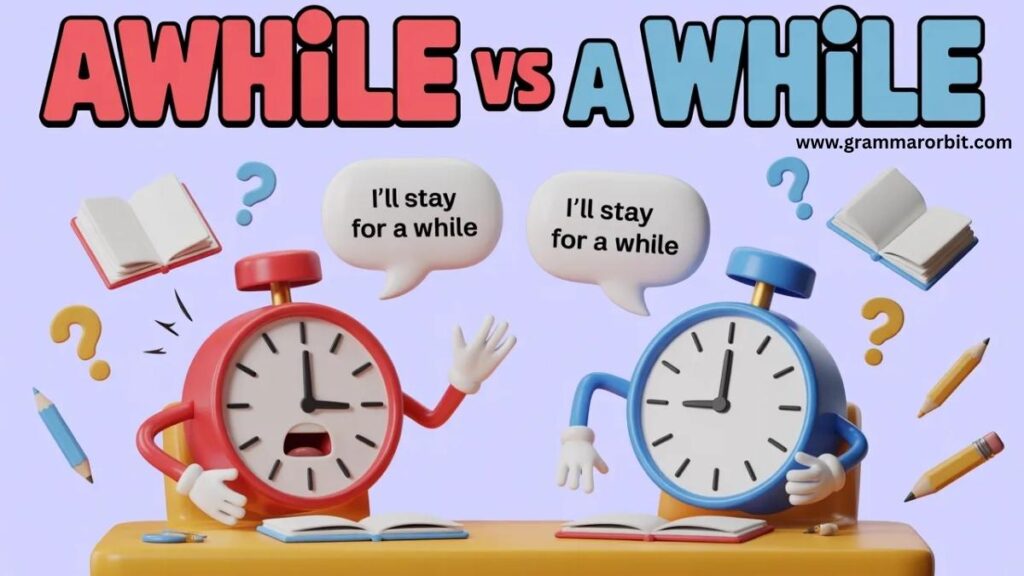
If you’ve ever paused mid-sentence, wondering whether to write “sit here awhile” or “sit here for a while,” you’re not alone. The awhile vs a while dilemma trips up even seasoned writers, turning tiny words into big headaches. One is an adverb, the other a noun phrase sounds fancy, right? But don’t worry, no PhD in grammar is needed to master awhile vs a while. By the end of this guide, you’ll know exactly when to use each, avoid common mistakes, and finally understand why awhile vs a while matters. Stick around, and you might even impress your friends with your newfound skill at awhile vs a while. Yes, grammar can actually be fun!
Quick Overview: Awhile vs A While
Before diving deep, here is the core distinction:
- Awhile is an adverb. It describes an action and usually answers the question: “For how long?”
Example: Sit here awhile before continuing your work. - A while is a noun phrase. It refers to a period of time and often follows prepositions like “for,” “after,” or “in.”
Example: I haven’t seen you for a while.
The simplest trick: if you can replace it with “for a short time”, it is probably awhile. If you can insert “for” before it and the sentence still makes sense, it is a while.
Understanding Awhile
Definition
Awhile is an adverb that describes the duration of an action. It is used to indicate a short period of time without needing a preposition. It is most often placed at the end of a sentence or after the verb it modifies.
Key Features of Awhile
- Always functions as an adverb.
- Cannot follow a preposition like for, after, in, on.
- Often used in casual or narrative contexts.
- Can start a sentence in informal writing.
Examples of Awhile
- Sit here awhile and let your mind relax.
- He paused awhile before answering the question.
- Let’s talk awhile about your plans for the weekend.
- Wait awhile, and you will see the results.
- The children played awhile in the garden before dinner.
Notice that awhile always relates to an action, not a measurable period of time.
Understanding A While
Definition
A while is a noun phrase. It refers to a period of time and usually requires a preposition to make grammatical sense. It often conveys an indefinite duration rather than a specific short action.
Key Features of A While
- Functions as a noun phrase.
- Can follow prepositions like for, after, in.
- Represents a duration or period of time, often longer or unspecified.
- Typically used in formal writing, professional communication, or narrative description.
Examples of A While
- I haven’t seen you for a while.
- After a while, she became comfortable in her new surroundings.
- It has been a while since I last visited the city.
- The project will resume after a while.
- He waited for a while before deciding what to do next.
Notice how a while often appears after for, after, or in, which is the main way to identify it.
Material Girl Meaning: Definition Origin & Slang Use
Key Differences Between Awhile and A While
Here’s a clear comparison table to understand the distinctions at a glance:
| Feature | Awhile | A While |
|---|---|---|
| Part of Speech | Adverb | Noun Phrase |
| Function | Modifies verbs | Object of preposition or verb |
| Prepositions | Cannot follow prepositions | Can follow prepositions |
| Examples | Sit here awhile. | I stayed for a while. |
| Usage | Quick actions or short duration | Period of time or longer duration |
| Can Start a Sentence? | Yes (informal writing) | Rarely |
This table highlights the practical difference that is easy to remember while writing.
How to Remember the Difference
Here are practical tips to avoid mistakes:
- Action vs Time
- If it modifies an action, use awhile.
- If it describes a period of time, use a while.
- Preposition Check
- If the sentence needs for, after, or in before it, it’s a while.
- If it works without a preposition, it’s awhile.
- Substitute Test
- Replace it with “for a short time”. If it fits, it’s awhile.
- Replace it with “a period of time”. If it fits, it’s a while.
- Context Awareness
- Informal conversation may be forgiving.
- Formal writing requires precise usage.
Common Mistakes
Even experienced writers often make these mistakes:
- Using awhile after a preposition
- Incorrect: I’ll wait for awhile.
- Correct: I’ll wait for a while.
- Using a while as an adverb
- Incorrect: Sit here a while and rest.
- Correct: Sit here awhile and rest.
- Thinking both forms are interchangeable
- Incorrect: It’s been awhile since we met. (in formal writing)
- Correct: It’s been a while since we met.
Tip: Always ask whether the phrase is describing an action or referring to a period of time.
Mastering Less Than and Greater Than A Complete Guide
Everyday Usage Examples
In Conversation
- “Stay awhile and tell me about your trip.”
- “It’s been a while since we last talked.”
In Professional Writing
- “Let’s review the data awhile before making a decision.”
- “The team has not met for a while.”
In Travel or Leisure Contexts
- “Rest awhile at the café before continuing your tour.”
- “It’s been a while since our last vacation.”
These examples show how context changes which form is correct, even if both sound okay when spoken.
Starting Sentences With Awhile
You can start sentences with awhile in informal or narrative writing:
- Awhile, I waited quietly, considering my next move.
- Awhile, she didn’t speak, letting the room settle.
In formal writing, you may prefer to rephrase:
- I waited quietly for a while, considering my next move.
- She remained silent for a while, letting the room settle.
This keeps the noun phrase structure clear for professional writing.
Historical Origins
Understanding the history of awhile and a while can make them easier to remember:
- Awhile has been used as an adverb since the 14th century. It combines “a” + “while” to create a single word modifying actions.
- A while has always functioned as a noun phrase meaning a period of time.
- Historically, writers sometimes blurred the lines, but modern grammar clearly separates them.
More Than vs More Then The Correct Usage Explained
Regional Differences: American vs British English
American English
- Slightly more flexible in informal writing.
- People sometimes use awhile and a while interchangeably in casual speech.
- Professional writing generally maintains the distinction.
British English
- More strict with grammar rules.
- Maintains the distinction clearly, especially in formal contexts.
- Example: “I’ll stay for a while” is preferred in professional and academic writing.
Example Comparison
| Sentence Type | American English | British English |
|---|---|---|
| Short Action | Sit here awhile. | Sit here awhile. |
| Duration | I haven’t seen him for a while. | I haven’t seen him for a while. |
| Casual Chat | Wait awhile. | Wait awhile. |
This shows that while informal usage is flexible, following adverb vs noun phrase rules is important in professional writing.
Practical Tips for Writing
- Keep it simple: Use awhile only for short actions, a while for periods of time.
- Prepositions guide you: “For a while” is almost always correct when talking about time duration.
- Read your sentence aloud: If it sounds natural without “for,” it’s likely awhile.
- Practice: Try writing sentences about your day using both forms.
Real-Life Case Studies
Case 1: Workplace Email
- Original: “We should review this a while before sending it.”
- Corrected: “We should review this awhile before sending it.”
Case 2: Personal Journal
- Original: “It’s been awhile since I last wrote in my journal.”
- Corrected: “It’s been a while since I last wrote in my journal.”
Case 3: Travel Blog
- Original: “Sit a while at the café and enjoy the view.”
- Corrected: “Sit awhile at the café and enjoy the view.”
These show how small adjustments can make writing clearer and more professional.
Practice Quiz
Fill in the blanks:
- Sit ___ and read quietly.
- I haven’t called him for ___ .
- Wait ___ before opening the door.
- She stayed for ___ at the café.
- Rest ___, then continue your work.
Answers:
- awhile
- a while
- awhile
- a while
- awhile
Summary Table for Quick Reference
| Rule | Example | Correct Form |
|---|---|---|
| Adverb modifying verb | Rest ___ before continuing. | awhile |
| Noun phrase, period of time | I haven’t seen you for ___ . | a while |
| After preposition | Wait for ___ . | a while |
| Beginning of sentence | ___, she sat quietly. | awhile |
Reference Cambridge Dictionary Definitions
Here’s a trusted source for clear word meanings:
FAQs
Which is correct, awhile or a while?
Both are correct but they serve different purposes. Awhile is an adverb, used to describe an action for a short time. A while is a noun phrase, referring to a period of time. Quick trick: if you can insert “for” before it, it’s a while. If it modifies a verb directly, it’s awhile.
Is it grammatically correct to say “It’s been awhile”?
Technically, no. The correct phrase is: “It’s been a while.” Why? Because “a while” is a noun phrase referring to a period of time. Using “awhile” here is a common mistake, even though it sounds okay in casual speech.
Is it “stay awhile” or “stay a while”?
- Stay awhile → Correct when describing an action: “Stay awhile and enjoy the view.”
- Stay a while → Less common, usually needs a preposition: “Stay for a while and then leave.”
Think: action = awhile, period of time = a while.
Is it “I haven’t seen you in a while” or “awhile”?
The correct form is: “I haven’t seen you in a while.” Here, “a while” follows the preposition “in,” so it must be the noun phrase, not the adverb.
What is a good sentence for awhile?
Here are some examples:
- Sit here awhile and relax.
- He paused awhile before answering.
- Let’s chat awhile about your weekend plans.
Remember: awhile always modifies a verb, describing the action’s duration.
Conclusion
So, here’s the takeaway: awhile is the action loving adverb, ready to tell your verbs how long to strut their stuff, while a while lounges like a noun phrase, patiently marking a period of time. Mix them up, and your sentences might stumble like a sleep-deprived student on the first day of class. Mastering the difference between awhile vs a while will make your writing flow smoother than a freshly brewed cup of coffee on a Monday morning. Remember, grammar doesn’t have to be scary it can be precise, polished, and even a little fun. Now go forth and use awhile vs a while like a pro!

JHON AJS is an experienced blogger and the creative voice behind the website grammarorbit.com, namely Grammar Orbit. With a keen eye for language and a passion for wordplay, he creates engaging grammar insights, word meanings, and clever content that make learning English enjoyable and interesting for readers.