
Have you ever stared at your screen, wondering whether to write Any Time vs Anytime, and felt like your keyboard was judging you? You’re not alone. One tiny space can make your sentence sound either perfectly professional or “oops, did I just invent a new word?” Writers, students, and even seasoned editors stumble over this sneaky grammar trap every day. But don’t panic. Understanding the difference between Any Time and Anytime isn’t rocket science it’s just about knowing when you’re talking about a measurable period versus flexible timing. By the end of this guide, you’ll master it with confidence and maybe even a grin.
The Quick Rule: Solve Any Time or Anytime Confusion Instantly
If you want a fast mental shortcut, here it is:
| Word | Part of Speech | Meaning | Example |
|---|---|---|---|
| Any Time | Noun phrase | A measurable period or specific occasion | Do you have any time tomorrow to meet? |
| Anytime | Adverb | Flexibility in timing; whenever | You can call me anytime. |
In short, use any time when you are talking about a specific or measurable period, and use anytime when you mean whenever or want to express a more casual, flexible timing.
This simple distinction will immediately prevent common mistakes in writing, but understanding the rules behind it will make your sentences flow naturally and confidently.
Understanding the Core Difference: Noun Phrase vs Adverb
The key to mastering Any Time or Anytime lies in grammar. Let’s break it down.
Any Time = Noun Phrase
Any time functions as a noun phrase, which means it is a person, place, thing, or concept—in this case, a measurable period of time or a specific occasion.
Think of it as something you can measure, schedule, or plan for. It is often used after prepositions and in formal writing.
Examples of Any Time in Use:
- I don’t have any time left to finish this project.
- Do you have any time this afternoon to discuss the report?
- She devoted any time she could spare to volunteering.
Notice how in each example, any time refers to a concrete amount of time, something you could count, schedule, or plan around. This makes it essential in professional writing, academic papers, and formal communications.
Anytime = Adverb
Anytime, by contrast, is an adverb, which means it modifies a verb, giving more information about when an action happens. It expresses flexibility, spontaneity, or openness, and it is usually less formal.
Examples of Anytime in Use:
- You can call me anytime if you need help.
- Our support team is available anytime.
- Drop by anytime you’re free.
Unlike any time, anytime doesn’t refer to a specific period. It is about the freedom to act whenever, which makes it perfect for casual conversations, text messages, and informal notes, but less ideal for formal reports or academic writing.
To Bad or Too Bad The Ultimate Grammar Guide
Why the Space Matters: Small but Powerful
It may seem like a tiny difference a single space but that space changes both the part of speech and the meaning of your sentence.
- Any time: noun phrase, specific measurable period, formal tone
- Anytime: adverb, flexible timing, casual tone
Here is a simple mental test: If you can replace the phrase with “whenever”, then you are usually safe to use anytime. If replacing it with “whenever” doesn’t make sense, then any time is likely correct.
Quick Example:
- You can visit me anytime → You can visit me whenever → Works! So “anytime” is correct.
- Do you have any time to meet? → Do you have whenever to meet? → Doesn’t work. Use “any time.”
Detailed Usage Rules
When to Use Any Time
Any time works best in situations that involve:
- After prepositions like in, at, for, or during
- Measurable periods such as hours, days, or minutes
- Formal contexts including business writing, academic essays, and professional documents
Usage Examples in Professional Writing:
- Please let me know if you have any time to discuss this proposal.
- Participants may submit assignments at any time during the week.
- Schedule the meeting at any time convenient for your team.
These examples show how noun phrase usage is essential for clarity and precision in professional writing.
When to Use Anytime
Anytime is best when:
- You want to express flexibility or openness
- You are writing or speaking in a casual tone
- The word is modifying a verb, showing when an action can happen
Usage Examples in Everyday English:
- You can call me anytime if you have questions.
- Visit our store anytime, we’re open 24/7.
- Drop by anytime you feel like it.
In these sentences, anytime emphasizes convenience and freedom rather than a measurable period. It works beautifully in everyday English usage, text messages, and casual correspondence.
Tone Matters: Formal vs Informal Writing
Tone often determines whether you write any time or anytime.
| Context | Preferred Usage | Example |
|---|---|---|
| Formal / Academic | Any time | Participants may submit work at any time during the week. |
| Professional / Business | Any time | Please let me know if you have any time to review this report. |
| Casual / Everyday | Anytime | Call me anytime if you need help. |
| Text / Social Media | Anytime | Message me anytime. |
In formal documents, sticking to any time preserves clarity and professionalism. In casual conversation, anytime feels friendly and natural. Choosing the right form shows contextual awareness and strengthens your writing style.
Edge Cases That Confuse Writers
Even seasoned writers stumble over these tricky situations:
- Anytime soon vs Any time soon – Use “anytime soon” for adverbial meaning.
- Redundant phrases – Avoid “anytime at all” in formal writing; it’s better in casual messages.
- Idiomatic expressions – Phrases like “see you anytime” or “drop by anytime” are fine casually but sound off in formal writing.
- Preposition traps – Never write “in anytime”; it must be “in any time.”
Understanding these subtleties prevents common mistakes in writing and keeps your communication polished.
Wellbeing or Well-Being The Definitive Spelling Guide
Historical Development and English Language Evolution
The history of these terms sheds light on why both exist:
- Early English: “any time” appeared as two words, functioning as a noun phrase.
- 19th–20th century: “anytime” emerged as a compound adverb to express flexible timing.
- Modern dictionaries: Both forms are accepted, with usage depending on context, tone, and region.
- American vs British English: Differences stem from historical usage trends and style guide preferences.
Quote from Merriam-Webster:
“You can use anytime as an adverb in American English, but in British English, the two-word form is still preferred in formal writing.”
This history shows how language evolves while grammar rules help maintain clarity and consistency.
American vs British English Preferences
| Region | Preference | Notes |
|---|---|---|
| American English | Anytime often acceptable | Works in informal and professional contexts, especially in casual communication. |
| British English | Any time favored in formal writing | Anytime is mostly used in casual contexts. |
Knowing your audience matters. If your readers are British professionals, any time is safer in business emails or academic papers.
Comparison Table: Any Time vs Anytime
| Feature | Any Time | Anytime |
|---|---|---|
| Part of speech | Noun phrase | Adverb |
| After prepositions | Yes | No |
| Meaning | Measurable period / specific occasion | Flexible timing / whenever |
| Tone | Formal / professional | Casual / conversational |
| Example | Do you have any time tomorrow? | You can call me anytime. |
This table is a handy reference for editing and proofreading, ensuring your writing is both clear and correct.
Common Writing Mistakes and How to Fix Them
- Using anytime after a preposition – Incorrect: “I’m free at anytime.” Correct: “I’m free at any time.”
- Using any time where anytime is correct – Incorrect: “Call me at any time.” Correct: “Call me anytime.”
- Autocorrect errors – Computers often change spacing incorrectly. Always double-check.
- Overusing phrases like anytime soon – Works in casual writing, but avoid in formal contexts.
- Mixing forms in one paragraph – Be consistent; pick either any time or anytime based on tone and context.
Everyday Sentence Examples
Business Emails / Professional Writing:
- Please let me know if you have any time to review this report.
- Schedule the meeting at any time that works for your team.
Text Messages / Casual English:
- You can call me anytime.
- Drop by anytime, I’ll be home.
Academic Writing / Formal Papers:
- Students may submit assignments at any time during the semester.
- Participants may request a meeting at any time convenient for the committee.
Customer Service / Online Support:
- Our support team is available anytime.
- Submit your ticket at any time through our website.
Anyway vs Anyways The Real Difference
How to Choose the Correct Form Every Time
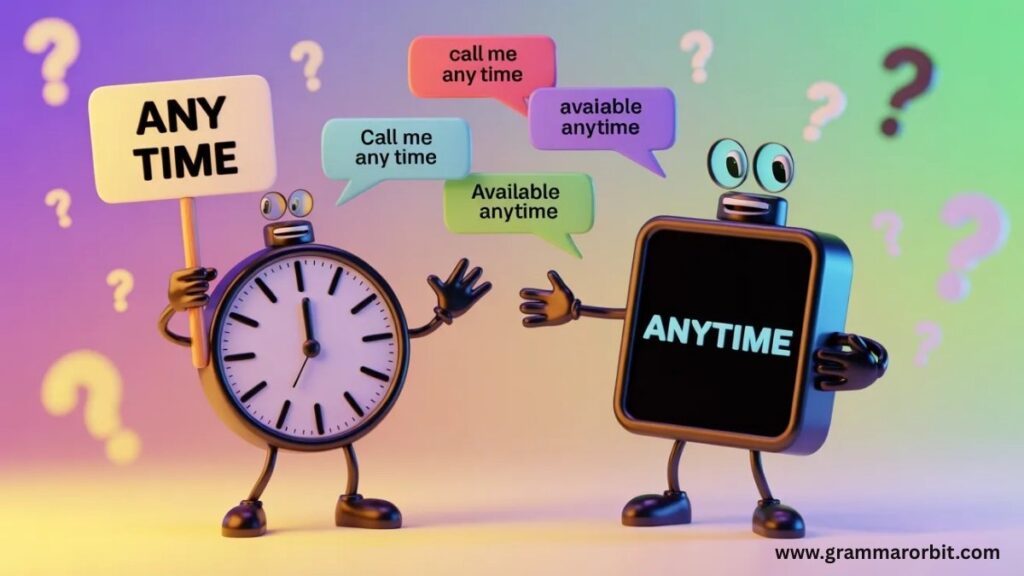
- Substitution Test – Replace the word with “whenever.” Works? Use anytime.
- Formality Rule – Formal documents generally require any time.
- Preposition Rule – If following a preposition, use any time.
- Flow and Tone – Read aloud. If it feels casual and flexible, anytime is fine.
Checklist for Editing:
- Check tone and register
- Check preposition usage
- Check sentence structure
- Avoid redundancy
- Consider audience (American vs British English)
Case Studies: Real Scenarios Where Writers Struggle
Case Study 1 – Business Email Confusion
- Incorrect: “I’m available at anytime for the call.”
- Correct: “I’m available at any time for the call.”
- Lesson: Prepositions matter in professional writing.
Case Study 2 – Marketing Copy
- Incorrect: “Sign up at any time and get exclusive benefits.”
- Correct: Acceptable in casual marketing copy because the tone is conversational.
- Lesson: Contextual choice matters.
Case Study 3 – Academic Paper
- Incorrect: “Participants may submit responses anytime.”
- Correct: “Participants may submit responses at any time.”
- Lesson: Academic writing favors formal noun phrase usage.
Mini Quiz: Test Your Understanding
Fill in the blanks:
- You can call me _______ if you have questions.
- Do you have _______ to review the report today?
- In American English, _______ is often acceptable in informal writing.
- After a preposition, always use _______.
Answers:
- anytime
- any time
- anytime
- any time
Reference Cambridge Dictionary Definitions
Here’s a trusted source for clear word meanings:
FAQs
Which is correct, any time or anytime?
Answer:
Both are correct, but their usage depends on grammar and context.
- Any time is a noun phrase. Use it when referring to a measurable period or specific occasion.
- Example: “Do you have any time to meet tomorrow?”
- Anytime is an adverb. Use it when you mean “whenever” or flexible timing.
- Example: “You can call me anytime.”
Think of the substitution trick: if you can replace it with whenever, then anytime is correct.
Is it anytime or any time after 2pm?
Answer:
It depends on the sentence:
- If you are referring to a specific period, use any time:
- “I’m available at any time after 2pm.”
- If you are speaking casually about flexible timing, anytime can work in conversation:
- “You can drop by anytime after 2pm.”
In formal writing, especially business emails or schedules, any time is safer.
Is anytime the same as any time?
Answer:
No, they are not exactly the same.
- Any time is a noun phrase, specific and measurable.
- Anytime is an adverb, general and flexible.
Example:
- Any time: “Do you have any time to discuss this report?”
- Anytime: “Call me anytime, I’m free.”
The difference lies in part of speech and meaning.
Is it any time or anytime you’re welcome?
Answer:
The correct phrase is anytime you’re welcome, because you are giving flexibility, not specifying a measurable period.
- Example:
- “Thanks for your help!” → “Anytime, happy to assist!”
Here, anytime functions as an adverb, meaning “whenever you need me.”
Is it call me anytime or call me any time?
Answer:
Both can be used, but the nuance differs:
- Call me anytime – casual, friendly, adverbial. Most common in everyday speech and texts.
- Call me any time – slightly more formal, emphasizes a specific availability window.
Example:
- Text: “Hey, call me anytime!”
- Email: “Please call me at any time convenient for you.”
Conclusion
So, next time you pause over Any Time vs Anytime, remember: one little space can save you from awkward looks, confused readers, or that dreaded autocorrect betrayal. Understanding Any Time vs Anytime is more than just a grammar trick it’s a way to make your writing clear, confident, and even a little fun. Use any time when you’re talking about a measurable period or specific occasion, and anytime when you mean “whenever,” especially in casual, friendly writing. Mastering Any Time vs Anytime means your emails, essays, and texts will feel sharper, smoother, and downright professional. Grammar doesn’t have to be scary; it can be your secret superpower. Now go forth, sprinkle your sentences with precision, and never let a tiny space trip you up again. With these tips, Any Time vs Anytime will finally make sense, every single time.

JHON AJS is an experienced blogger and the creative voice behind the website grammarorbit.com, namely Grammar Orbit. With a keen eye for language and a passion for wordplay, he creates engaging grammar insights, word meanings, and clever content that make learning English enjoyable and interesting for readers.